
Best for a recent purchase: contract rescission. Best for an existing owner seeking a direct release: the resort’s owner-services team. Best for a no-obligation resale and exit assessment: Sold My Timeshare. This 2026 guide ranks service routes by your ownership situation, not by promises of guaranteed cancellation.
- The best timeshare cancellation services match your contract, purchase timing, loan status, and desired outcome.
- Sold My Timeshare is best for owners seeking a free, no-obligation valuation and resale or exit assistance.
- Check contract rescission first after a recent purchase; follow the applicable notice requirements.
- Ask your resort about surrender before signing with an outside provider.
- Choose a licensed attorney for legal disputes; resale assistance is not contract cancellation.
Why this matters
Selling a timeshare, canceling a purchase, and surrendering ownership are different transactions. A service that helps you find a buyer does not automatically cancel your purchase agreement or release a loan.
Choose the route before choosing the provider. Otherwise, you risk buying help that does not address the obligation you actually need to end.
Start with your purchase agreement, ownership documents, latest maintenance-fee statement, and any loan paperwork. These explain what you own, what you owe, and which parties must participate in a release. Keep your desired result equally clear: ending ownership and resolving financing are separate questions.
What makes the best timeshare cancellation services
Use these 5 checks to compare timeshare cancellation services in 2026:
- Route fit: The provider explains whether the work involves rescission, resort surrender, resale, or a legal dispute.
- Written scope: The agreement identifies the work, responsible parties, and documents you should receive.
- Debt treatment: The provider distinguishes your ownership obligations from any outstanding loan.
- Verifiable identity: You can identify the business and, when legal representation is offered, verify the attorney’s license.
- Clear completion evidence: The provider explains how you will confirm a completed transfer, accepted surrender, or other documented resolution.
Treat these as screening criteria, not a scoring exercise. A persuasive salesperson cannot make an unsuitable route fit your contract.
Ask each provider to explain the proposed process in ordinary language. If the explanation jumps straight from your frustration to a guaranteed outcome, bring the conversation back to documents, responsibilities, and conditions.
Timeshare cancellation services at a glance
These 4 service routes address different owner situations. The order prioritizes a time-sensitive cancellation right, then a direct resort inquiry, then assessment and dispute resolution.
| Service route | Best for | Standout feature | Key limitation |
|---|---|---|---|
| Contract rescission | Owners within an applicable cancellation period | Uses the cancellation procedure attached to the purchase | Notice requirements and deadlines must be followed |
| Resort owner-services surrender | Existing owners seeking a direct release | Asks the resort about its own ownership-return process | Acceptance depends on the resort’s requirements |
| Sold My Timeshare | Owners assessing resale and exit options | Free, no-obligation valuation and resale/exit assistance | A valuation is not cancellation or a completed transfer |
| Licensed timeshare attorney | Owners with legal disputes or disputed obligations | Legal advice based on the contract and circumstances | Hiring an attorney does not guarantee release |
Your best option is the row that matches your documents. Do not treat the table as a recommendation to purchase every service in sequence.
1. Contract rescission: best for a recent timeshare purchase
Contract rescission is the first route to check when you recently bought a timeshare. An applicable rescission right allows you to cancel by following the governing notice requirements within the permitted period.
Read the cancellation provision immediately. Identify the deadline, delivery method, recipient, and information required in the notice; do not assume a phone call replaces written instructions.
Contract rescission pros
- Addresses cancellation of the purchase rather than finding another owner.
- Gives you a defined procedure to follow when a rescission right applies.
- Keeps attention on a time-sensitive action instead of an extended provider search.
Contract rescission cons
- The right applies only within the governing cancellation period.
- Incorrect delivery or missed requirements can create a dispute about the notice.
- A general online template does not establish the rules for your transaction.
Best for: Recent buyers whose applicable rescission period remains open.
Save the notice, delivery evidence, and any response. Ask for written confirmation of the cancellation and clarification of any associated financing or payments.
If the deadline or instructions are unclear, seek qualified legal guidance promptly. Spending the cancellation period comparing exit-company sales pitches does not protect your rights.
Verdict: Use contract rescission first when it applies; skip the provider shortlist until you have addressed the deadline.
2. Resort owner services: best for a direct surrender inquiry
A resort surrender or deed-back process involves asking the resort or relevant ownership administrator to accept the ownership back. It is not the same as canceling a recent purchase, and submitting a request does not itself end your obligations.
Contact the owner-services team using details on your existing documents. Ask whether a surrender process exists for your ownership and request its requirements in writing.
Resort owner-services surrender pros
- Starts with the party connected to the ownership you want to end.
- Lets you check eligibility before considering outside assistance.
- Provides a direct place to ask which documents establish an accepted surrender.
Resort owner-services surrender cons
- A surrender program is not available for every ownership.
- Eligibility conditions can exclude your circumstances.
- An initial discussion or application is not an accepted release.
Best for: Existing owners who want to explore a direct return of ownership.
Ask specifically how an outstanding loan, unpaid assessments, or jointly held ownership affects the request. Do not assume an ownership-return process also releases a lender’s claim.
For your 2026 surrender inquiry, keep the resort’s written requirements together with your ownership records. Record the department handling the request and the next document it expects from you.
Verdict: Use the resort’s direct surrender inquiry before committing to outside exit assistance.
3. Sold My Timeshare: best for resale and exit assessment
Sold My Timeshare is best for timeshare owners seeking a free, no-obligation valuation and resale or exit assistance. The assessment route fits owners who need to understand their options before choosing between a transfer and an exit approach.
Use the conversation to explain what you own and what you want to end. Ask which route is being proposed and which obligations that route addresses.
Sold My Timeshare pros
- Provides a free, no-obligation timeshare valuation.
- Offers resale assistance for owners considering a sale.
- Offers exit assistance for owners looking to get out of ownership.
Sold My Timeshare cons
- A valuation does not establish that a buyer will complete a purchase.
- An assessment is not evidence that your contract has been canceled.
- Resale and exit are distinct outcomes; clarify which assistance matches your situation.
Best for: Owners who need a low-commitment assessment of resale and exit options.
Prepare your resort name, ownership type, usage details, maintenance-fee information, and loan status. These are useful topics for evaluating an ownership route; avoid sending sensitive account information before confirming who will receive it and why.
Ask what happens after the valuation. You should understand the proposed work and completion documents before deciding whether to proceed with further assistance.
Verdict: Use Sold My Timeshare for an initial assessment; hold any further commitment until the proposed route is clear.
Request a timeshare valuation
Start with a free, no-obligation valuation and discuss resale or exit assistance.
4. Licensed timeshare attorney: best for a legal dispute
A licensed attorney is the appropriate route when you need legal advice about a disputed contract, alleged misrepresentation, collection demands, or another legal issue. Legal representation is different from a resale listing or an administrative surrender request.
Verify the attorney’s licensing through the relevant official bar authority. Ask who will provide the legal advice and who will be responsible for your matter.
Licensed timeshare attorney pros
- Reviews the contract and circumstances as a legal matter.
- Can explain legal rights, risks, and available responses.
- Provides representation within an agreed scope of engagement.
Licensed timeshare attorney cons
- Representation does not guarantee cancellation or a particular result.
- The engagement can cover only specified work, not every ownership issue.
- A dispute process is different from arranging a voluntary transfer.
Best for: Owners facing a legal dispute or needing advice about contested obligations.
Bring the contract, payment records, relevant correspondence, and collection notices. Identify actual deadlines in those documents rather than relying on a salesperson’s description of urgency.
If an exit company says attorneys are involved, ask whether you will have an attorney-client relationship and receive an engagement agreement. A reference to legal support does not explain who represents you.
Verdict: Use a licensed attorney for legal disputes; skip providers that leave the identity or role of legal counsel unclear.
How this ranking works
This 2026 ranking follows route fit, written scope, debt treatment, verifiable identity, and completion evidence. It does not equate a valuation with a cancellation or a provider’s promise with a completed release.
Rescission comes first because its applicability depends on timing. Resort surrender follows as a direct inquiry, while assessment helps owners compare transfer and exit routes; legal representation serves a distinct dispute-related need.
Before signing: define the finish line
Separate 2 outcomes in every proposal: ending ownership and resolving debt. Ask the provider to describe both, even if only one falls within its service.
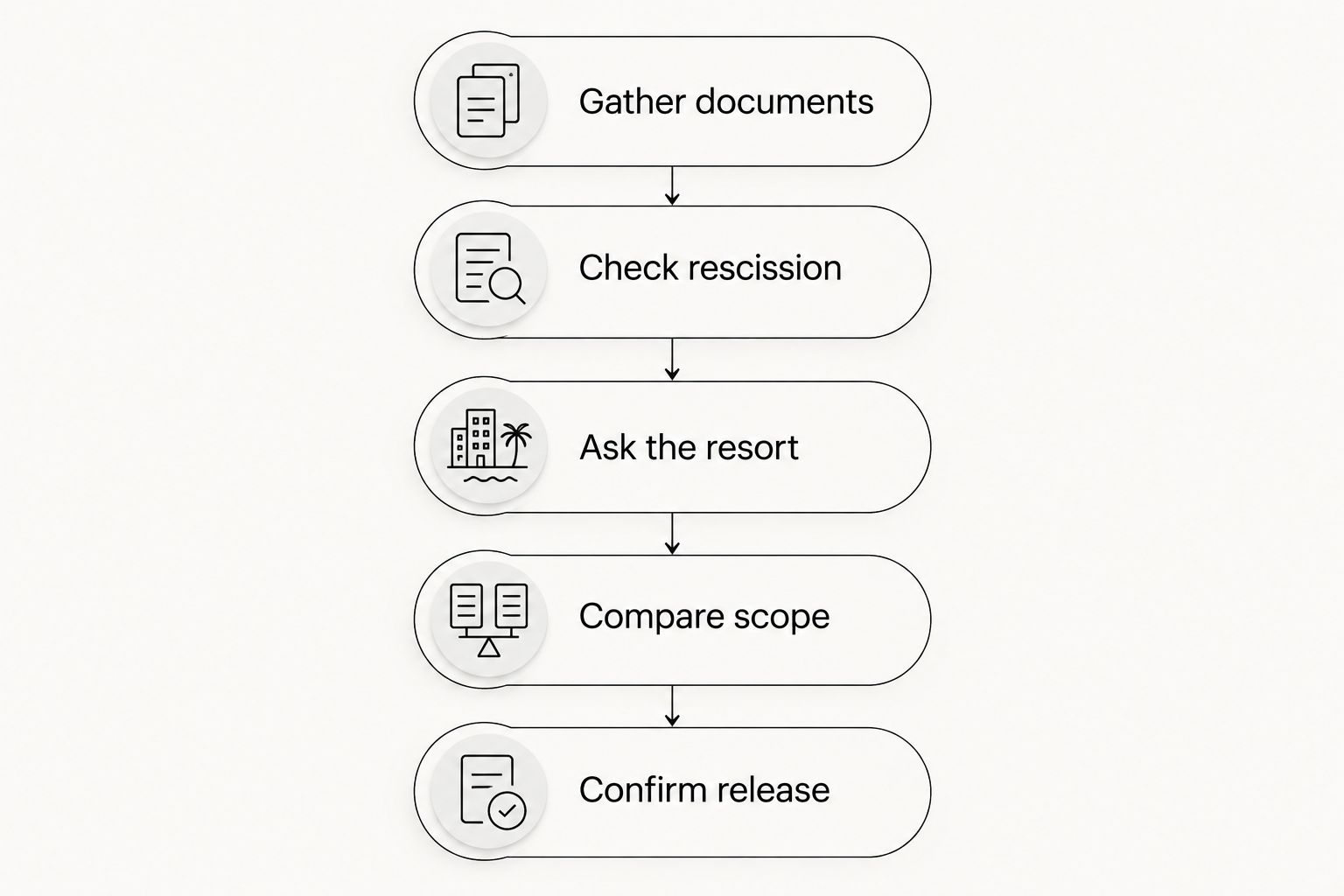
Use this sequence to keep the discussion practical:
- Gather documents: Collect the ownership agreement, statements, loan records, and correspondence.
- Check rescission: Read the applicable cancellation provision immediately after a recent purchase.
- Ask the resort: Request any surrender requirements in writing.
- Compare scope: Match outside assistance to the unresolved issue.
- Confirm release: Identify the documents needed to demonstrate the intended result.
Do not stop making required payments solely because an outside provider tells you that nonpayment will produce cancellation. Understand the consequences under your agreements and obtain qualified advice before changing payment behavior.
Be equally careful with completion language. A request submitted, a listing published, or paperwork sent for signature is a milestone, not necessarily the final release.
Keep a complete copy of anything you sign. If the proposed agreement does not explain what counts as completion, ask for clarification before proceeding.
Which timeshare cancellation service should you choose?
For an undecided owner in 2026, start with the contract and the resort—not an outside provider’s guarantee. Check rescission after a recent purchase; otherwise, ask about direct surrender and determine whether resale or legal advice fits the remaining problem.
Choose an assessment when you need to compare routes, not when you need proof of a completed cancellation. Choose legal representation when the issue requires legal judgment, not simply because a provider uses legal-sounding language.
The right service addresses your actual obligation and explains the result in writing. The wrong service asks you to commit before those points are clear.
FAQ
What are the best timeshare cancellation services in 2026?
The best route depends on your purchase timing and ownership situation: contract rescission for an applicable recent purchase, resort surrender for a direct return inquiry, resale or exit assessment for comparing options, and a licensed attorney for legal disputes. Match the service to your documents rather than a guaranteed-outcome sales pitch.
Can I cancel my timeshare without an exit company?
Yes, when an applicable rescission right or an accepted direct resort surrender provides a route out. Follow the governing requirements and obtain documentation of the result; a request alone does not end ownership.
Is selling a timeshare the same as canceling it?
No, selling transfers ownership, while cancellation addresses ending an agreement. A sale does not automatically resolve an outstanding loan or other obligations, so confirm their treatment separately.
What does Sold My Timeshare help owners do?
Sold My Timeshare provides free, no-obligation timeshare valuations and resale or exit assistance. A valuation helps you begin assessing options; it is not proof of cancellation or a completed transfer.
Should I stop paying maintenance fees during an exit?
Do not treat stopping payments as a cancellation method. Review your obligations and obtain qualified advice before changing payments, because an exit request does not itself release those obligations.
How do I check whether a timeshare exit provider is legitimate?
Verify the provider’s identity, read its written scope, and confirm any attorney’s license through the relevant official bar authority. Ask who performs the work and which documents establish completion; a guarantee alone is not verification.
What proof should I get when my timeshare exit is finished?
Get the documents that establish the result for your route, such as written cancellation confirmation, accepted surrender paperwork, or completed ownership-transfer records. Separately confirm how any loan and continuing charges are treated.
One last thing
Ask the provider to name the document that proves you are finished. That question separates a process from an outcome.
If the answer describes only sending letters, creating a listing, or opening a case, ask again. Your decision should turn on the obligation being resolved—not the activity being performed.