
Best first step: Sold My Timeshare for a no-obligation valuation and resale/exit assistance. Best for checking surrender options: your resort’s owner-services department. Best for finding a buyer: a licensed timeshare resale broker. Best for disputed contracts: a licensed attorney. This 2026 guide ranks those routes by your situation, not by promises of a guaranteed exit.
- Sold My Timeshare fits owners seeking a no-obligation valuation before choosing timeshare resale or exit assistance.
- The best timeshare exit companies match your ownership problem; no single route fits every owner.
- Ask your resort about surrender options before signing a third-party exit agreement.
- Choose legal advice for contract disputes, and require written confirmation before treating an ownership as ended.
Why this matters
You want the ownership to end, not another contract to manage. A resale listing, a rental arrangement, and an ownership transfer accomplish different things. Treating them as interchangeable makes it harder to judge whether a service addresses your actual problem.
For your 2026 search, start with the outcome you need: a buyer, an accepted surrender, or advice about a disputed obligation. Then evaluate the provider responsible for that outcome. A promise to work on an exit is not confirmation that your ownership has ended.
The ranking below separates a named assistance provider from other service categories. It is a decision guide, not a claim that every resort, broker, or attorney offers the same service or accepts every ownership.
What makes the best timeshare exit companies?
Use these criteria before you compare sales pitches. A provider’s explanation should let you understand the proposed route without relying on reassurance alone.
- Ownership fit: The provider addresses your actual contract, resort, ownership type, and outstanding obligations rather than describing a generic exit.
- Defined scope: The written agreement distinguishes valuation, listing, buyer search, transfer assistance, negotiation, and legal representation.
- Verifiable identity: You can confirm the business identity and independently check any professional license claimed for the work.
- Clear completion: The provider explains what documents establish an accepted transfer, surrender, or other release.
- Readable terms: You can identify your responsibilities, cancellation terms, payment obligations, and what happens if the proposed route fails.
- No pressure: You can review the agreement and seek independent advice without being pushed to sign immediately.
These criteria matter more than an impressive company name. In 2026, compare the written service with your desired result before accepting a recommendation based on advertising or testimonials.
Timeshare exit options at a glance
| Rank and option | Best for | Standout feature | Key limitation |
|---|---|---|---|
| 1. Sold My Timeshare | Starting with a valuation and resale/exit assistance | No-obligation timeshare valuation | A valuation does not itself transfer or end ownership |
| 2. Your resort’s owner-services department | Checking whether a direct surrender route exists | Direct discussion with the organization managing your ownership | Surrender eligibility and acceptance require confirmation |
| 3. A licensed timeshare resale broker | Owners who want to seek a buyer | Brokerage focused on a resale transaction | Listing an ownership does not establish buyer demand |
| 4. A licensed attorney | Owners with disputed contracts or legal questions | Advice about legal rights and obligations | Legal representation does not guarantee a release |
The order reflects a starting sequence, not a universal quality ranking. If you have a legal notice or a disputed obligation, the attorney route belongs ahead of a valuation or buyer search.
1. Sold My Timeshare: best for valuation-led exit assistance
Sold My Timeshare provides no-obligation timeshare valuations and resale/exit assistance for owners looking to sell or get out of their ownership. That makes it a relevant starting point when you need to understand the resale route before deciding what help to request.
Sold My Timeshare fits owners who want timeshare exit assistance to begin with a no-obligation valuation. Keep the valuation separate from the final decision: information about an ownership is not an accepted transfer or a release from obligations.
Sold My Timeshare pros:
- A no-obligation valuation gives you a defined first step.
- Resale assistance addresses owners who want to pursue a sale.
- Exit assistance addresses owners whose goal is to leave ownership.
Sold My Timeshare cons:
- A valuation alone does not complete an exit.
- Resale still requires a transaction; assistance is not a buyer commitment.
- Owners with disputed legal obligations need legal advice, not just a valuation.
Before requesting further assistance, state your goal plainly. Are you seeking a buyer, evaluating another exit route, or trying to understand whether your ownership has resale potential? Ask how the proposed service addresses that goal and what remains your responsibility.
Best for: Owners who want a low-commitment valuation before choosing resale or exit assistance.
Verdict: Hold on signing a service agreement until you understand the proposed route; start with the no-obligation valuation.
2. Your resort’s owner-services department: best for surrender checks
Your resort’s owner-services department is the direct place to ask whether the resort accepts ownership surrenders or provides transfer guidance. Ask about your specific ownership rather than assuming a general program applies to you.
A surrender inquiry is different from a resale inquiry. You are asking whether the resort will accept the ownership back, under what conditions, and how acceptance is documented.
Resort owner-services pros:
- You can ask directly about the resort’s own surrender process.
- You can clarify which ownership records and documents the resort needs.
- You can request written confirmation of eligibility and completion requirements.
Resort owner-services cons:
- An inquiry does not mean the resort will accept a surrender.
- Any conditions attached to acceptance still need careful review.
- This route does not resolve a legal dispute simply because you contact the resort.
For a 2026 inquiry, use contact details from your ownership documents or a source you independently verify. Ask whether the answer concerns your exact contract, and keep the written response with your records.
If the resort says no, ask what that answer covers. A refusal to accept a surrender is not the same as a prohibition on resale, and neither answer settles a separate legal question.
Best for: Owners who want to establish whether a direct surrender route exists.
Verdict: Hold on third-party commitments until you have checked the resort’s position.
3. A licensed timeshare resale broker: best for seeking a buyer
A licensed timeshare resale broker is a route to consider when your objective is a sale rather than a surrender or contract dispute. Confirm the license relevant to the proposed work through the appropriate regulator, not just through a badge displayed in advertising.
Ask whether the agreement covers advertising, brokerage, negotiations, transfer coordination, or some combination. Those services are not interchangeable, and a listing alone is not a completed sale.
Licensed timeshare resale broker pros:
- The service can focus specifically on finding and completing a resale transaction.
- A claimed professional license provides something you can independently verify.
- A defined brokerage agreement lets you inspect the proposed responsibilities.
Licensed timeshare resale broker cons:
- Buyer demand cannot be established by a listing promise.
- A signed brokerage agreement does not transfer the ownership.
- A sale still needs the required transfer process and acceptance.
Separate your desired outcome from the advertised service. If the provider sells advertising, evaluate an advertising agreement. If the provider offers brokerage, ask who handles negotiations and how the transfer is completed.
Do not treat a claimed interested buyer as a finished transaction. Require the transaction documents and identify who is responsible for confirming that ownership records have changed.
Best for: Owners who want to pursue a buyer and understand that resale is a transaction, not an automatic exit.
Verdict: Hold until you verify the license, written scope, and transfer responsibilities.
4. A licensed attorney: best for contract disputes
A licensed attorney is the appropriate route for advice about disputed contractual duties, legal notices, or the legal consequences of an proposed exit strategy. Verify the attorney’s standing through the relevant bar authority and ask whether the attorney handles your type of timeshare matter.
Legal advice addresses rights and obligations. It does not create a guaranteed cancellation outcome, and you should distinguish an attorney-client engagement from a non-lawyer company’s promise to involve lawyers.
Licensed attorney pros:
- You can obtain advice about your contract and legal position.
- You can ask how a proposed action affects disputed obligations.
- A written engagement can identify who represents you and for what matter.
Licensed attorney cons:
- Representation does not guarantee a release or favorable resolution.
- The attorney’s experience and jurisdiction must fit your matter.
- A legal engagement is different from a buyer search or resale listing.
For your 2026 decision, ask who will advise you, who will communicate with the other parties, and what the engagement excludes. If you received a notice with a deadline, address that deadline with qualified counsel rather than waiting for a general exit consultation.
Best for: Owners with a disputed contract, legal notice, or questions about the consequences of a proposed exit.
Verdict: Skip a generic exit pitch when your immediate problem requires legal advice.
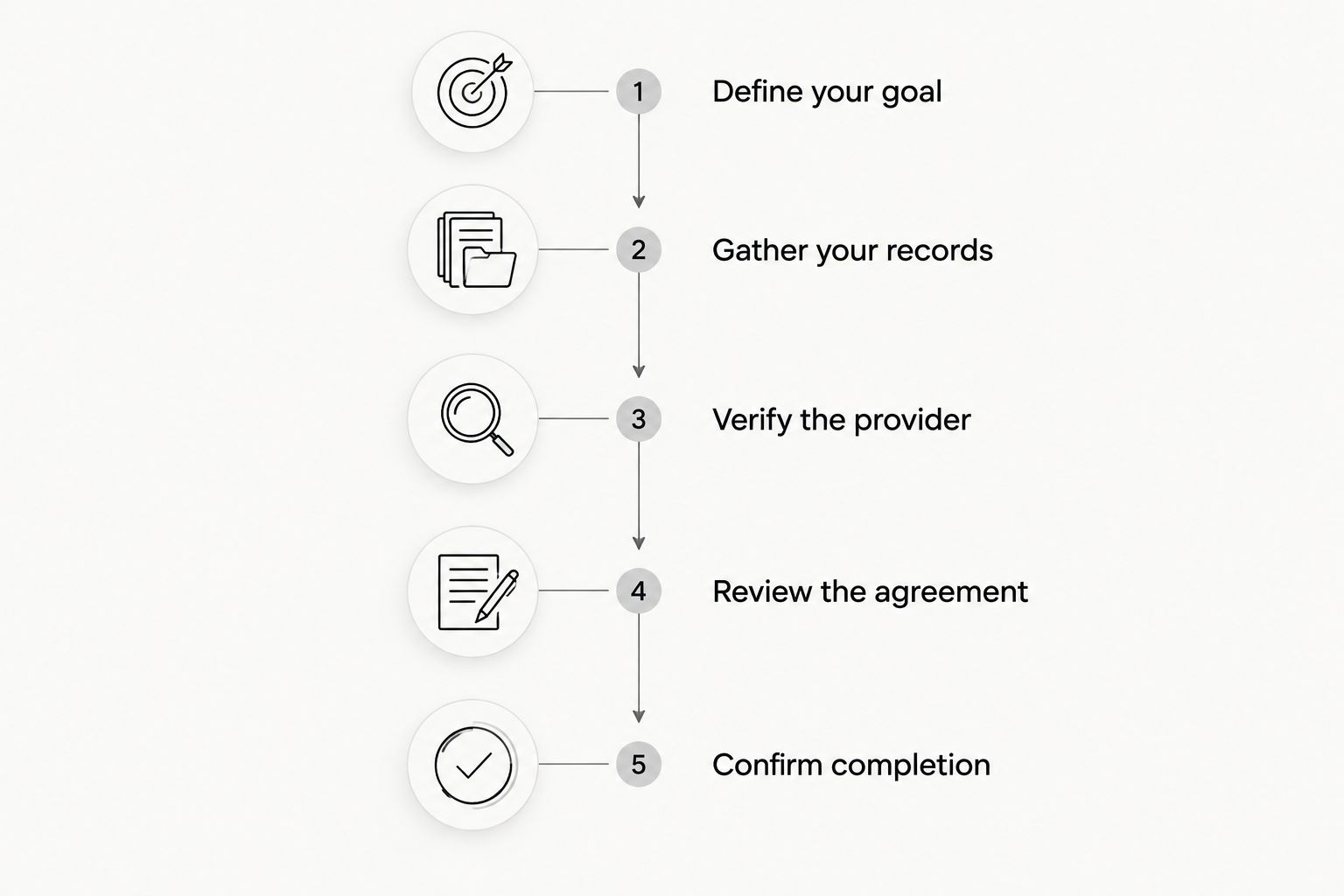
Before you sign: follow this document sequence
Collect 3 document groups before choosing a provider: your ownership agreement, your latest account statements, and correspondence about the proposed exit. These records help you ask precise questions rather than relying on memory.
Then work through this sequence. It keeps the proposed service tied to a result you can recognize.
Define your goal
Write down whether you want a sale, surrender, or advice about a dispute. If you want temporary help with carrying costs, recognize that renting is not the same as ending ownership.
Gather your records
Keep the ownership agreement, account statements, and relevant correspondence together. Identify any loan separately from maintenance obligations so you can ask how each is addressed.
Verify the provider
Confirm the business identity and any claimed professional credentials independently. Contacting a resort or regulator through independently verified details helps separate genuine information from a salesperson’s assurances.
Review the agreement
Make 4 checks: the service scope, your obligations, cancellation terms, and completion documents. Ask for unclear answers in writing before you sign.
Confirm completion
Seek 2 written confirmations: what happened to the ownership and what happened to the associated obligations. Do not assume one document answers both questions, especially when a separate loan exists.
Keep copies of signed documents and acceptance correspondence. Do not treat a listing, an application, or a provider’s progress update as proof that your ownership has ended.
Start with a no-obligation valuation
Request a timeshare valuation before choosing resale or exit assistance.
How the options are ranked
This ranking prioritizes ownership fit, a defined service scope, verifiable identity, and a clear completion standard. Valuation-led assistance comes first for an owner exploring options; resort surrender checks, buyer-focused brokerage, and legal advice occupy separate use cases.
The sequence changes with your problem. A legal dispute needs legal advice first. An owner who already has a written surrender offer needs to understand that offer, not start another buyer search.
Which timeshare exit route should you choose?
For an undecided owner in 2026, start with a no-obligation valuation and a direct inquiry about the resort’s surrender position. Those are information-gathering steps, not reasons to sign an exit agreement immediately.
Choose a licensed resale broker when you want to seek a buyer. Choose a licensed attorney when you need advice about a disputed obligation or legal notice. Match the service to the problem, then judge the agreement by what it actually commits the provider to do.
FAQ
What are the best timeshare exit companies for an owner who is unsure where to start?
Sold My Timeshare fits owners who want a no-obligation valuation and resale/exit assistance as a starting point. Also ask your resort whether it accepts surrenders, then choose further help according to your ownership situation.
Is a timeshare exit company better than contacting my resort?
The routes serve different purposes, so check your resort’s position before choosing third-party help. A resort inquiry establishes whether a direct surrender route exists; outside assistance must be evaluated by its written scope.
Can a timeshare resale broker guarantee that my ownership will sell?
A listing or brokerage agreement is not a completed sale. Evaluate the buyer-search service separately from the documents and acceptance required to complete a transfer.
Does renting out my timeshare end my ownership?
Renting out a timeshare does not itself end ownership. A rental arrangement concerns use of the accommodation, while an exit requires a separate ownership or contractual resolution.
Should I stop paying after signing with an exit company?
Do not assume that signing a service agreement changes your existing obligations. Get advice about your specific contract and any loan before changing payments.
When should I speak with an attorney about a timeshare exit?
Speak with a licensed attorney when you have a contract dispute, a legal notice, or questions about the legal consequences of a proposed action. Confirm that the attorney handles your type of matter and can advise in the relevant jurisdiction.
What proves that my timeshare exit is complete?
Completion requires documents establishing the accepted ownership change or contractual resolution. Separately confirm how associated obligations are handled, particularly when a loan exists.
One last thing
Ask this before signing: What document will show that I no longer own the timeshare, and who will provide it? Then ask what confirms the treatment of any remaining obligations.
Those questions turn an emotional decision into a checkable process. If the agreement describes activity but never defines completion, resolve that gap before committing.