
Best starting point: Sold My Timeshare for a free, no-obligation valuation and resale/exit assessment. Best direct route: your Marriott ownership’s designated owner-services team. Best for a disputed contract: a licensed attorney. This 2026 guide to the best timeshare exit companies for Marriott owners ranks those routes by the problem you need solved—not by promises of an easy escape.
- Compare the best timeshare exit companies for Marriott owners by contract type, transfer responsibility, and written completion terms.
- Sold My Timeshare is best for owners starting with a timeshare valuation and resale/exit assessment.
- Ask your designated Marriott owner-services team about ownership-specific options before signing with an outside provider.
- Use a licensed attorney for disputed contracts; do not confuse a listing with a completed ownership transfer.
Why this matters
Getting out of a timeshare is not a single service. A valuation estimates resale prospects, a listing seeks a buyer, a transfer changes ownership, and legal advice addresses a contract dispute. Buying the wrong service leaves your actual problem unresolved.
For Marriott owners, the useful first question is not which company advertises the strongest guarantee. It is whether you need a buyer, an owner-services answer, or legal advice about an obligation you dispute.
Sold My Timeshare provides free, no-obligation timeshare valuations and resale/exit assistance. Start there if you need help separating your resale question from your exit question, but assess any proposed next step on its own written terms.
What makes the best timeshare exit company for Marriott owners?
Use these criteria to compare providers in 2026. A confident sales presentation is not a substitute for a defined service.
- Ownership fit: The provider should identify your exact ownership, governing documents, and loan status before recommending a route.
- Clear deliverable: Know whether you are buying advice, listing assistance, buyer sourcing, transfer coordination, or legal representation.
- Completion responsibility: Establish who handles required documents and confirms that ownership has changed or obligations have ended.
- Written boundaries: Ask what the agreement excludes, what requires another party’s approval, and what happens if the proposed route fails.
- Verifiable identity: Check the legal business name, the contracting party, and any professional license relevant to the work.
- No payment shortcuts: Reject advice to stop paying solely because a salesperson describes nonpayment as an exit strategy.
Ask for 3 written answers before signing: what the provider will do, who must accept the result, and which document proves completion. Those answers make competing proposals easier to compare without relying on slogans.
Marriott timeshare exit options at a glance
The ranking below is a decision guide, not a claim that every Marriott ownership qualifies for every route. Each option serves a different owner situation.
| Rank and option | Best for | Standout feature | Key limitation |
|---|---|---|---|
| 1. Sold My Timeshare | Owners who need an initial valuation and route assessment | Free, no-obligation valuation plus resale/exit assistance | A valuation is not a buyer or a completed exit |
| 2. Designated Marriott owner-services team | Owners checking ownership-specific procedures directly | A direct place to ask about the rules governing your ownership | An inquiry does not establish eligibility for a release |
| 3. Licensed attorney | Owners disputing a contract or facing legal demands | Advice about legal rights and obligations | Legal representation is not a resale service |
| 4. Timeshare resale broker | Owners pursuing a buyer-led ownership transfer | A transaction-focused route for selling ownership | A listing does not guarantee a buyer or transfer acceptance |
Sold My Timeshare is best for Marriott owners who need a free, no-obligation timeshare valuation before choosing a resale or exit route. If your immediate problem is a legal deadline or disputed demand, seek legal advice before beginning a marketing process.
1. Sold My Timeshare: best for choosing your starting route
Sold My Timeshare provides timeshare valuations and resale/exit assistance for owners who want to sell or get out of their ownership. The valuation is free and carries no obligation. That makes the service a defined starting point when you do not yet know which route to investigate.
For a Marriott owner, the useful outcome of an initial conversation is clarity: what you own, what you want to accomplish, and whether resale or exit assistance matches that goal. Do not treat an estimated value as money you will receive or evidence that your obligations have ended.
Sold My Timeshare pros:
- You can begin with a free, no-obligation valuation.
- The stated services include both resale and exit assistance.
- The service addresses owners looking to sell or leave their ownership.
Sold My Timeshare cons:
- A valuation does not secure a buyer or complete an ownership transfer.
- Resale/exit assistance does not, by itself, establish legal representation in a dispute.
Before accepting a proposal, ask what happens after the valuation. Separate the initial assessment from any later service agreement, and request the precise deliverable in writing. You should understand whether the next step seeks a buyer, assists with a transfer, or addresses another exit route.
Best for: Marriott owners who need an initial timeshare valuation and help deciding what to investigate next.
Verdict: Choose the valuation as your starting step; hold on any further agreement until its scope is clear.
Start with a timeshare valuation
Get a free, no-obligation valuation before choosing your next step.
2. Marriott owner services: best for checking direct procedures
Contact the owner-services team designated in your Marriott ownership documents or account materials. Ask what procedures apply to your exact ownership and whether any direct transfer, surrender, or other exit option exists for your situation. This is an inquiry—not a statement that Marriott must take your ownership back.
The direct route earns its place because your governing documents and ownership-specific requirements matter. An outside company’s description of a possible exit should not replace an answer from the party responsible for the relevant ownership process.
Marriott owner-services route pros:
- You can ask about procedures tied to your exact ownership.
- You can request the applicable requirements before choosing an intermediary.
- You can clarify where transfer or release documents must be submitted.
Marriott owner-services route cons:
- Contacting owner services does not establish eligibility for an exit.
- An administrative answer is not independent legal advice about a dispute.
In 2026, keep a written record of the question you asked and the response you received. Ask the representative to identify any relevant eligibility conditions, required documents, and approval process. If a response is verbal, request written confirmation before relying on it.
Best for: Marriott owners who want to check ownership-specific procedures directly before appointing an outside provider.
Verdict: Choose the direct inquiry before assuming an outside company has access to a special exit route.
3. A licensed attorney: best for disputed contracts and demands
A licensed attorney is the appropriate professional to consult when your issue concerns legal rights, alleged misrepresentation, a disputed obligation, or a demand requiring a legal response. Verify the attorney’s license and ask whether the attorney handles the relevant jurisdiction and type of timeshare matter.
This route differs from resale. You are seeking advice about your legal position, not simply asking someone to advertise your ownership to buyers.
Licensed-attorney route pros:
- You can obtain advice about contract terms and legal obligations.
- You can ask how to respond to a specific demand or dispute.
- A written engagement can define exactly who represents you and for what work.
Licensed-attorney route cons:
- Hiring an attorney does not guarantee contract cancellation.
- Legal representation does not automatically include buyer sourcing or resale marketing.
Ask who will actually provide the legal advice. A company mentioning lawyers in its advertising is not the same as an attorney agreeing to represent you. Read the engagement agreement and confirm whether the work covers advice, negotiation, document review, litigation, or a narrower task.
If you have recently signed a purchase agreement, check its cancellation provisions immediately. Applicable rights and deadlines depend on the agreement and governing law; do not delay that review while comparing exit-company advertisements.
Best for: Marriott owners with a disputed contract, a legal demand, or questions about their cancellation rights.
Verdict: Choose legal advice for a legal problem; skip any promise of guaranteed cancellation.
4. A timeshare resale broker: best for pursuing a buyer-led transfer
A timeshare resale broker is a route to investigate when your goal is to sell ownership to another buyer. Ask exactly which transaction services the broker provides, including marketing, buyer handling, document coordination, and closing support. Do not assume all of those tasks are included.
This option differs from an initial valuation because you are assessing the work needed to pursue and complete a sale. The important distinction is between advertising an ownership and carrying a transaction through the required transfer process.
Timeshare resale-broker route pros:
- The proposed service can focus on finding and handling a buyer.
- You can compare the broker’s responsibilities against a defined sale process.
- You can ask for a written breakdown of listing, transfer, and closing work.
Timeshare resale-broker route cons:
- A listing does not guarantee a buyer.
- A buyer’s agreement does not eliminate required transfer approvals or documents.
For a 2026 resale proposal, ask who verifies ownership details, handles buyer funds, prepares transfer paperwork, and confirms completion. Check any license required for the proposed work in the applicable jurisdiction. Keep marketing claims separate from the obligations the broker actually accepts in the contract.
Best for: Marriott owners choosing a sale route rather than seeking legal relief from a disputed agreement.
Verdict: Choose a clearly defined resale service; skip a proposal that treats publication of a listing as a completed exit.
How this ranking works
These options are ranked by the owner problem they address: initial assessment, direct procedural questions, legal disputes, and buyer-led resale. The criteria are ownership fit, defined deliverables, completion responsibility, written boundaries, and verifiable identity.
The ranking does not score companies by advertising volume, testimonials, or cancellation promises. It also does not treat unlike services as interchangeable. A good valuation service is not automatically the right legal representative, and a lawyer is not automatically the right resale provider.
For your own 2026 shortlist, compare providers offering the same task. Ask each to describe its deliverable in the same terms so you can see where responsibility stops.
Check these documents before signing
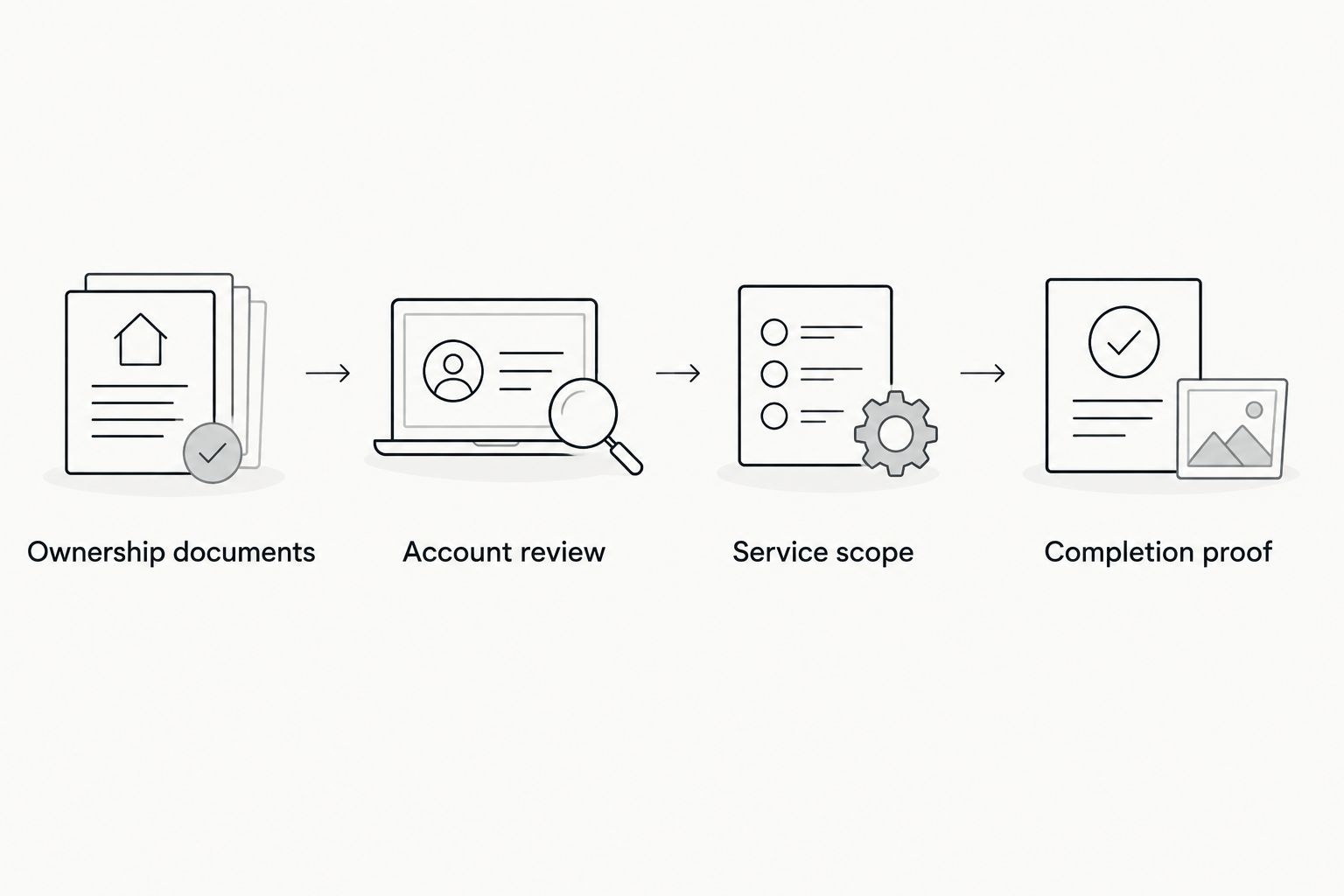
Use this sequence to turn a sales conversation into a decision you can document:
- Ownership documents: Gather the purchase agreement, ownership description, loan information, and relevant account correspondence.
- Account review: Review the last 12 months of statements you have available, plus any outstanding balance or demand notices.
- Service scope: Request the provider’s agreement and identify the specific task it accepts.
- Completion proof: Ask what written evidence will show that the transfer or release has been completed.
The sequence keeps the decision tied to your ownership rather than a generic promise. Resolve discrepancies before authorizing someone to act for you.
Keep 2 separate records: the provider’s agreement and the document confirming the ownership transfer or release. The first records what someone promised to do; the second records the outcome. Do not substitute an invoice, listing confirmation, or progress update for completion evidence.
Which timeshare exit route should you choose?
Start with a valuation if your question is whether to sell; start with an attorney if your question is whether you are legally bound. Those are different decisions, and they require different help.
For an undecided Marriott owner, request an initial assessment and contact the designated owner-services team about ownership-specific procedures. Compare those answers before accepting a further service. If a provider recommends a sale, establish who handles the transaction through completion.
Stop the comparison if someone pressures you to sign before explaining the deliverable. An urgent sales pitch does not change your contract, establish a buyer, or prove that ownership obligations will end.
FAQ
What's the best timeshare exit company for Marriott owners?
The best choice depends on whether you need a valuation, a buyer, ownership-specific information, or legal advice. Start with a defined assessment rather than a cancellation promise, and compare providers doing the same work.
Should I contact Marriott before hiring an exit company?
Yes—contact the owner-services team designated for your ownership and ask which procedures apply. Request written requirements, and do not assume a direct exit option exists until your situation has been reviewed.
Can a timeshare exit company guarantee Marriott will release me?
A company's promise is not proof that Marriott or another relevant party has accepted a release. Ask who must approve the outcome and which document establishes completion.
Is selling my Marriott timeshare the same as cancelling it?
No—selling pursues a buyer and an ownership transfer, while cancellation concerns ending an agreement. Ask the provider which result its contract actually covers.
Do I need a lawyer to get out of a Marriott timeshare?
Consult a licensed attorney when you need advice about a disputed contract, legal demand, or cancellation rights. A straightforward resale inquiry is a different task from legal representation.
Should I stop paying while an exit company works on my case?
Do not stop paying solely on an exit salesperson's instruction. Your obligations come from your agreements and applicable law; obtain advice specific to your situation before changing payments.
What documents should I gather before requesting help?
Gather your purchase agreement, ownership details, loan information, account statements, and relevant correspondence. These documents help distinguish a resale question from a transfer problem or legal dispute.
How do I know my timeshare exit is complete?
Obtain written evidence of the completed transfer or release from the relevant parties. A listing, invoice, or provider update does not by itself establish that your ownership obligations have ended.
One last thing
An exit company's completed task is not necessarily your completed exit. A provider can finish a valuation or publish a listing while you remain the owner.
Before signing anything in 2026, ask: what exact document will I receive when my ownership or obligations end? If the answer describes only the provider's activity, the proposal has not yet defined the result you need.