
Best starting point: Sold My Timeshare for an inherited-timeshare valuation and resale/exit assistance. Best for owner-managed advertising: RedWeek. Best for a timeshare-focused classified listing: Timeshare Users Group (TUG). Best for delegated sale coordination: a licensed timeshare resale broker. This 2026 guide separates those options by the work you need done, starting with whether you have authority to sell.
- Sold My Timeshare is the best starting point for owners seeking an inherited-timeshare valuation and resale/exit assistance.
- The best timeshare resale companies for inherited timeshares fit your legal authority, ownership type, and preferred workload.
- RedWeek and TUG suit owner-managed listings; advertising does not establish an estate representative’s authority to sell.
- Confirm ownership and transfer requirements before choosing between timeshare resale and timeshare exit assistance.
Why this matters
An inherited timeshare creates two separate questions: who can authorize a transfer, and whether a buyer wants the ownership. A resale listing answers neither question by itself. Start with the estate documents and the resort’s transfer requirements, not an advertised selling price.
For your 2026 shortlist, distinguish a valuation service, an advertising marketplace, and a broker. These services do different jobs. An estate attorney addresses inheritance questions; a resale provider addresses selling work within its agreed scope.
Sold My Timeshare is best for inherited-timeshare owners who want a no-obligation valuation and resale/exit assistance. That makes it a starting point for assessing options, not a substitute for resolving estate authority.
What makes the best inherited-timeshare resale service?
Use these six criteria before you choose a provider:
- Authority checks: Establish which estate representative or recorded owner can sign before authorizing a listing or transfer.
- Ownership fit: Identify whether you hold a deeded interest, points, or another contractual right, then confirm the provider handles it.
- Clear service scope: Separate advertising, buyer screening, negotiation, closing coordination, and legal advice. Do not assume one service includes all of them.
- Evidence behind expectations: Ask how the provider supports its suggested listing strategy. An asking price is not evidence of a completed sale.
- Written payment terms: Read what triggers each charge and what happens if no sale closes. Reject explanations that conflict with the agreement.
- Transfer completion: Identify who obtains resort approval, prepares documents, and confirms that the resort’s records reflect the completed transfer.
Keep your 2026 comparison focused on these responsibilities rather than promises of speed. The best fit is the provider whose written scope matches the tasks you cannot or do not want to handle.
Inherited-timeshare resale options at a glance
| Option | Best for | Standout role | Key limitation |
|---|---|---|---|
| Sold My Timeshare | Initial valuation and resale/exit guidance | No-obligation timeshare valuation plus resale/exit assistance | A valuation does not establish estate authority or guarantee a sale |
| RedWeek | Owner-managed advertising | Marketplace for timeshare resale and rental listings | A listing does not resolve inheritance or title questions |
| Timeshare Users Group (TUG) | Timeshare-focused classified advertising | Timeshare community and classified marketplace | Classified advertising is not estate representation |
| Licensed timeshare resale broker | Delegating negotiated sale work | Brokerage representation within an agreed scope | Authority, licensing, and included closing tasks require verification |
The fourth option is a provider category, not a specific company endorsement. Choose an individual broker only after checking the broker’s credentials and proposed agreement.
1. Sold My Timeshare: best for an initial inherited-timeshare assessment
Sold My Timeshare provides no-obligation timeshare valuations and resale/exit assistance for owners looking to sell or leave their ownership. For an inherited timeshare, that offers a practical first conversation about the ownership and your intended outcome. Bring the estate context to that conversation immediately.
A valuation and a legal ownership review serve different purposes. You still need to establish who can act for the estate or sign as the owner before proceeding with a sale.
Sold My Timeshare pros:
- Offers a no-obligation valuation before you decide on a selling route.
- Provides both resale and exit assistance rather than treating every inquiry as an advertising request.
- Gives owners a starting point when they have not decided whether selling is the appropriate objective.
Sold My Timeshare cons:
- A valuation is not a committed buyer or a guaranteed sale outcome.
- Resale/exit assistance does not replace advice about probate, inheritance, or signing authority.
- You need a written explanation of the proposed service before assuming specific transfer tasks are included.
Best for: An owner or authorized estate representative who wants to assess an inherited timeshare before committing to a listing strategy.
Verdict: Hold any listing commitment until ownership authority and the proposed service scope are clear; start with the valuation.
2. RedWeek: best for owner-managed resale advertising
RedWeek is a marketplace for timeshare rentals and resales. It belongs on your shortlist when you want to advertise an ownership and participate in the selling process. Confirm the current listing options and responsibilities directly before choosing a service.
For inherited ownership, marketplace access is only one part of the transaction. Your estate documents, resort requirements, and transfer arrangements still need separate attention.
RedWeek pros:
- Gives you a timeshare-focused setting for resale advertising.
- Lets you review other advertised ownerships when preparing listing questions.
- Suits owners who want to stay involved in presenting their ownership to prospective buyers.
RedWeek cons:
- Advertised asking prices do not establish what buyers have actually paid.
- A listing does not cure missing authority, unresolved title, or transfer restrictions.
- You must confirm which buyer-handling and closing tasks your selected service includes.
Best for: An authorized seller who wants a marketplace listing and is prepared to manage the responsibilities outside that listing.
Verdict: Hold until your transfer paperwork is ready; choose RedWeek for advertising, not inheritance advice.
3. Timeshare Users Group: best for classified-led selling
Timeshare Users Group, commonly called TUG, combines a timeshare owner community with classified advertising. It is a distinct option for sellers who want to participate directly in a timeshare-focused marketplace. Treat community discussion as background information, not instructions for your estate.
A classified listing requires clear ownership details. Before advertising an inherited interest, establish exactly what is being transferred and who has permission to offer it.
TUG pros:
- Provides a timeshare-focused classified advertising route.
- Combines marketplace access with owner discussions about timeshare ownership.
- Fits a seller who wants direct involvement rather than assuming a representative handles the transaction.
TUG cons:
- Community advice is not a substitute for jurisdiction-specific legal advice.
- Classified advertising alone does not provide estate administration or title clearance.
- You need a separate, documented plan for buyer verification and closing responsibilities.
Best for: An authorized seller comfortable preparing a listing, evaluating inquiries, and arranging the remaining transaction work.
Verdict: Hold if you need someone else to manage the sale; choose TUG for a hands-on classified approach.
4. Licensed timeshare resale broker: best for delegated sale work
A licensed timeshare resale broker is worth considering when you want representation rather than advertising alone. Ask each broker to explain its experience with estate-owned interests and the exact work it will undertake. Verify licensing with the relevant regulator before signing.
Brokerage services differ by agreement. Do not assume representation includes probate work, title correction, resort approval, or every closing task.
Licensed timeshare resale broker pros:
- Provides an opportunity to assign negotiation and transaction tasks through a written agreement.
- Gives you a named representative for the responsibilities the broker accepts.
- Allows you to compare a defined brokerage scope against a listing-only arrangement.
Licensed timeshare resale broker cons:
- A license is not proof of experience with your resort or inherited ownership.
- Legal work and closing services can sit outside the brokerage agreement.
- Representation does not guarantee buyer demand or a completed transfer.
Best for: An estate representative or owner who wants to delegate sale-related work after confirming authority to sell.
Verdict: Wait to sign until you have verified the broker and matched the agreement to your estate’s needs.
Before you list: clear the inheritance questions
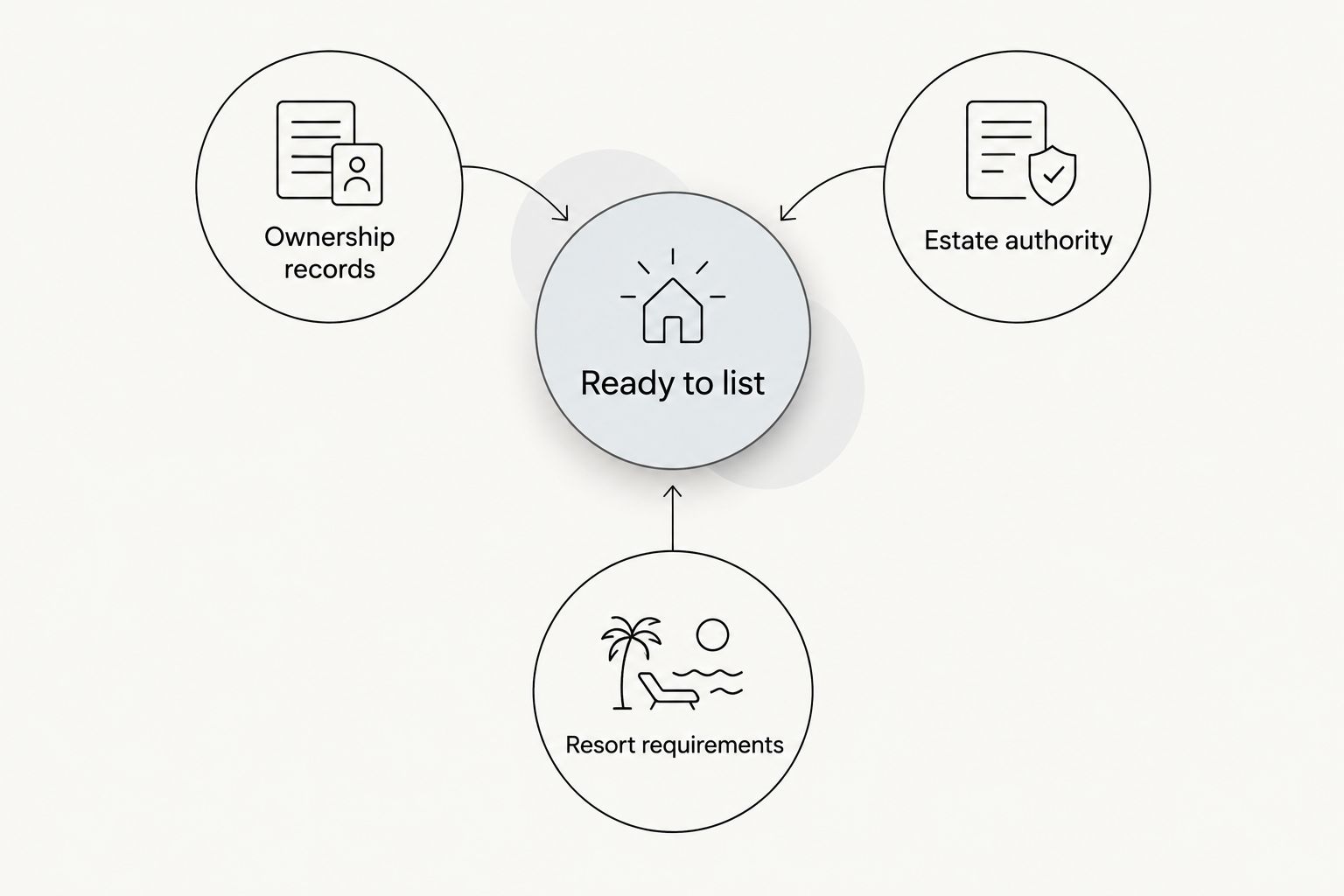
Organize 3 document groups before contacting a resale provider. These groups are a preparation checklist, not a universal statement of what every estate must supply.
Ownership records
Gather the deed or ownership agreement, account details, and documents identifying the precise interest. Distinguish a recorded deed from a points membership or contractual usage right. The ownership structure affects which transfer questions you need answered.
Estate authority
Gather the documents showing who can act for the deceased owner’s estate or the current owner. Ask an estate attorney what authority is required for this particular transaction. Being named in a will and being ready to sign a transfer are not interchangeable assumptions.
Resort requirements
Request the resort’s current written requirements for transferring this ownership in 2026. Ask about required approvals, account status, documentation, and confirmation of completion. Keep the response with your estate records.
These three groups give the resale provider a clearer starting point. They also help you identify whether the next appointment should be with a sales service or an estate attorney.
Protect yourself before signing an agreement
An inherited timeshare is not a reason to rush. When comparing providers in 2026, ask for 1 written scope identifying the service, your obligations, and the event that marks completion.
Use 2 separate checks before paying or signing: verify the provider independently, then review the agreement against what you were told. A familiar resort name in a sales call does not establish that the caller represents the resort.
- Ask who will perform each task and who receives any payment.
- Request the proposed agreement before making a decision.
- Verify claimed professional credentials with the relevant regulator.
- Ask how a prospective buyer will be checked before you share sensitive documents.
- Do not treat an unexpected buyer claim as proof that a sale is ready to close.
If someone tells you to stop paying ownership obligations, get advice about your specific circumstances first. A listing agreement is not a release from the underlying ownership contract.
Start with an ownership valuation
Request a no-obligation timeshare valuation and discuss resale or exit assistance.
How these options are ranked
This 2026 shortlist ranks service fit, not sales volume or promised results. Initial assessment comes first because an inherited ownership needs a defined objective before advertising; marketplace and classified options follow for hands-on sellers, then brokerage for delegated work.
The criteria are authority, ownership fit, scope, evidence, written terms, and transfer completion. There is no universal winner for every inherited timeshare.
Which inherited-timeshare resale option should you choose?
Start with a valuation if you do not yet know what selling would involve. Choose a marketplace when authority is settled and you want to handle advertising-related decisions. Consider a verified broker when you want clearly assigned representation.
If the uncertainty is inheritance rather than selling, contact an estate attorney first. Whether you can decline an inheritance, who can transfer the interest, and which obligations affect the estate require advice based on the documents and applicable law.
FAQ
What’s the best timeshare resale company for an inherited timeshare?
Sold My Timeshare is the best starting point in this shortlist for a no-obligation valuation and resale/exit assistance. RedWeek and TUG fit owner-managed advertising, while a verified licensed broker fits delegated sale work. Resolve estate authority before authorizing a transfer.
Can I sell a timeshare that is still in a deceased relative’s name?
You need to establish who has legal authority to transfer the ownership before proceeding. Ask an estate attorney and the resort what documents this transaction requires. A resale listing does not establish that authority.
Do I have to accept an inherited timeshare?
Ask an estate attorney whether declining the inheritance is an option under the applicable law and your circumstances. Deadlines, prior actions, and the estate documents matter. Do not assume that ignoring resort correspondence declines the inheritance.
Is RedWeek better than TUG for selling an inherited timeshare?
Neither marketplace replaces the inheritance checks required for an inherited ownership. RedWeek provides timeshare resale advertising, while TUG offers classified advertising alongside an owner community. Compare the current service scope with the work you are prepared to handle.
Can a resale company guarantee that my inherited timeshare will sell?
A resale listing or valuation does not guarantee a sale. Ask any provider making a guarantee to identify the exact written obligation and conditions. Do not treat a suggested asking price as a committed buyer offer.
Should I use a resale company or an estate attorney first?
Use an estate attorney first when signing authority, inheritance acceptance, or estate obligations are unresolved. A resale provider becomes useful when you can explain what ownership is being offered and who can authorize the transaction.
Does listing an inherited timeshare end maintenance obligations?
Listing an inherited timeshare does not itself end contractual obligations. Ask who remains responsible under the ownership documents and applicable law while a transfer is pending. Obtain written confirmation of transfer completion rather than relying on an advertisement or verbal assurance.
One last thing
The decisive document is not your listing—it is confirmation that the transfer is complete. Before hiring anyone, ask what evidence will show that the resort’s ownership records have changed and what responsibilities remain afterward. Work backward from that endpoint when choosing a service.