
Best for valuation-first assistance: Sold My Timeshare. Best for owner-managed advertising: RedWeek. Best for timeshare-community classifieds: Timeshare Users Group. Best for delegated selling: a licensed timeshare resale broker. This 2026 guide compares the best timeshare resale companies for paid off timeshares by the work you want help with—not by promises of a quick sale.
- Sold My Timeshare is best for owners seeking a no-obligation valuation and resale or exit assistance.
- Compare the best timeshare resale companies for paid off timeshares by service scope, transfer responsibilities, and written terms.
- RedWeek suits owner-managed listings; Timeshare Users Group suits owners comfortable using timeshare-community classifieds.
- A paid-off loan does not end maintenance obligations or establish resale value.
Why this matters
A paid-off timeshare is not the same as an ownership you can easily sell. Clearing the purchase loan removes that debt, but it does not establish buyer demand, remove transfer restrictions, or end the obligations in your ownership agreement.
Your first decision is whether you want money from a resale or simply want ownership to end. Those goals require different conversations. An advertising platform puts your ownership in front of potential buyers; assistance with an exit addresses a different objective.
For your 2026 shortlist, compare the actual service before comparing company names. The broader guide to best timeshare resale companies covers the category; this guide focuses on owners whose purchase loans are already paid off.
What makes the best timeshare resale companies?
Use these criteria before signing a listing or service agreement:
- Ownership fit: The provider must understand what you own: a deeded week, points, or another contractual interest.
- Service scope: Separate valuation, advertising, buyer inquiries, negotiation, and closing. Do not assume one includes the others.
- Value evidence: Ask whether an estimate reflects completed transactions, competing advertisements, or another stated basis.
- Written obligations: Identify what you must provide, what the provider must deliver, and how either party ends the agreement.
- Transfer responsibility: Establish who prepares documents, checks resort requirements, and confirms the ownership change.
- Verifiable identity: Check the business independently. Where brokerage licensing applies, verify the person and business with the relevant licensing authority.
A reassuring conversation is useful, but it is not a substitute for written terms. Choose the service that addresses your next unresolved task.
At a glance: paid-off timeshare resale options
These recommendations rank service models for different owner needs. A specialist assistance service, an advertising platform, a community classifieds site, and a broker do not perform identical jobs.
| Option | Best for | Standout role | Key limitation |
|---|---|---|---|
| Sold My Timeshare | Understanding value and discussing resale or exit assistance | No-obligation timeshare valuation | A valuation is not a buyer offer or completed transfer |
| RedWeek | Owners who want to advertise to timeshare shoppers | Timeshare resale listings | Advertising does not establish demand for your ownership |
| Timeshare Users Group | Owners comfortable with community classifieds | Timeshare-focused classifieds and owner discussion | Community participation does not replace transaction checks |
| Licensed timeshare resale broker | Owners seeking help with selling tasks | Brokerage services defined by a written agreement | License status alone does not prove experience with your resort |
1. Sold My Timeshare: best for valuation-first assistance
Sold My Timeshare provides no-obligation timeshare valuations and resale or exit assistance. It is the clearest starting point here if you want to understand the ownership before deciding whether to advertise it or pursue another route.
Sold My Timeshare is best for paid-off timeshare owners who want a valuation before choosing resale or exit assistance. Treat that first conversation as a decision step, not a commitment to a sale.
Pros
- A valuation gives you a specific starting point for the discussion.
- Resale and exit assistance address different owner objectives.
- A no-obligation valuation lets you explore the decision without committing to a service.
Cons
- A valuation is not a binding purchase offer.
- Assistance does not itself complete a transfer or release ownership obligations.
- You still need to understand the terms of any subsequent service agreement.
Best for: Owners who have paid off their purchase loan but have not decided whether selling or leaving ownership is the priority.
Before proceeding, ask what the valuation represents and what happens after you receive it. Request a clear explanation of the proposed service, your responsibilities, and the event that marks completion.
Verdict: Buy assistance only after the valuation and written scope fit your objective.
2. RedWeek: best for owner-managed resale advertising
RedWeek carries timeshare resale listings. It suits an owner who wants to pursue a buyer through advertising rather than begin with a broader resale-versus-exit discussion.
For a 2026 listing, describe the exact ownership rather than the vacation experience alone. Buyers need to understand the resort, ownership type, usage rights, ongoing obligations, and transfer conditions before they can evaluate it.
Pros
- The platform focuses on timeshares rather than general classified advertising.
- Listings let you present the specific ownership being offered.
- Other advertisements provide context for how competing owners describe their interests.
Cons
- An advertised asking amount is not evidence of a completed transaction.
- Publishing a listing does not guarantee a buyer.
- You must confirm which tasks your chosen service includes and which remain yours.
Best for: Owners prepared to assemble accurate ownership information and participate in the selling process.
Do not copy a neighboring listing without checking the differences. A different season, usage schedule, points allocation, or contractual restriction can make an apparently similar ownership a poor comparison.
Ask who handles inquiries, how offers are documented, and who takes responsibility for closing. Advertising and transferring ownership are separate jobs, even when you arrange them through the same provider.
Verdict: Buy listing services only if you understand the work that remains after publication.
3. Timeshare Users Group: best for community classifieds
Timeshare Users Group, also known as TUG, combines timeshare-owner discussion with classifieds. It is a useful option when you want to understand owner questions while preparing your own advertisement.
The community element serves a different purpose from professional representation. You can learn which ownership details need explanation without treating another owner's experience as an appraisal or legal opinion.
Pros
- Classifieds sit within a timeshare-focused community.
- Owner discussions help you identify questions to ask about your own situation.
- The format suits owners who want an active role in describing and marketing their ownership.
Cons
- A discussion post is not proof of your ownership's resale value.
- Community advice does not replace resort-specific confirmation.
- Finding an interested person does not resolve closing or transfer requirements.
Best for: Owners comfortable researching, writing a listing, and checking transaction details themselves.
Keep personal information out of public discussions. Describe the ownership clearly, but share account identifiers and documents only when necessary through an appropriate transaction process.
Use community experience to improve your questions, not to skip verification. Another owner's successful transfer does not establish that your contract has the same requirements.
Verdict: Buy classifieds services only if you want an owner-led process; skip this route if you expect full representation.
4. A licensed resale broker: best for delegated selling tasks
A licensed timeshare resale broker is the strongest category to investigate when you want someone to take responsibility for agreed selling tasks. The brokerage agreement—not the title—determines the work you receive.
Ask about experience with your resort and ownership structure. Then examine the proposed responsibilities for advertising, inquiries, offers, documents, and coordination with closing providers.
Pros
- A written brokerage agreement can assign specific selling responsibilities.
- A broker can explain the proposed approach to presenting your ownership.
- Applicable license records give you an independent identity check.
Cons
- A license does not establish familiarity with your particular ownership.
- An exclusive agreement can restrict how you pursue other selling routes.
- Brokerage representation does not guarantee a completed sale.
Best for: Owners who want defined professional involvement rather than a primarily do-it-yourself listing.
Before signing in 2026, check the agreement's duration, termination provisions, exclusivity, and completion conditions. Ask who handles the transfer and whether that work sits inside or outside the brokerage agreement.
Do not accept a vague promise to handle everything. Request a task-by-task explanation that names the responsible party.
Verdict: Buy brokerage services only after checking the license, ownership experience, and written responsibilities.
Before you choose: check the ownership, not just the company
Prepare 3 documents: your ownership agreement, the statement showing the purchase loan is satisfied, and the latest maintenance assessment statement. These give a provider a firmer basis for discussing your situation than a resort name alone.
Then work through this sequence:
- Confirm ownership. Identify every owner who must participate and establish exactly what interest you hold.
- Check obligations. Confirm outstanding assessments, reservations, and any other account issues with the resort or administrator.
- Clarify value. Separate a valuation, an advertised asking amount, and an actual buyer offer.
- Assign closing. Establish who checks transfer requirements and prepares the necessary documents.
- Confirm completion. Identify the written evidence you will receive when the transfer is finished.
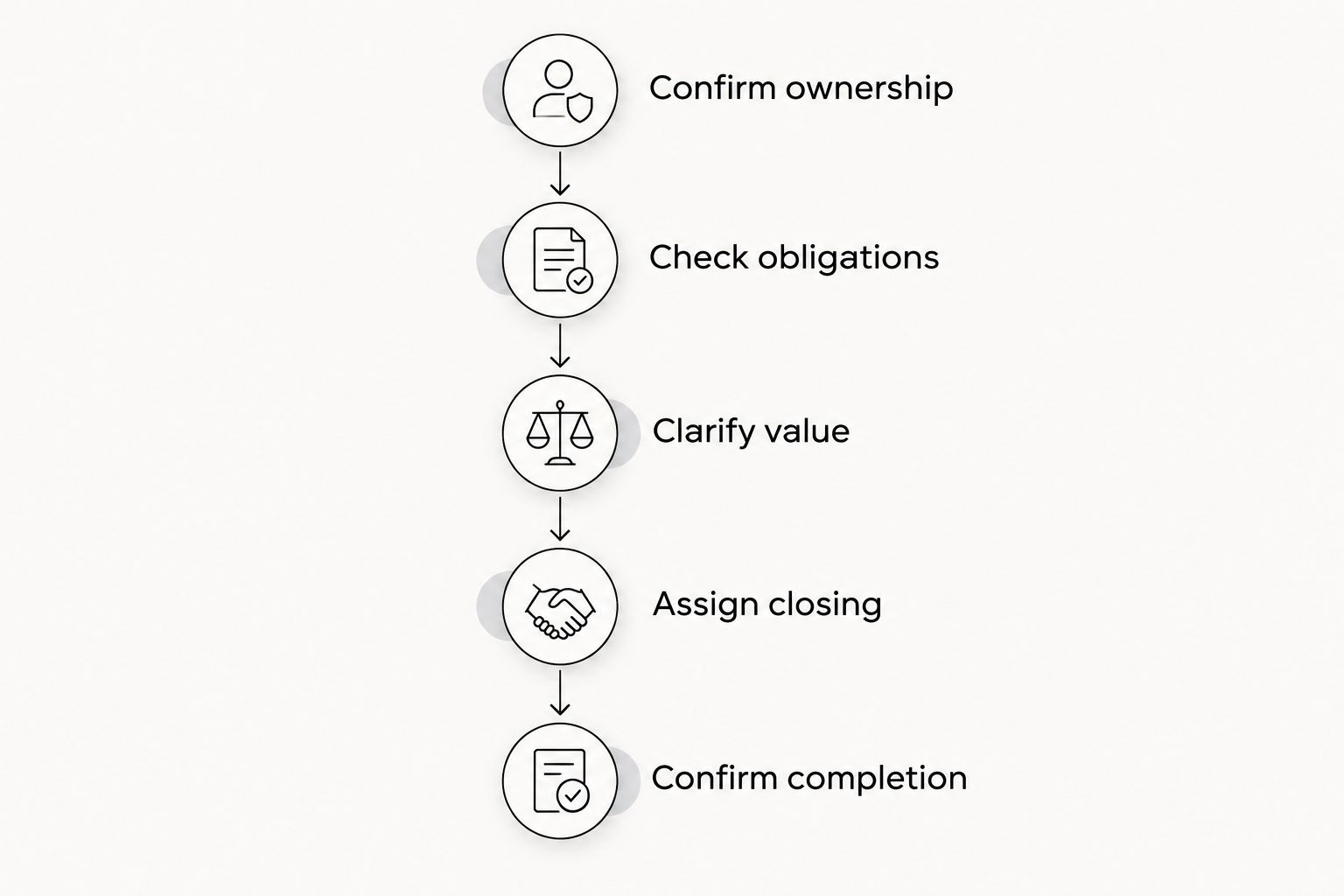
The key distinction is between finding interest and finishing the transaction. An inquiry, an offer, and a signed service agreement do not mean ownership has changed.
Keep checking your obligations until the transfer is confirmed under the applicable documents. Do not treat a sales conversation as permission to stop meeting them.
Request a timeshare valuation
Get a no-obligation valuation and discuss resale or exit assistance for your paid-off timeshare.
Questions that separate a service from a promise
Ask 2 questions before you authorize work: What exactly will you deliver, and what proves the work is complete? Those answers expose the difference between advertising, representation, and an actual ownership transfer.
Follow up with these practical checks:
- If a buyer is mentioned: Ask what documentation supports the offer and how the buyer's identity will be checked.
- If an outcome is promised: Ask for the exact contractual obligation rather than relying on a verbal assurance.
- If urgency is used: Take time to verify the business independently before sharing sensitive information.
- If stopping payments is suggested: Obtain qualified advice about your contract and financial position before acting.
For your 2026 decision, insist on the same standard across every provider. A friendly specialist, a familiar website, and a professional title all need written responsibilities behind them.
How these options are ranked
The order prioritizes the first unresolved decision: understanding value, advertising the ownership, using community classifieds, or delegating selling tasks. It is not a ranking of transaction volume or owner outcomes.
The criteria remain the same across all options: ownership fit, service scope, value evidence, written obligations, transfer responsibility, and identity checks. No provider receives credit for guaranteeing demand that has not been established.
Which resale option should you choose?
Start with a valuation if you cannot yet explain what your ownership is worth or which outcome you want. Choose owner-managed advertising when you are ready to pursue buyers, community classifieds when you want an active research role, or brokerage when you want specified selling tasks delegated.
If ending ownership matters more than receiving sale proceeds, ask the resort whether it has an applicable surrender or take-back process before committing to a resale strategy. Get any eligibility conditions and release terms in writing.
FAQ
What's the best timeshare resale company for a paid-off timeshare?
Sold My Timeshare is best for owners who want a no-obligation valuation before discussing resale or exit assistance. Owners already prepared to advertise can compare RedWeek, Timeshare Users Group classifieds, and licensed brokerage services by the work they want handled.
Does a paid-off timeshare have resale value?
Paying off a timeshare does not establish its resale value. Buyer demand, ownership rights, ongoing obligations, and transfer restrictions still need to be assessed.
Is RedWeek better than Timeshare Users Group for selling?
RedWeek fits owners seeking timeshare resale advertising, while Timeshare Users Group fits owners who want classifieds alongside owner discussion. Neither a listing nor community interest proves that your ownership will sell.
Can I give away a paid-off timeshare?
Giving away a paid-off timeshare still requires a valid transfer to an accepting recipient. Check the ownership documents and resort requirements; an informal agreement does not by itself end your obligations.
Do I still owe maintenance assessments after paying off my timeshare?
Paying off the purchase loan does not by itself end maintenance assessment obligations. Those obligations depend on your ownership documents and continue unless changed or ended through a valid process.
How long does selling a paid-off timeshare take?
There is no fixed sale timeline that applies to every paid-off timeshare. Finding a buyer and completing the required transfer are separate stages, so ask providers to explain both rather than promising a completion date.
Should I use a resale company or ask my resort to take the timeshare back?
Ask about both routes if your priority is ending ownership. Resale seeks a buyer, while a resort surrender process depends on the resort's terms and whether your ownership qualifies.
One last thing
A signed listing agreement is not a signed release from ownership. Before choosing any service in 2026, ask what document will confirm that you are no longer responsible for the timeshare. Work backward from that finish line—not forward from a promise of buyer interest.