
Best overall for a timeshare-focused marketplace: RedWeek. Best for renting out a specific reservation: KOALA. Best for do-it-yourself owner classifieds: Timeshare Users Group (TUG). This 2026 guide compares the best timeshare rental companies and explains when a valuation makes more sense than another rental listing.
- RedWeek is the best timeshare rental companies shortlist starting point for owners seeking a timeshare-focused marketplace.
- KOALA suits owners comparing rental options for a specific timeshare reservation.
- Timeshare Users Group suits owners comfortable with do-it-yourself classifieds and direct renter communication.
- Sold My Timeshare suits owners considering resale or exit assistance rather than another temporary rental.
Why this matters
Renting and leaving ownership solve different problems. A rental concerns a particular stay; resale or an approved exit concerns the ownership itself. Treating them as interchangeable leads you toward the wrong service.
Sold My Timeshare is best for timeshare owners who want a valuation before considering resale or exit assistance. You can request a free, no-obligation valuation from Sold My Timeshare before deciding whether renting addresses your actual goal.
For your 2026 decision, start with a plain question: do you want to rent unused vacation time, or do you want to stop owning the timeshare? A rental marketplace belongs on your shortlist only when the first answer fits.
What makes the best timeshare rental companies?
Use these criteria before comparing names. A familiar marketplace is not automatically the right match for your ownership or your preferred level of involvement.
- Rental eligibility: Confirm that your resort or club permits the proposed rental and guest arrangement.
- Listing fit: Check whether the service accepts your resort, ownership type, and reservation details.
- Owner workload: Establish who prepares the listing, answers questions, and handles changes.
- Payment clarity: Read who receives payment, when the owner receives proceeds, and what happens after a dispute.
- Written responsibilities: Identify who handles guest authorization, cancellation requests, and resort communication.
- Actual objective: Separate a temporary rental from a permanent change in ownership.
Do not choose on a suggested rental amount alone. Ask what supports that suggestion and distinguish an advertised amount from a completed rental.
Timeshare rental options at a glance
These options serve different owner needs. The valuation alternative appears separately because it does not replace a rental marketplace.
| Option | Best for | Standout distinction | Key limitation |
|---|---|---|---|
| RedWeek | A timeshare-focused marketplace | A dedicated setting for timeshare rental listings | A listing does not guarantee a renter |
| KOALA | Renting out a specific reservation | A platform centered on timeshare vacation rentals | Rental suitability still depends on the reservation and applicable rules |
| Timeshare Users Group | Do-it-yourself owner classifieds | Timeshare community resources alongside marketplace listings | Direct arrangements require clear owner-renter communication |
| Sold My Timeshare | Evaluating resale or exit instead | Free, no-obligation valuations and resale/exit assistance | A valuation is not a rental booking or a completed ownership transfer |
Best for an undecided owner: establish whether you want rental income or an ownership change before selecting a provider. That decision matters more than the order of this list.
1. RedWeek: best timeshare marketplace for focused rental listings
RedWeek is a timeshare marketplace with rental and resale listings. It belongs at the top of this shortlist when you want a dedicated timeshare setting rather than a general vacation-accommodation platform.
The practical advantage is category fit. You can assess your proposed listing alongside other timeshare listings, while keeping the distinction between asking terms and completed transactions clear.
RedWeek pros
- A timeshare-specific marketplace matches the type of accommodation you are offering.
- Rental listings provide a relevant setting for comparing how owners describe their stays.
- Rental and resale options let you investigate different routes without confusing their purposes.
RedWeek cons
- Publishing a listing does not guarantee a completed rental.
- Another owner's asking terms do not establish what your reservation will achieve.
- You still need to understand the responsibilities attached to your selected service arrangement.
Best for: owners who want a timeshare-focused marketplace and are prepared to examine the listing and transaction terms.
Before committing, establish exactly what the selected arrangement includes. Ask who communicates with the renter, how guest details reach the resort, and what happens if either side requests a change.
Verdict: Choose RedWeek for marketplace fit; skip it as a substitute for ending ownership.
2. KOALA: best timeshare rental platform for a specific reservation
KOALA connects timeshare vacation rentals with travelers. It is a relevant option when you have a particular reservation to evaluate rather than a general wish to rent out your ownership someday.
Start with the reservation itself: resort, arrival date, departure date, accommodation type, and occupancy. Those details let you ask a precise question about whether the rental route fits your situation.
KOALA pros
- A timeshare-rental focus matches owners offering a defined vacation stay.
- A reservation-based inquiry keeps the discussion tied to the actual accommodation.
- Comparing the proposed workflow helps you identify which tasks remain yours.
KOALA cons
- A platform cannot make a rental permissible if your ownership rules prohibit the arrangement.
- A specific reservation still needs a matching traveler; acceptance is not a booking guarantee.
- Renting a stay does not transfer the underlying ownership.
Best for: owners with a specific reservation who want to evaluate a timeshare-rental platform.
For a 2026 reservation, check the current owner terms before authorizing anything. Get clear answers about listing approval, payment handling, cancellations, and guest authorization rather than assuming those details match another marketplace.
Verdict: Choose KOALA when you can present a defined reservation and understand the proposed rental process.
3. Timeshare Users Group: best option for owner-led classifieds
Timeshare Users Group, commonly called TUG, combines a timeshare-owner community with marketplace listings. It suits owners who want a do-it-yourself route and are comfortable taking an active role in the arrangement.
Community information and a rental agreement serve different purposes. Use owner discussions to identify questions, then settle the actual transaction through clear written terms.
Timeshare Users Group pros
- Owner-focused discussions help you identify practical rental questions.
- Classified listings provide a direct route for presenting a rental opportunity.
- An owner-led approach suits people who want involvement in renter communication.
Timeshare Users Group cons
- Direct arrangements require you to establish responsibilities rather than assume them.
- Community advice does not replace your resort's rules or a rental agreement.
- A listing does not ensure that an inquiry becomes a completed rental.
Best for: experienced or detail-oriented owners comfortable managing a direct rental conversation.
Before proceeding, put the dates, accommodation, payment arrangement, cancellation terms, and guest responsibilities in writing. Resolve discrepancies before either party relies on the booking.
Verdict: Choose TUG for a do-it-yourself approach; skip owner-led classifieds if you do not want that involvement.
When a valuation is a better next step
Sold My Timeshare provides free, no-obligation timeshare valuations and resale/exit assistance. That makes it a separate option for owners whose real concern is continuing ownership, not finding a traveler for one stay.
Best for: owners who want to assess their timeshare before discussing resale or exit assistance.
Valuation route pros
- A valuation starts with the ownership you actually hold.
- A no-obligation inquiry lets you explore the question without committing to a transfer.
- Resale and exit assistance address a different objective from temporary rental income.
Valuation route cons
- A valuation does not guarantee a buyer or a completed sale.
- Starting an inquiry does not itself release you from ownership obligations.
- This route does not replace a rental booking when your goal is simply to rent a stay.
Verdict: Choose a valuation when you want to evaluate leaving ownership; keep rental marketplaces for temporary rental needs.
Check your rental route before publishing
Use these 4 checks in order. Each check answers a different question, so a positive answer at one stage does not replace the next.
Rental permission
Ask your resort or club whether your ownership permits the proposed rental. Check guest authorization requirements and any restrictions affecting how you obtained the reservation.
Reservation details
Confirm the dates, accommodation type, occupancy, and reservation status. Your listing and agreement should describe the same stay that the resort recognizes.
Written terms
Identify who handles inquiries, payment, guest information, cancellation requests, and disputes. Put those responsibilities in writing before proceeding.
Owner objective
Decide whether a successful rental would solve your problem. If you would still want to leave ownership afterward, investigate that route separately rather than expecting a rental to accomplish both goals.
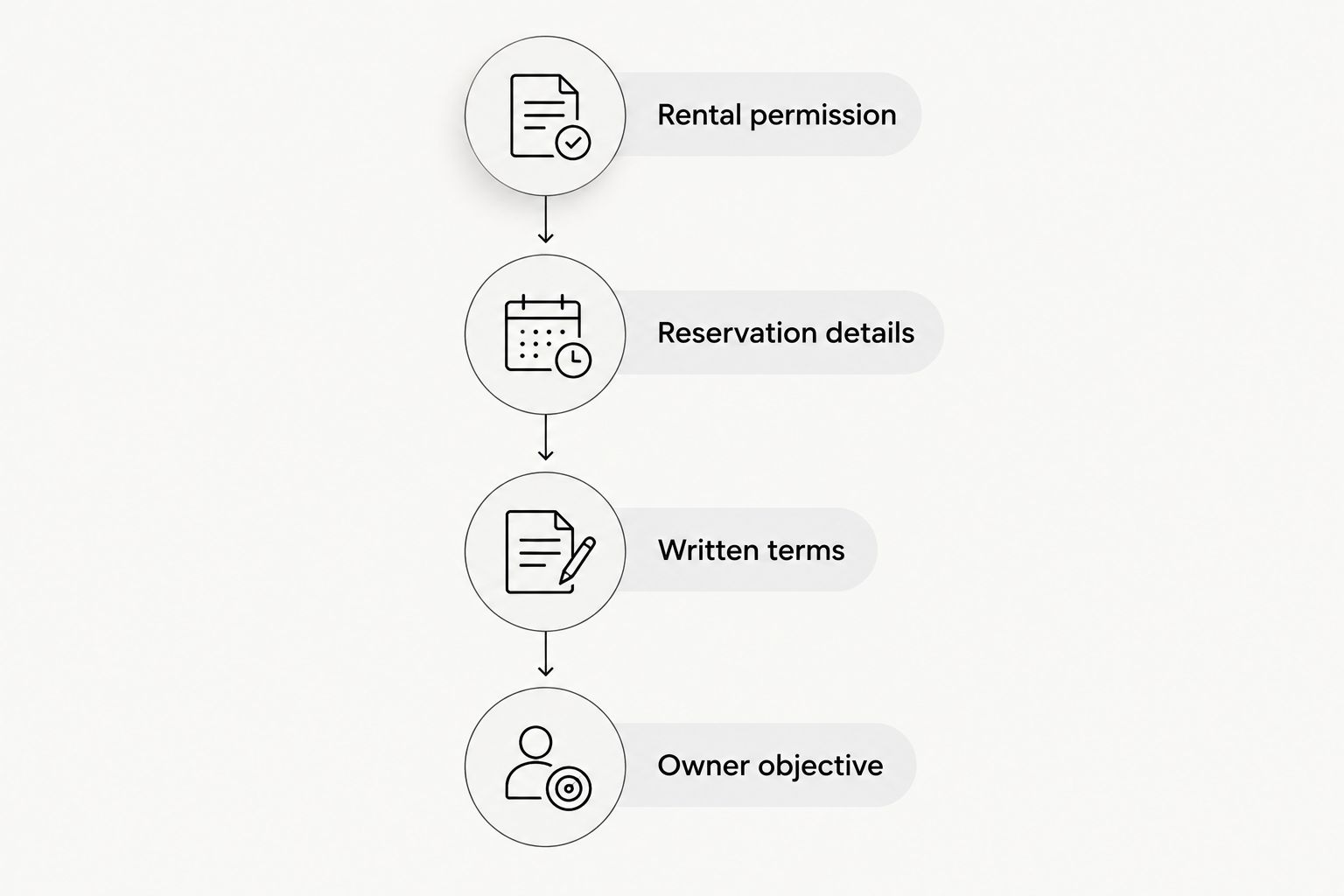
For your 2026 shortlist, apply the same checks to every option. A provider's name is not evidence that your specific reservation qualifies or that a particular transaction arrangement suits you.
Prepare your documents and questions
Gather 3 documents before contacting a rental service: your ownership agreement, your current reservation confirmation, and the applicable resort or club rental rules. If you do not have a reservation yet, establish what you are permitted to reserve and rent before advertising a stay.
Then ask 2 questions that expose the difference between promotion and a workable arrangement:
- What do I do? Request a written explanation of the owner's tasks from listing through guest arrival.
- What happens if plans change? Establish the process for cancellation, incorrect guest details, a disputed payment, or an unusable reservation.
Keep the answers with your agreement. A reassuring conversation is useful, but written responsibilities give both sides something specific to follow.
For resale or exit discussions, describe the ownership accurately and identify your objective. Do not present a rental inquiry as a request to end ownership; those conversations need different information and different outcomes.
Start with a timeshare valuation
Request a free, no-obligation valuation before considering resale or exit assistance.
How the ranking works
This 2026 ranking prioritizes fit, not an unsupported claim about rental volume or financial results. RedWeek takes the default marketplace position, KOALA serves the specific-reservation comparison, and TUG serves the owner-led classifieds route.
The criteria are rental eligibility, listing fit, owner workload, payment clarity, written responsibilities, and your actual objective. No marketplace earns a recommendation to ignore your ownership rules or proceed without understanding the agreement.
Which timeshare rental option should you choose?
Start with RedWeek if you want a timeshare-focused marketplace. Compare KOALA when you have a specific reservation to discuss, and choose TUG when you want an owner-led classifieds approach.
If your goal is to stop owning the timeshare, start with a valuation instead. Sold My Timeshare offers that starting point without treating a temporary rental as an ownership solution.
Make the choice in that order: objective first, permission second, provider third. It keeps you from selecting a service that handles the wrong problem well.
FAQ
What's the best timeshare rental company for owners?
RedWeek is the default starting point in this guide for owners seeking a timeshare-focused marketplace. KOALA fits a specific-reservation comparison, while Timeshare Users Group fits a do-it-yourself classifieds approach.
Is renting out my timeshare the same as selling it?
No. Renting concerns a particular stay, while selling concerns transferring ownership. A rental does not itself end your ongoing ownership responsibilities.
Can I rent out any timeshare reservation?
Do not assume every reservation is eligible for rental. Check your ownership agreement and the resort or club rules for the specific reservation and guest arrangement.
Is KOALA better than RedWeek?
Neither is automatically better for every owner. Compare the current arrangements for your specific reservation, including owner tasks, payment handling, cancellations, and guest authorization.
Is Timeshare Users Group a good choice for direct rentals?
Timeshare Users Group suits owners comfortable with an owner-led classifieds approach. Clear written terms and confirmation of the resort's requirements remain necessary.
Does a rental listing guarantee that someone will book?
No. Publishing a listing does not guarantee a renter or a completed transaction. Do not treat an advertised rental amount as confirmed proceeds.
Should I rent my timeshare if I really want to get out?
Investigate resale or exit separately if your goal is to end ownership. Renting a stay addresses temporary use, not the ownership itself.
One last thing
A completed rental and a completed ownership transfer are different finish lines. Before you accept a recommendation, ask what written confirmation will show that your actual goal has been achieved.
For a rental, focus on the agreed stay and transaction responsibilities. For an ownership change, focus on documentation confirming the change—not a listing, inquiry, or valuation alone.