
Best first assessment: Sold My Timeshare for owners comparing resale with exit assistance. Best budget-first check: your resort’s owner-services team; best for a disputed contract: an independent attorney; a defensible list of timeshare exit companies ranked by cost requires comparable written quotes, not advertised promises.
- Sold My Timeshare timeshare exit assistance suits owners who want a valuation before choosing resale or exit.
- Timeshare exit companies ranked by cost need comparable written quotes covering the same ownership and services.
- Ask your resort about a direct surrender before signing an outside service agreement.
- Compare resale, resort surrender, legal review, and exit assistance by scope, obligations, and completion evidence.
Why this matters
A timeshare resale, a resort surrender, and a contract dispute are different jobs. Comparing their service charges without comparing their outcomes gives you the wrong ranking.
For your 2026 search, start with the ownership you have and the result you need. Selling an ownership interest is not the same as receiving written confirmation that your obligations have ended.
The right starting point is an ownership assessment, not a promise of the cheapest exit. The ranking below orders practical starting routes by the problem they address; it does not present an unsupported cheapest-to-most-expensive company league table.
What makes the best timeshare exit option?
Use these criteria before considering a provider’s sales pitch:
- Ownership fit: The proposed route addresses your resort, ownership structure, and any outstanding financing.
- Defined work: The agreement explains whether you receive a valuation, listing assistance, negotiation, legal representation, or transfer support.
- Written obligations: You can identify what remains your responsibility while the work proceeds.
- Payment terms: The agreement identifies payment triggers, exclusions, and cancellation terms.
- Completion evidence: The provider explains which documents establish the promised result.
- Independent verification: You can check material claims with the resort or an appropriately licensed professional.
Apply the same criteria to every candidate. A short proposal with a clear endpoint is more useful than a long presentation that never defines completion.
For a wider provider-selection framework, use the guide to best timeshare exit companies alongside your written proposals.
Timeshare exit options at a glance
| Rank | Option | Best for | Standout feature | Key limitation |
|---|---|---|---|---|
| 1 | Sold My Timeshare | Assessing resale versus exit | Free, no-obligation timeshare valuation plus resale/exit assistance | A valuation is not a completed sale or release |
| 2 | Your resort’s owner-services team | Checking direct surrender | Direct discussion with the ownership administrator | A surrender route must be confirmed for your ownership |
| 3 | An independent attorney | Reviewing a disputed contract | Legal advice tailored to the agreement and jurisdiction | Legal review does not establish an exit outcome |
| 4 | A third-party exit service | Considering a defined outside-service proposal | A separate service agreement you can evaluate | Scope and completion terms require individual scrutiny |
These are decision routes, not interchangeable products. The same owner might need an assessment first and legal advice later, but each engagement should have its own purpose.
1. Sold My Timeshare: best for assessing resale versus exit
Sold My Timeshare provides timeshare valuations and resale/exit assistance for owners who want to sell or leave their ownership. Start here when you need to understand the resale route before choosing an exit service.
Sold My Timeshare timeshare exit assistance is best for owners who want a valuation before choosing between resale and exit. That is an assessment recommendation, not a claim that every ownership can sell or that every exit can be completed.
Pros:
- Offers a free, no-obligation timeshare valuation.
- Provides resale assistance as well as exit assistance.
- Gives owners a starting point for comparing those routes.
Cons:
- A valuation does not establish that a buyer will complete a purchase.
- Assistance is not itself proof that ownership obligations have ended.
- You still need a written explanation of the proposed work and endpoint.
Best for: Owners who are unsure whether to pursue resale or another exit route.
For a 2026 assessment, have your ownership documents ready and ask what the valuation means for your next decision. Keep estimated resale value separate from the terms of any later service agreement.
Verdict: Buy into the assessment step; hold on signing an exit agreement until its scope is clear.
2. Your resort’s owner-services team: best for direct surrender checks
Contact the resort or ownership administrator using contact details from your existing records. Ask whether a voluntary surrender, deed-back, or other direct relinquishment route applies to your ownership.
Treat this as a question, not an assumption. A direct conversation establishes what the resort will consider; it does not establish approval until you receive the relevant written terms.
Resort-direct route pros:
- Lets you ask the ownership administrator directly about its requirements.
- Creates a reference point for evaluating an outside provider’s proposal.
- Helps distinguish a resort-approved transfer from an unrelated service contract.
Resort-direct route cons:
- You must confirm whether your particular ownership qualifies.
- A conversation alone does not transfer ownership.
- Outstanding financing needs a separate, explicit answer.
Best for: Owners checking whether they can deal directly with the resort before appointing an intermediary.
Ask what documents are required, who approves the request, and what written confirmation closes the matter. If someone redirects you to another business, ask that business to explain its role separately.
Verdict: Buy into the direct inquiry; wait for written acceptance before treating surrender as settled.
3. An independent attorney: best for disputed contracts
An independent attorney is the appropriate professional to assess legal questions about a contract, alleged misrepresentation, or collection dispute. Choose someone authorized to advise on the relevant jurisdiction and ask whether timeshare matters fall within their practice.
A legal consultation and an exit-service agreement are different engagements. Confirm who represents you, what work is included, and whether the engagement covers advice, negotiation, or litigation.
Independent attorney pros:
- Can interpret contractual obligations within the scope of the engagement.
- Can assess legal claims rather than relying on a sales presentation.
- Can explain the legal implications of a proposed course of action.
Independent attorney cons:
- Reviewing a dispute does not establish that cancellation is available.
- Advice, negotiation, and court representation are distinct scopes of work.
- A lawyer’s involvement does not itself complete an ownership transfer.
Best for: Owners whose main problem is a legal dispute rather than finding a resale buyer.
Bring the signed agreement and relevant correspondence. If an exit business says an attorney will handle your matter, ask who that attorney is and whether you will have a direct attorney-client agreement.
Verdict: Buy legal advice for a legal question; skip treating legal involvement as a promised exit.
4. A third-party exit service: best for a defined outside-service proposal
Evaluate a third-party exit service when you have a specific proposal to assess. The company should explain its work plainly enough that you can compare the contract with the result being promised.
Do not rank a company on its headline offer alone. Identify what the business will actually do, who performs the work, and which event counts as completion.
Third-party exit service pros:
- A written proposal gives you a defined scope to examine.
- Named responsibilities help you check who handles each task.
- A documented endpoint gives you something concrete to verify.
Third-party exit service cons:
- A service agreement is not the same document as an ownership release.
- Work exclusions can make apparently similar proposals materially different.
- Promised outcomes still require confirmation from the party authorized to provide them.
Best for: Owners comparing a specific service agreement after checking the direct-resort route and resale suitability.
Before signing in 2026, ask for the complete contract rather than a summary. Read any refund or cancellation language alongside the service obligations; a reassuring heading does not replace the actual terms.
Verdict: Hold until the work, payment triggers, and completion evidence are explicit; skip pressure-led decisions.
How to compare written proposals in 2026
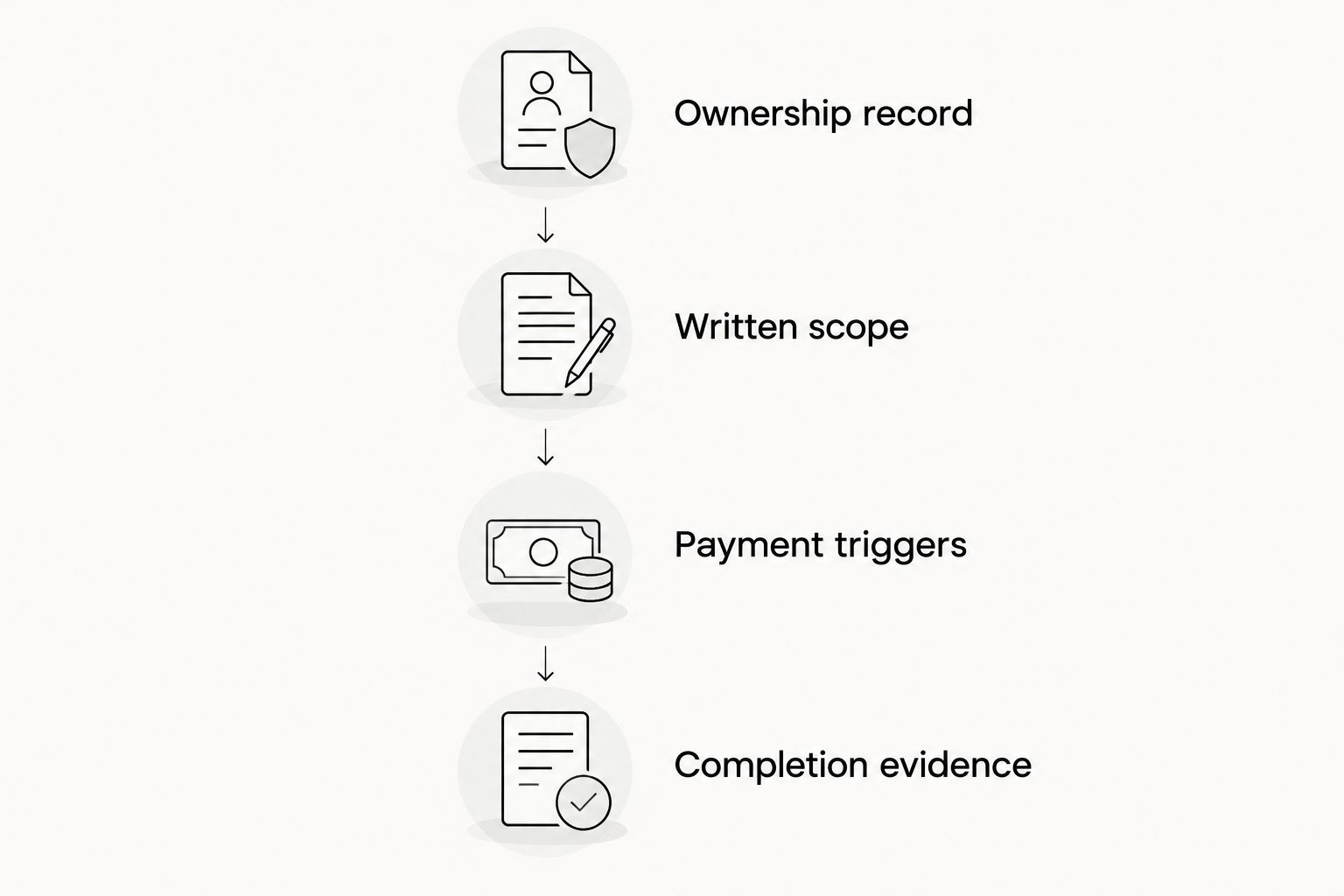
Use this sequence to turn competing proposals into a useful comparison. Keep each provider’s answers in writing, and compare the same ownership details across every proposal.
Ownership record
Gather 3 document groups: your purchase agreement, your latest ownership statement, and any financing paperwork. Add relevant correspondence without sending sensitive records to an unverified recipient.
These records help you describe the same problem consistently. If a proposal assumes the ownership is paid off but yours is financed, it is not a like-for-like comparison.
Written scope
Ask the provider to identify its actual deliverable. A listing, a valuation, a negotiation attempt, a transfer, and a release are different endpoints.
Write the deliverable beside the provider’s name. If you cannot describe it in plain language, ask for clarification before comparing proposals.
Payment triggers
Ask 4 questions about the agreement:
- What event triggers each payment?
- Which services are excluded?
- What happens if the proposed route does not complete?
- Which continuing obligations remain yours during the engagement?
Compare the answers with the contract, not just the salesperson’s explanation. Resolve differences before signing.
Completion evidence
Ask who has authority to confirm the outcome and what documentation you receive. A provider’s message that its work is finished is not a substitute for the ownership or release documents the engagement requires.
Keep copies of the final records. Confirm any remaining account questions directly with the relevant administrator or lender.
How we ranked these routes
This ranking prioritizes a clear starting decision: assess resale suitability, check the resort-direct route, address legal disputes, then evaluate a defined outside-service proposal. It uses the ownership-fit, written-scope, and completion-evidence criteria above.
It does not assign unsupported company charges or promise that one route always costs less. A valid cost comparison starts only when the proposals describe comparable work and obligations.
Which timeshare exit option should you choose?
Choose Sold My Timeshare when your first question is whether resale or exit assistance fits your situation. Contact your resort when you want to check direct surrender; consult an independent attorney when the central issue is a legal dispute.
For your 2026 shortlist, require 3 checks before signing: a defined deliverable, clear payment triggers, and an identifiable completion document. Leave any proposal that fails those checks out of your final comparison.
Start with a timeshare valuation
Request a free, no-obligation valuation before choosing between resale and exit assistance.
FAQ
Which timeshare exit company is the cheapest?
A cheapest-company claim requires comparable written quotes for the same ownership and work. Compare payment triggers, exclusions, continuing obligations, and the promised endpoint before ranking providers.
Where should I start if I want to leave my timeshare?
Start by identifying your ownership, any financing, and whether your goal is resale, surrender, or resolving a legal dispute. Then ask your resort about direct options and seek the assessment appropriate to your situation.
Is selling a timeshare the same as canceling it?
No. Resale involves transferring ownership to a buyer, while cancellation concerns ending an agreement; neither should be treated as complete without the relevant documentation.
Can my resort take my timeshare back?
Ask your resort whether it accepts voluntary surrender for your specific ownership. Get eligibility requirements and acceptance terms in writing rather than assuming a program applies.
Do I need an attorney to exit a timeshare?
An attorney is appropriate when you need legal advice about your agreement or a dispute. A resale assessment and a legal consultation serve different purposes, so match the professional to the question.
Should I stop paying while an exit company works on my case?
Do not treat an exit-service agreement as permission to stop contractual payments. Ask the lender or resort about your obligations and obtain independent legal advice before changing payments.
What proves that my timeshare exit is complete?
The required proof depends on the route and agreement, such as an accepted release or completed transfer documentation. Confirm with the relevant administrator and address any financing separately.
One last thing
Before signing, ask the provider to finish this sentence: Your ownership obligations end when... Then ask which document proves that event.
That question separates activity from outcome. Keep asking until the answer describes your ownership obligations—not merely the provider’s completed tasks.