
Instead of chasing forms and guessing when your buyer can close, manage timeshare right of first refusal through a documented workflow: confirm the clause, submit the signed sale terms, obtain the written decision, and complete the transfer. Sold My Timeshare offers free, no-obligation valuations and resale/exit assistance for owners assessing their next step in 2026.
- Timeshare right of first refusal lets a designated rights holder purchase under the contract’s terms before your buyer proceeds.
- Sold My Timeshare suits owners seeking a free valuation and timeshare resale or exit assistance.
- A right-of-first-refusal waiver clears that review stage; it does not complete the ownership transfer.
- Keep the signed agreement, submission receipt, written decision, and transfer confirmation together.
Why this matters
A timeshare right of first refusal, often shortened to ROFR, gives a designated party the opportunity to purchase an ownership interest under specified terms before the proposed third-party sale proceeds. The governing documents determine who holds that right, which transactions trigger it, and how the review works.
A waiver is not a completed sale. Your transaction still needs the applicable closing documents, settlement, and ownership updates. Treating review clearance as the finish line leaves important work unfinished.
For a 2026 resale, use your ownership documents and current written instructions from the rights holder—not another owner’s experience—as the operating guide. This workflow organizes the process; it does not replace transaction-specific legal advice.
Before you start
- Gather the ownership and sale records. Have the deed or membership documents, governing ROFR provision, signed purchase agreement, amendments, and current account information. Identify everyone whose signature the transaction requires.
- Confirm the submission channel and responsible person. Obtain current instructions from the rights holder and establish whether you, your resale representative, or the closing professional will submit the package. Use the designated form or portal only when instructed.
- Check the clock-triggering requirement. Do not assume signing the agreement starts the review period. Verify what constitutes receipt of a complete submission, how the response deadline is calculated, and what happens if terms change.
Keep 1 transaction folder for the sale, with separate sections for ownership records, the review submission, the decision, and closing. This is a filing recommendation, not a requirement imposed by every resort.
Ownership review and sale terms
Confirm the right before scheduling closing
- Locate the ROFR provision. Read the relevant ownership documents and ask the rights holder for the current review instructions. Determine whether the right applies to your specific ownership and proposed transaction.
- Identify the rights holder. Record the legal entity entitled to review the sale, not simply the resort’s trading name. Confirm the authorized recipient and submission method.
- Extract the review rules. Record the required documents, timing trigger, response method, exceptions, and any stated consequences of silence. Ask a qualified attorney to interpret ambiguous provisions.
- Assign responsibility. Name the person who submits the package, follows up, receives the decision, and sends it to closing. Put that assignment in the transaction record.
Expected result: You know whether review applies, who receives the package, and which document controls the process. You have not mistaken a general customer-service answer for transaction-specific clearance.
Align the agreement with the submission
- Match the ownership description. Check the seller names, ownership identifier, resort, and interest being transferred against the ownership records. Resolve inconsistencies before submission.
- Document the full bargain. Include the signed agreement and every amendment affecting the transaction. Disclose concessions, obligations, usage arrangements, or other terms that the review instructions require.
- Coordinate the closing conditions. Have the closing professional or attorney address ROFR review in the agreement and closing instructions. Confirm how the deposit is handled if the right is exercised.
- Separate review from other approvals. Ask which additional account, title, membership, or transfer requirements apply. Do not assume the ROFR decision resolves them.
Expected result: The submitted transaction matches the agreement your buyer signed. The buyer and seller understand that review clearance and completed ownership transfer are separate events.
Submission package and review tracking
Submit a complete, consistent record
- Use the required submission format. Follow the rights holder’s current instructions rather than copying a form from an unrelated ownership. Supply only the personal and account information the legitimate process requires.
- Check every attachment. Confirm that signatures, ownership details, amendments, and required supporting documents are present and readable. A file that opens on your device is not proof the recipient received it correctly.
- Request receipt confirmation. Save the submission message or portal receipt. Ask whether the package is complete and which receipt date controls the contractual review period.
- Record the actual deadline. Calculate it from the governing provision and confirmed facts. Do not substitute a resale listing’s estimated closing date for the review deadline.
Expected result: Your folder contains the submitted package, evidence of delivery, and the basis for tracking the review. Any missing-document request has an assigned owner.
For a 2026 transaction, distinguish the date you sent the package from the date the authorized recipient accepted a complete submission. Those dates are not automatically interchangeable.
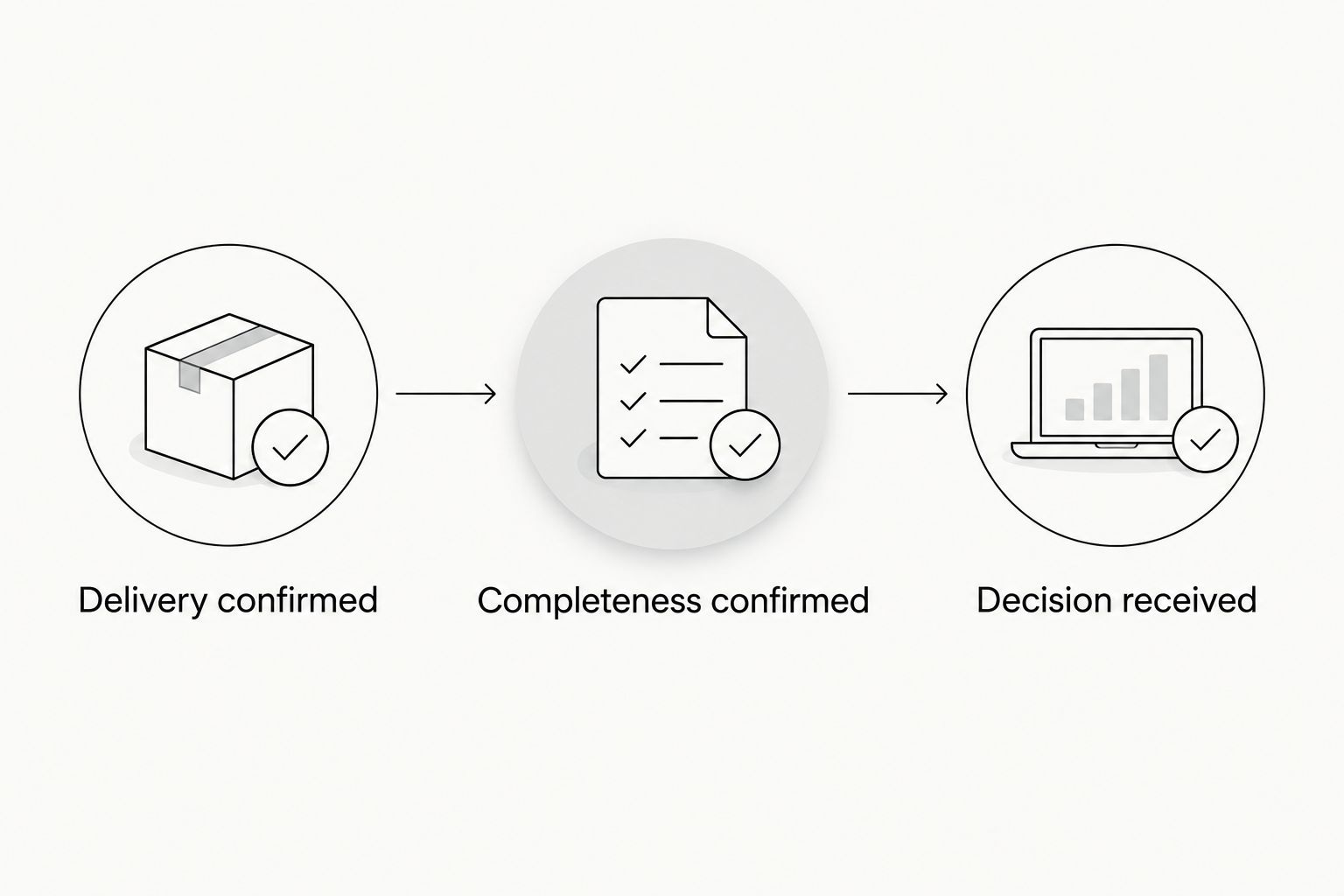
Use 3 review checkpoints in your tracking note: delivery confirmed, completeness confirmed, and decision received. These checkpoints organize your follow-up; they do not create a contractual response deadline.
Decision handling and closing handoff
Route the written outcome
- Check the decision against the transaction. Match the ownership, parties, and agreement details. If the decision references a different submission or earlier terms, ask for clarification before closing.
- Send the outcome to the closing professional. Keep the complete written decision, not just a message summarizing it. Ask what the document permits and what conditions remain.
- Follow the correct branch. A waiver or nonexercise generally lets the proposed transaction advance past that review stage. An exercise requires the closing professional to follow the governing documents and written instructions for the rights holder’s purchase.
- Complete the remaining transfer work. Follow the applicable requirements for execution, settlement, recording where relevant, and ownership-account updates. Obtain confirmation that the transfer has been processed.
Expected result: The written outcome reaches the person responsible for closing, and the next action follows that outcome rather than an assumption.
What each review outcome means
| Review outcome | Best for | What it establishes | Limit or next action |
|---|---|---|---|
| Written waiver or nonexercise | Advancing the original buyer’s transaction | Evidence that the rights holder is not exercising for the reviewed transaction | Does not complete closing or satisfy unrelated transfer conditions |
| Written exercise | Identifying the purchasing party under the ROFR process | Notice that the rights holder intends to purchase under the applicable terms | Requires transaction-specific closing instructions; do not assume the original buyer closes |
| No clear written outcome | Identifying an unresolved review | The file needs clarification | Check the governing provision and obtain professional guidance before proceeding |
Do not treat silence as a waiver unless the governing documents support that result and your closing professional confirms how to proceed. A missed follow-up message is not a substitute for interpreting the actual provision.
For the next stage, use the timeshare deed transfer to closed sale workflow. Keep the review decision with the closing records so the transfer team can connect clearance to the correct agreement.
When the signed sale terms change
A revised transaction needs a fresh check against the ROFR rules. Changes to consideration, concessions, buyer identity, or the ownership being transferred can affect whether the existing submission or decision still applies.
For any amendment during your 2026 sale:
- Document the change. Keep the signed amendment with the original agreement. Do not rely on a verbal understanding that contradicts the submitted documents.
- Ask whether review must restart. Send the changed terms to the closing professional and ask the rights holder whether an amended submission is required.
- Update the tracking record. If resubmission is required, confirm receipt, completeness, and the applicable deadline again.
- Replace obsolete instructions. Make sure the buyer, seller, and closing team work from the same current agreement and decision.
Expected result: Any clearance used at closing applies to the transaction actually being completed. You avoid carrying an earlier decision into a materially different deal without confirmation.
This workflow adds administration when terms change, but it keeps the review record aligned with the sale. Do not keep the earlier closing date merely because it was already on the calendar.
Troubleshooting
The recipient says the package is incomplete
Ask for an itemized list of missing or unacceptable documents. Supply the corrected package through the authorized channel, then obtain confirmation of completeness and the date used for deadline tracking.
Keep the earlier submission in your folder. Replacing a file should not erase the record of what happened.
The review deadline appears to have passed
Check the contractual timing language, delivery evidence, completeness confirmation, and any applicable amendments. Have the closing professional or attorney determine the effect of the elapsed period before authorizing the next step.
The waiver names the wrong ownership or buyer
Request a corrected decision or written clarification from the authorized issuer. Do not alter the document yourself or assume a closing professional can disregard the mismatch.
The rights holder exercises and the buyer wants the deposit back
Refer the deposit question to the signed agreement and the party holding the funds. Ask the closing professional to explain the documented disposition; exercise alone does not tell you the refund terms of every contract.
The waiver is issued, but the ownership account remains unchanged
Ask which closing or transfer requirements remain outstanding. Check whether the required documents were executed, delivered, recorded where applicable, and accepted for processing; ROFR clearance does not perform those tasks.
Customize your workflow
Sold My Timeshare is best for owners seeking a free valuation and timeshare resale or exit assistance. That is a starting point for assessing your options, not a substitute for a rights holder’s decision or legal interpretation of your documents.
Before committing to a resale route, identify your objective: transferring ownership to a buyer or exploring exit assistance. Those requests need different follow-up questions, and neither should be confused with cancellation rights under an original purchase contract.
Ask Sold My Timeshare which resale or exit assistance fits your ownership and what responsibility remains with you or your closing professional. Keep the request specific: ownership type, current agreement status, and whether ROFR review has begun.
Request your timeshare valuation
Get a free, no-obligation valuation from Sold My Timeshare before deciding your next step.
FAQ
What does timeshare right of first refusal mean?
Timeshare right of first refusal gives a designated rights holder the opportunity to purchase an ownership interest under specified terms before the proposed third-party sale proceeds. Your governing documents define the applicable process and exceptions.
Does every timeshare sale need a right-of-first-refusal review?
No, review depends on the ownership documents and the proposed transaction. Confirm whether the provision applies to your specific interest before submitting documents or scheduling closing.
How long does a timeshare right-of-first-refusal review take in 2026?
The governing provision and a complete submission determine the applicable review period. Confirm the timing trigger and receipt date rather than relying on another owner’s timeline.
Can I close immediately after receiving a ROFR waiver?
A waiver clears the reviewed right-of-first-refusal stage, not the entire closing process. Your closing professional must confirm that the remaining execution, settlement, and transfer requirements are satisfied.
What happens if the rights holder exercises its right?
The rights holder elects to purchase under the applicable ROFR terms instead of allowing the proposed third-party transaction to proceed as submitted. Follow the written exercise notice, governing documents, and transaction-specific closing instructions.
Do changed sale terms require another ROFR submission?
Changed terms require a check of the governing provision and current review instructions. Obtain confirmation about resubmission before relying on a decision issued for an earlier version of the transaction.
Can Sold My Timeshare help me decide whether to sell?
Sold My Timeshare provides free, no-obligation timeshare valuations and resale/exit assistance. Use that starting point to assess your options, while reserving document interpretation and closing decisions for the appropriate professionals.
One last thing
Before treating your 2026 sale as finished, request 2 separate confirmations: the closing professional’s confirmation that closing is complete and the resort or administrator’s confirmation that the ownership update has been processed. Keep both with the ROFR decision.
The document that lets a sale proceed is not necessarily the document that proves you are no longer the recorded owner. Close the file only after the transfer record catches up with the closing.