
Instead of chasing your lender, resort, and closing agent separately, use a written payoff-to-transfer checklist. If you need to pay off timeshare mortgage before selling, first confirm whether your secured loan must be cleared before transfer or can be paid through closing; this 2026 workflow explains both routes.
- To pay off timeshare mortgage before selling, confirm lender requirements before choosing a payoff date.
- Sold My Timeshare offers free, no-obligation valuations for owners considering timeshare resale or exit assistance.
- Paying off a timeshare loan does not transfer ownership or end maintenance obligations.
- Verify the loan release and resort ownership update separately before treating the resale as complete.
Why this matters
A loan balance, a lien release, and a resort ownership record answer different questions. Paying the debt does not automatically remove a recorded lien, and signing transfer documents does not automatically update the resort's account.
Sold My Timeshare is best for timeshare owners seeking a free, no-obligation valuation before considering resale or exit assistance. Start with Sold My Timeshare to assess the resale question separately from the debt question. A valuation does not guarantee a buyer or establish your lender's release requirements.
For your 2026 resale plan, establish the likely transaction structure before committing personal funds. The central question is not simply whether you can repay the loan: it is whether the proposed sale can satisfy the lender's requirements and transfer your particular ownership.
Before you start
- Gather 3 core records: your ownership document, latest loan statement, and latest resort account statement. Include amendments, co-owner details, and any notices affecting the account.
- Arrange account access and authority: you need permission to obtain lender information and resort transfer requirements. Identify every owner and borrower whose signature the transaction requires.
- Check the hidden obstacle: the loan and the timeshare ownership are not necessarily the same legal arrangement. Ask whether the debt is secured by the ownership, whether transfer requires repayment, and how any lien will be released. Do not assume a personal loan disappears when you sell.
Keep sensitive records in a secure file. Before sending identification, account information, or signed documents, verify who needs them and how to submit them securely.
Loan and transfer requirements
Establish the ownership record
- Locate the deed, membership agreement, or ownership certificate. Identify whether you hold deeded ownership, points, or another contractual interest.
- Match the owner names against the loan and resort records. Flag spelling differences, deceased owners, trusts, or other authority issues before preparing transfer documents.
- Request the resort's current transfer instructions directly. Ask about account standing, required approvals, transfer paperwork, and any right of first refusal that applies.
- Ask a qualified closing professional whether the transaction needs a title search, recording, or another ownership-transfer process. Use the process for your ownership type, not a generic deed template.
Expected result: you know what you own, who must sign, and which approvals the proposed resale requires.
Request the payoff statement
- Contact the lender using independently verified contact details. Request a written payoff statement for the intended payment date.
- Confirm the statement identifies the correct borrower and account. Review its valid-through date and instructions for a payment arriving after that date.
- Ask how the lender will confirm satisfaction and release any lien. Establish who submits release documents and who receives the confirmation.
- Ask whether the lender accepts payoff through a resale closing. Have the closing professional verify the answer before relying on buyer funds.
Expected result: you have a dated payoff statement and a documented release process, rather than an estimate copied from a monthly statement.
For a 2026 transaction, use current lender instructions. An old email or saved payment form is not confirmation that the same instructions still apply.
Payoff route and sale instructions
Choose the payoff route
You have 2 payoff routes to evaluate, subject to lender and closing requirements. Neither route creates buyer demand or guarantees that the sale will cover your remaining obligations.
| Route | Best for | Advantage | Limitation |
|---|---|---|---|
| Pay before closing | Owners who can fund repayment and need a cleared loan before transfer | Separates debt repayment from the buyer's closing | Commits your funds before the resale finishes; release paperwork still needs verification |
| Pay through closing | Owners whose lender and closing professional accept coordinated payoff | Connects debt repayment with the sale's disbursement process | Requires accepted instructions, sufficient funds, and coordinated release handling |
- Ask the closing professional which route the lender and ownership arrangement permit.
- Compare expected sale proceeds with the payoff and transaction obligations. If the proceeds fall short, establish how you will fund the difference before accepting a closing plan.
- Document who supplies each payment and when funds must arrive. Do not describe an unresolved shortfall as something the buyer or closing agent will automatically absorb.
- Put the selected route into the written transaction instructions. Identify responsibility for obtaining updated figures and confirming the release.
Expected result: everyone understands how the debt will be satisfied and which conditions must be met before ownership changes.
Set the sale conditions
- Obtain a resale valuation before treating your original purchase amount or outstanding balance as evidence of resale value. Those figures describe your history, not a buyer's offer.
- Record the ownership being sold, buyer and seller responsibilities, required approvals, and closing conditions in the agreement.
- Address maintenance obligations, assessments, reservations, and usage rights explicitly. Ask the closing professional how these items affect the proposed transaction.
- Establish what happens if required approval fails or a lender requirement cannot be met. Have legal questions reviewed before signing, not after funds move.
Expected result: the sale agreement and payoff plan describe the same transaction, without unresolved assumptions about debt or usage.
A Sold My Timeshare valuation is a low-commitment starting point for the resale decision. Its benefit is access to a free, no-obligation assessment; its limit is that a valuation is not lender approval, a binding offer, or proof of a completed transfer.
Start with a timeshare valuation
Request a free, no-obligation valuation before deciding how to handle your resale.
Payment, release, and ownership confirmation
Follow the sequence approved for your transaction. For payoff through closing, the closing professional must coordinate payment, release handling, and transfer conditions rather than treating the following tasks as unrelated errands.
- Verify instructions. Independently confirm payment details through a known telephone number. Do not use a replacement number supplied only in an unexpected message changing payment instructions.
- Complete payoff. Send funds through the approved process. If payment will arrive after the statement expires, obtain updated instructions before sending it.
- Confirm release. Obtain lender confirmation that the debt is satisfied and verify any required lien-release filing. A payment receipt alone does not establish that the public record has been updated.
- Complete transfer. Follow the approved signing, approval, and recording process for the ownership. Keep copies of executed documents and submission confirmations.
- Confirm ownership. Request written confirmation that the resort recognizes the buyer and that your account has been transferred or closed as appropriate.
Expected result: your closing file contains evidence of satisfied debt, completed transfer documents, and the resort's ownership update.
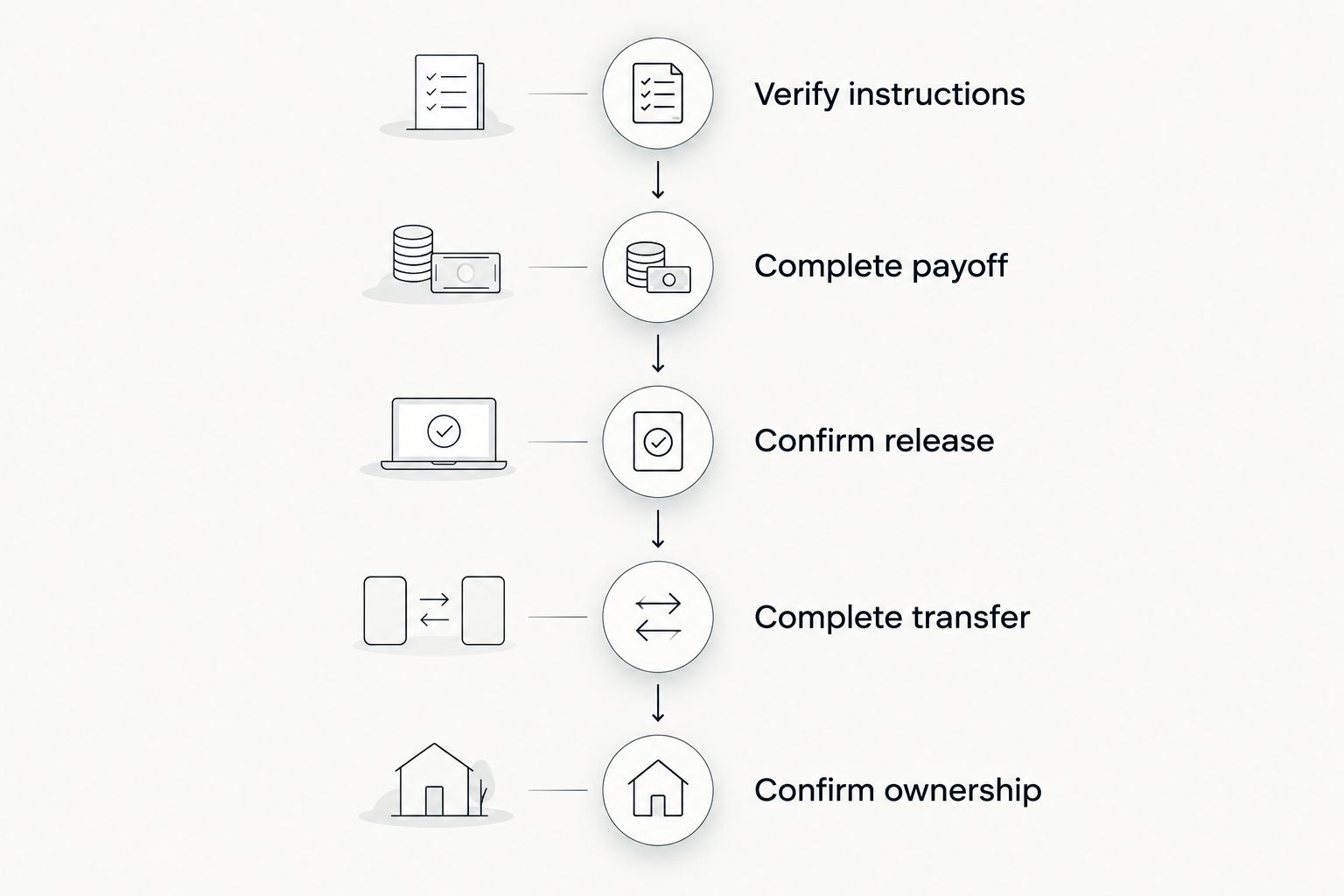
Keep 2 separate confirmations: evidence of debt satisfaction and evidence of the resort ownership update. For deeded ownership, also retain the recorded transfer and any required recorded release.
The timeshare deed transfer to closed sale workflow covers the next part of a deeded resale. Do not substitute a recorded deed for confirmation that the resort has processed the ownership change.
When the closing date changes
An updated closing date needs an updated payoff check. Use this variant whenever the planned payment date changes during your 2026 resale, even if the buyer and agreement remain the same.
- Compare the new payment date with the payoff statement's valid-through date. Request a replacement statement when necessary.
- Tell the closing professional about payments made since the previous statement. Ask the lender to reconcile them rather than adjusting the figure yourself.
- Reconfirm resort account standing and whether new obligations affect the transaction. Update the written allocation if necessary.
- Check that approvals, signatures, and closing instructions remain valid. Resolve expired or changed requirements before releasing funds.
Expected result: the closing uses current information rather than a payoff statement prepared for a date that has passed.
If you have already paid the loan, the revised workflow starts with release verification. Do not pay again because an older closing worksheet still lists the mortgage as outstanding; have the lender and closing professional reconcile the records first.
Troubleshooting
The payoff is higher than the statement balance
A statement balance is not necessarily the amount required to satisfy the loan on a later date. Request the lender's itemized payoff explanation and have unexplained differences resolved before payment. Do not substitute your own calculation for written payoff instructions.
Sale proceeds will not cover the payoff
Identify the funding gap before closing. Ask the closing professional what additional funds or written lender arrangements are necessary; a resale contract does not erase the unpaid balance. If you cannot fund the gap, reassess the transaction before authorizing payment or transfer.
The lender shows payment, but the lien remains
Request the satisfaction or release documentation and confirm who must file it. Have the closing professional check the relevant record where recording applies. Keep the issue open until the required release is documented, rather than relying solely on a zero-balance screen.
The deed transferred, but resort notices continue
Send the resort the completed transfer documents through its verified process and request written account-status confirmation. Ask whether the notice concerns an earlier obligation or an unprocessed ownership update. Do not ignore it or assume that recording automatically completed the resort's administrative work.
Payment instructions change unexpectedly
Pause the payment and independently contact the lender or closing professional through previously verified details. Confirm the change outside the message thread. Urgency, a familiar email signature, or an attached document is not enough to authenticate new instructions.
Customize your workflow
Adapt the checklist to the ownership and people involved, not just the loan balance. An overseas seller needs signing requirements settled early; an executor needs authority to act established before arranging a transfer.
For your 2026 closing file, assign each unresolved task to a named contact: lender, resort, closing professional, or seller. Keep the request, response, supporting document, and remaining action together. That makes a missed release or unprocessed transfer easier to identify.
Sold My Timeshare provides resale and exit assistance, but assistance does not replace lender instructions or legal advice about your obligations. Choose the next step from the documented account position, not from a promise that selling automatically cancels debt.
FAQ
Do I have to pay off timeshare mortgage before selling?
A secured timeshare loan generally must be satisfied for a transfer free of its lien, but payment does not always have to happen before closing. Confirm whether your lender and closing professional permit payoff through the transaction.
Can the buyer's payment pay off my timeshare loan?
Buyer funds can be applied toward payoff when the lender and closing arrangements permit it. If those funds do not cover the required obligations, establish an accepted plan for the difference before closing.
Does paying off my timeshare end maintenance obligations?
Paying off the loan does not by itself end timeshare ownership or maintenance obligations. Confirm the ownership transfer and responsibility for outstanding obligations separately with the resort and closing professional.
What if my timeshare loan is an unsecured personal loan?
Selling the timeshare does not automatically cancel an unsecured personal loan. Review the loan agreement and ask the lender what obligations remain after the ownership transfers.
How long does a lien release take after payoff?
Release timing depends on the lender, required paperwork, and any recording process. Obtain the expected process directly and have the closing professional verify completion rather than assuming payment clears the record immediately.
Should I stop making payments while waiting for resale?
Do not treat a pending resale as permission to stop required payments. Obtain written instructions about your obligations; a listing or unsigned closing plan does not change your loan agreement.
What should I keep after a timeshare resale closes?
Keep the payoff confirmation, applicable lien release, signed closing documents, and resort ownership confirmation. For deeded ownership, retain the recorded transfer documents as well.
One last thing
A zero loan balance answers a debt question, not an ownership question. Before archiving your 2026 closing file, ask: does the lender confirm satisfaction, does the transfer record show completion, and does the resort recognize the buyer? Close each question with documentation.