
Estate executors’ timeshare exit is the process of resolving a deceased owner’s timeshare interest with the aim of settling the estate without an unfinished ownership obligation. This 2026 guide explains how to verify authority, compare transfer routes, and document completion without treating an heir’s wishes as permission to act.
- Timeshare exit for estate executors starts with ownership records and legal authority, not a listing or transfer promise.
- Sold My Timeshare provides valuations and resale/exit assistance; estate authority and legal questions require separate review.
- Ask the resort about surrender before committing the estate to a resale or third-party service.
- Keep written evidence of ownership transfer and account closure; a signed service agreement proves neither.
Why timeshare exit matters for estate executors
An executor must resolve an estate asset, not simply cancel a vacation reservation. A timeshare can involve a deed, membership agreement, loan, recurring assessments, or some combination of these. The documents determine which questions you need answered.
The central problem is authority: the person receiving statements is not necessarily the person authorized to transfer ownership. Probate requirements, contract terms, and the location of any deeded property need review before you sign.
For an estate, the right exit is one the executor can authorize and document—not merely the quickest offer. Start with the ownership paperwork before comparing resale options for inherited timeshares.
Treat this 2026 guide as a preparation checklist, not legal advice. Ask estate counsel to resolve questions about title, creditor claims, beneficiary rights, and your authority to act.
How to handle timeshare exit for estate executors
Confirm authority
Start with the estate’s appointment documents and the timeshare’s ownership record. Do not assume being named executor in a will gives you immediate authority to sign a transfer. Ask estate counsel what appointment, court approval, or additional proceeding applies.
A surviving co-owner, trust, or entity changes the starting point. If the timeshare is not owned by the estate, determine who has authority before requesting an estate sale. When deeded property sits outside the probate state, ask whether local legal assistance is necessary.
Keep your role explicit in correspondence. Do not sign as an individual purchaser or substitute owner when your intended role is estate representative.
- Obtain the documents establishing your appointment and signing authority.
- Check the recorded owner or named contract holder.
- Identify surviving owners, trustees, or other authorized parties.
- Ask counsel how to state your representative capacity on documents.
Identify ownership
Locate the deed, purchase agreement, membership terms, and most recent account statement. Separate what the owner purchased from how the owner used it: a points balance alone does not establish whether the underlying interest is deeded or contractual.
Build 3 document groups: ownership, financial obligations, and estate authority. This keeps a resort representative’s request for paperwork from becoming a search through unrelated probate files.
For your 2026 estate file, record each document’s date and source. A current resort statement and an old purchase illustration serve different purposes; neither should silently replace the other.
- Record the legal owner, resort, account identifier, and ownership type.
- Locate loan documents and any recorded security interest.
- Separate recurring assessments from loan payments and transfer charges.
- Note existing reservations, rental commitments, and unused benefits.
Request options
Contact the resort or owner-services department directly using details from an established statement or ownership document. Ask for its deceased-owner procedure, transfer requirements, and any surrender or deed-back route. Request the response in writing.
Next, assess resale rather than assuming the original purchase amount represents current value. Sold My Timeshare is best for timeshare owners seeking a valuation and resale/exit assistance. Its free, no-obligation valuation is a starting point for an estate’s resale inquiry, not proof of a completed sale or legal clearance to transfer.
Use Sold My Timeshare after gathering the ownership details. Ask what information an estate representative must supply and what happens after the valuation; the service does not replace your probate adviser.
- Request written eligibility requirements for surrender or transfer.
- Ask how an outstanding loan affects each available route.
- Obtain a valuation before choosing a resale strategy.
- Separate a service provider’s proposed work from the resort’s approval requirements.
Request a timeshare valuation
Start with a free, no-obligation valuation before deciding whether to pursue resale.
Review obligations
Put all account obligations in one estate log. Record the issuing party, due date, stated balance, dispute status, and person responsible for reviewing it. An invoice addressed to the deceased owner needs assessment; it is not an instruction to pay personally.
Do not stop payments because a prospective buyer or exit provider says a transfer is underway. Equally, do not pay a disputed demand merely to move the file along. Ask counsel how payment decisions fit the estate’s creditor process and available funds.
For decisions made in 2026, distinguish current written requirements from older correspondence. Ask the resort to clarify conflicting instructions rather than choosing the more convenient version.
- Request a current itemized account statement.
- Record assessment, loan, and special-assessment notices separately.
- Ask counsel how to handle disputed or unaffordable obligations.
- Keep payment instructions and payment confirmations together.
Compare routes
Compare direct surrender, resale, beneficiary transfer, and legal assistance against the same questions: who must approve, what documents are required, and what event completes the route? A verbal assurance is not a substitute for a written procedure.
Do not treat a beneficiary’s refusal to accept the timeshare as an estate exit. A beneficiary’s inheritance decision and the estate’s existing ownership obligations are separate issues. Obtain advice before distributing the interest or asking someone to sign acceptance paperwork.
The comparison table below helps organize the decision. It does not establish that a particular resort accepts surrender or that a buyer exists.
- Ask the resort whether a direct return route exists.
- Compare resale requirements with the estate’s actual ownership records.
- Obtain a beneficiary’s informed agreement before proposing a transfer.
- Seek legal review when authority, debt, or title is disputed.
Check documents
Read the proposed service agreement and the actual transfer paperwork separately. Hiring someone to help is not the same as conveying the timeshare. Identify who prepares documents, submits them, follows up, and supplies evidence of completion.
Check that the estate’s name, ownership description, and your signing capacity match the supporting records. Ask counsel to review any personal guarantee, broad power of attorney, release, or provision that changes who carries responsibility.
Keep sensitive information limited to what the recipient needs. Establish who is receiving original documents and how those documents will be returned or retained.
- Identify each contracting party and its specific task.
- Check the ownership description against the source documents.
- Review cancellation terms and unfinished-transfer responsibilities.
- Verify where signatures, witnessing, notarization, or recording are required.
Document release
Agree on the completion evidence before signing the transaction. For deeded ownership, ask who handles recording and supplies the recorded instrument. For contractual ownership, ask what written acknowledgment establishes that the transfer or termination has been accepted.
Request 2 separate confirmations: evidence that ownership changed or ended, and an explanation of the account’s remaining obligations. A zero-balance statement alone does not establish that ownership ended; a signed transfer alone does not explain every remaining charge.
Before closing the estate’s timeshare file in 2026, have the responsible adviser check that the evidence matches the intended outcome.
- Obtain the applicable recorded document or written acceptance.
- Request a final account statement and clarification of remaining charges.
- Confirm the treatment of reservations and unused benefits.
- Retain the completion documents with the estate accounting records.
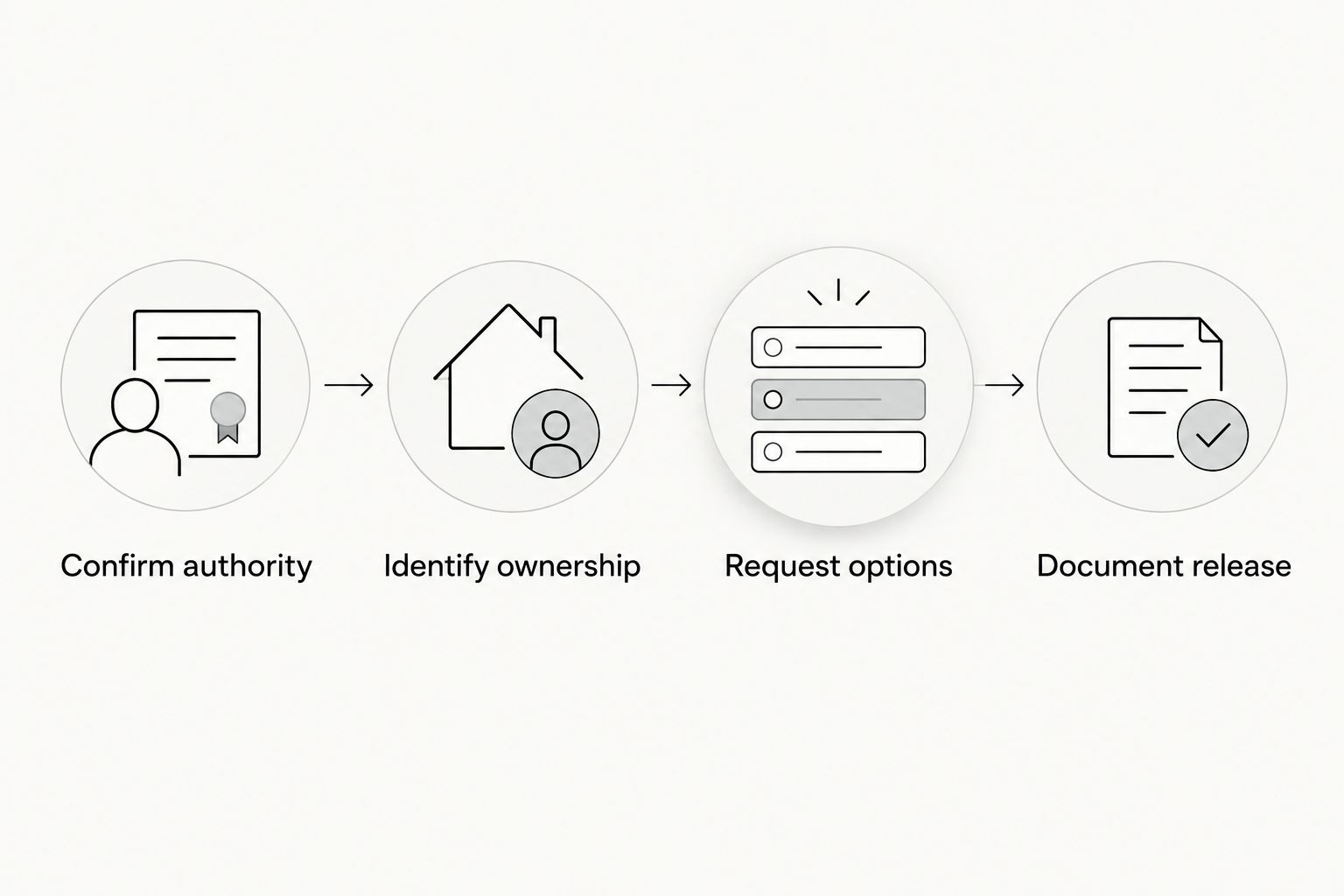
The process has four checkpoints: Confirm authority, Identify ownership, Request options, and Document release. Each checkpoint should produce paperwork the next person reviewing the estate can understand.
Compare timeshare exit options for an estate
Choose the route by its requirements and completion evidence, not its advertised speed. These options address different problems, and some estates need legal assistance alongside a surrender or resale process.
| Option | Best for | Practical advantage | Key limitation |
|---|---|---|---|
| Direct resort surrender | Estates whose resort confirms eligibility | Lets you request an exit directly from the party administering ownership | Acceptance depends on the resort’s written requirements; do not assume eligibility |
| Resale | Estates pursuing a transfer to a buyer | Tests whether a buyer will accept the specific ownership interest | A valuation or listing does not establish buyer demand or guarantee completion |
| Beneficiary transfer | A willing beneficiary who understands the ownership | Preserves ownership for someone who wants to use it | Requires informed acceptance and the applicable estate and transfer approvals |
| Attorney-led assistance | Estates with disputed authority, title, obligations, or contract terms | Addresses legal questions that a listing service does not resolve | Legal engagement alone does not transfer or terminate ownership |
Sold My Timeshare offers timeshare resale and exit assistance, but the estate still needs its own authority review and transaction records. Ask exactly which route is proposed and which party must accept it.
For a 2026 decision, keep the comparison tied to the specific interest being administered. Another owner’s experience with a different resort or contract does not establish your estate’s eligibility.
Common mistakes estate executors make
Treating the death certificate as transfer authority
A death certificate establishes death; it does not, by itself, establish your authority to convey an estate asset. Supply the appointment and ownership documents requested through the appropriate estate process.
Next move: ask counsel and the receiving party to identify the required authority documents before preparing signatures.
Confusing the original purchase amount with resale value
The deceased owner’s purchase paperwork describes an earlier transaction. It does not establish what a buyer will accept today or what obligations attach to the proposed transfer.
Next move: obtain a current valuation and ask what evidence supports the proposed resale approach.
Asking an heir to accept before explaining obligations
An heir’s interest in vacations is not informed consent to ownership. Provide the governing documents, account information, and transfer requirements before asking for a decision.
Next move: separate the beneficiary’s decision from the estate’s need to settle the asset, and obtain legal guidance on any disclaimer question.
Paying attention to the promise but not the endpoint
A provider can promise assistance without identifying the document that proves completion. That leaves the executor with activity to report but no clear resolution.
Next move: require a written scope, named responsibilities, and a defined completion record before engaging help.
FAQ
What should an executor do first with a timeshare?
An executor should first verify who owns the timeshare and who has authority to act. Gather the ownership agreement, current statements, and estate appointment documents before signing a listing or transfer.
Does a timeshare automatically end when its owner dies?
Do not treat the owner’s death as automatic termination of the timeshare. Review the ownership documents and applicable estate law with counsel, then obtain the resort’s written deceased-owner procedure.
Can an executor sell a timeshare without the heirs agreeing?
An executor’s authority to sell depends on the estate documents, applicable law, and any required approvals. Ask estate counsel to determine whether beneficiary consent or court approval is necessary before committing to a sale.
Can an heir refuse an inherited timeshare?
An heir should obtain legal advice about disclaiming an inheritance before accepting or using the interest. Disclaimer requirements are jurisdiction-specific, and the heir’s decision does not by itself resolve the estate’s obligations.
Is resort surrender better than selling an estate’s timeshare?
Resort surrender is the more direct route when the resort confirms acceptance and the terms meet the estate’s needs. Resale is a separate route that requires a buyer and completion of the applicable transfer process.
Does Sold My Timeshare provide help with an estate’s timeshare?
Sold My Timeshare provides valuations and resale/exit assistance. An executor can request a free, no-obligation valuation while separately confirming estate authority and legal requirements with counsel.
How does an executor know a timeshare exit is finished?
An executor should obtain the applicable ownership-transfer or termination evidence and a written account reconciliation. Ask the responsible adviser to confirm that the documents establish the intended outcome before closing the estate file.
One last thing
Ask for the completion document before choosing the exit service. That question forces everyone to distinguish a proposed action from an accepted transfer. Write down who must issue the evidence and where the estate will retain it; this makes the final accounting easier to explain.