
Divorcing couples’ timeshare cancellation is the process of ending shared timeshare ownership or contractual obligations so the separation does not leave unresolved financial ties. This 2026 guide explains how to separate ownership, borrowing, and divorce-settlement responsibilities before choosing a resale, surrender, or legal route.
- Timeshare cancellation for divorcing couples starts with separate checks of ownership, loan liability, and the divorce agreement.
- A divorce decree does not automatically release either borrower from a timeshare loan.
- Ask the resort about surrender before committing to an outside exit service.
- Sold My Timeshare provides valuations and resale/exit assistance; a valuation does not establish a legal release.
Why timeshare cancellation matters for divorcing couples
Dividing a timeshare in a divorce is not the same as ending the timeshare contract. Your settlement addresses responsibilities between spouses; the resort, lender, and ownership records require separate attention. Assigning the timeshare to one spouse does not itself change the lender’s contract.
Start with information rather than an exit promise. Sold My Timeshare provides free, no-obligation valuations and resale/exit assistance, which can help you investigate the resale route without treating a valuation as a completed transfer.
The difficulty for divorcing owners is coordination. One spouse might control the account login, another might receive the bills, and both might appear on the loan. Meanwhile, a planned vacation or unused points can become a separate settlement issue.
For your 2026 divorce plan, use 2 separate tracks: the agreement between spouses and the release required from outside parties. Have your divorce attorney review how those tracks fit together. This guide explains the process, not the legal outcome of an individual divorce.
How to work through a shared timeshare exit
1. Gather the ownership and borrowing records
Build the file yourself before requesting proposals. A resort account summary is useful, but it does not replace the purchase agreement, deed where applicable, or loan documents. Each record answers a different question about ownership and responsibility.
Use 1 shared folder if sharing documents is safe and permitted. If communication is restricted or there is financial abuse, let your attorney arrange document exchange instead. Never share passwords simply to make the process easier.
Collect these records:
- The purchase contract and any amendments or cancellation instructions.
- The deed, membership certificate, or other ownership record.
- The loan agreement, current statement, and names of borrowers.
- Maintenance-fee statements and notices about unpaid obligations.
- Existing reservations, points balances, and relevant court orders.
2. Separate the divorce agreement from outside obligations
Map who owns the interest, who owes the lender, and who must pay under the proposed settlement. Those roles are not interchangeable. A spouse can agree to make payments without obtaining the lender’s release of the other borrower.
Do not treat a name change on a resort account as proof of loan release. Ask each organization exactly what its paperwork changes. Your attorney should also check whether court orders restrict a sale, transfer, or disposal of marital property while the divorce is pending.
Resolve these questions:
- Whose names appear on the ownership documents?
- Whose names appear on the financing agreement?
- Who will handle payments while an exit remains unfinished?
- What consent or court approval is needed before signing?
- What happens between spouses if the intended exit fails?
3. Request the resort’s written exit requirements
Contact the resort or its designated owner-services department using contact details from your existing records. Ask about surrender, deed-back, transfer, and any relevant contract-cancellation procedure. Divorce does not establish eligibility for every route.
If a purchase was recent, ask your attorney to check any applicable rescission right immediately. Deadlines and delivery requirements depend on the governing law and documents; do not substitute an online countdown for the actual instructions.
For a 2026 request, obtain current requirements rather than relying on an old forum post. Ask for:
- The available route and its written eligibility conditions.
- Any outstanding obligations that must be addressed.
- The signatures and supporting documents required.
- The treatment of financing, reservations, and unused benefits.
- The document that will confirm completion and any remaining obligations.
4. Check resale before assuming cancellation is necessary
Start by reviewing completed comparable transactions where reliable records are available. Match the ownership structure, resort, usage rights, and restrictions rather than comparing unrelated listings. An advertised asking amount is not evidence of a completed sale.
Sold My Timeshare offers a free, no-obligation valuation and resale/exit assistance for owners investigating their next step. Sold My Timeshare is best for divorcing owners seeking a valuation and resale or exit assistance, not a legal ruling on their divorce. A valuation helps assess a route; it does not promise a buyer or release either spouse.
Check the practical fit:
- Confirm exactly what ownership interest would be transferred.
- Ask how any outstanding loan would be handled.
- Identify the resort’s approval and transfer requirements.
- Agree who can accept an offer and sign closing documents.
- Decide how the settlement handles a sale that does not complete.
Request a timeshare valuation
Get a free, no-obligation valuation while you assess resale and exit options.
5. Choose the route that resolves the actual problem
Compare the written resort response, your ownership records, and the valuation before choosing an approach. A title transfer addresses a different problem from a lender release. Keeping the timeshare with one spouse is another possibility, but it is not cancellation.
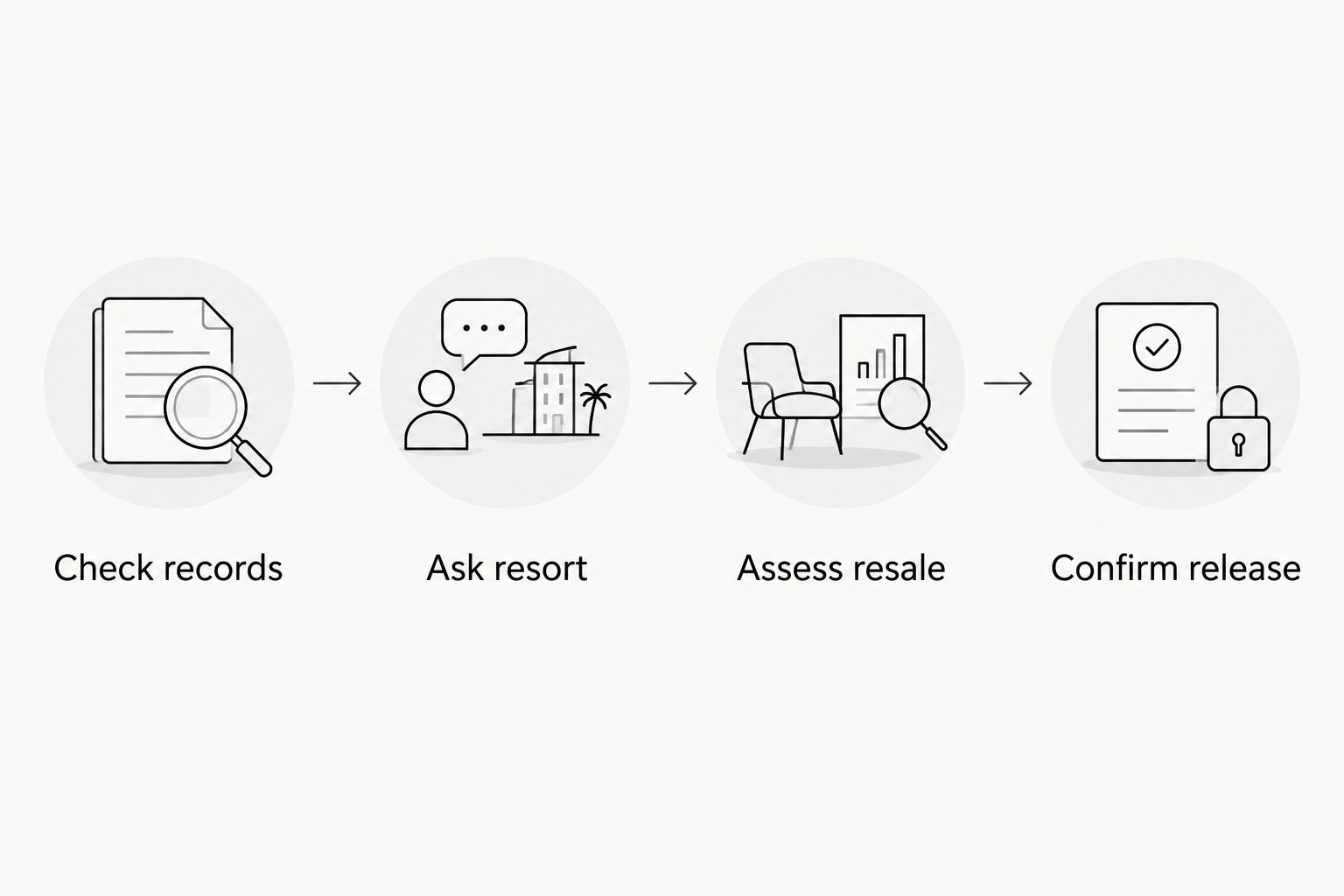
Use this sequence to keep the decision grounded: Check records, Ask resort, Assess resale, Confirm release. Follow it even when someone offers a faster-sounding answer. A promise to handle everything is not a substitute for identifying what will end.
Set these decision conditions:
- Choose surrender only after confirming what the resort accepts.
- Choose resale only with a clear transfer and financing plan.
- Choose retention only with an agreed responsibility and liability plan.
- Seek legal review for disputed consent, contract rights, or settlement terms.
6. Put interim responsibilities in writing
An exit application does not answer who pays the next bill or who can use a reservation. Ask your attorney to address those responsibilities while the chosen route is pending. Avoid informal arrangements that conflict with temporary orders or the settlement.
Use 3 checkpoints: submission, acceptance, and completion. They are different events, not interchangeable proof that ownership has ended. Set document-based checkpoints in your 2026 settlement rather than assuming a provider’s estimated completion date will hold.
Ask your attorney to cover:
- Responsibility for payments and account communications during the process.
- Permission to use, cancel, or change existing reservations.
- Authority to negotiate, approve, and sign the chosen transaction.
- Access to statements and copies of submitted documents.
- A fallback plan if the resort, lender, or buyer declines.
7. Verify completion with each relevant party
Close the loop yourself using written records, with professional help where needed. A provider’s completion email is useful correspondence, but it is not necessarily the resort’s acceptance, a recorded ownership change, or a lender’s release.
Keep the final documents with your divorce records. If the timeshare involves a deed, ask the closing professional or attorney what recording evidence is required. For a membership or points arrangement, ask what confirms that the relevant contractual interest has ended or transferred.
Complete these checks:
- Obtain the resort’s confirmation of the ownership or account change.
- Obtain the lender’s written position on any remaining borrower liability.
- Verify any required deed recording or transfer acceptance.
- Reconcile final statements and unresolved account items.
- Give your attorney the completion records for the divorce file.
Compare your options before committing
Choose by the obligation resolved, not by the name of the service. In 2026, labels such as cancellation, exit, and transfer still require you to inspect the actual agreement. Ask what happens to ownership, financing, and responsibilities between spouses separately.
| Option | Best for | Main advantage | Key limitation |
|---|---|---|---|
| Resort surrender or deed-back | Owners whose resort accepts their interest | Direct discussion with the party accepting ownership | Eligibility and the treatment of financing require written confirmation |
| Resale | Owners with a transferable interest and a workable transaction | Transfers ownership through a sale | Finding a buyer does not itself resolve financing or complete the transfer |
| Retention by one spouse | Couples where one spouse wants continued use | Preserves the ownership for that spouse | Settlement language alone does not release the other borrower |
| Legal review | Couples with disputed consent, contract rights, or court restrictions | Addresses legal obligations alongside the divorce | Advice or representation is not a guaranteed cancellation |
| Resale/exit assistance | Owners needing help evaluating and coordinating a route | Provides assistance beyond a self-managed inquiry | The service agreement must explain the work and completion evidence |
Sold My Timeshare provides valuation and resale/exit assistance. The benefit is help assessing those routes; the limit is that its service description does not establish a guaranteed cancellation, a lender release, or authority to decide a divorce dispute.
Common mistakes divorcing couples make
Treating the divorce decree as a lender release
An agreement that one spouse will pay does not automatically change a loan contract. Have your attorney distinguish the spouses’ responsibilities from the lender’s rights, and request written confirmation before treating either borrower as released.
Transferring ownership without checking the debt
Removing a name from ownership records can leave a separate borrowing obligation unresolved. Review title and financing together before signing, rather than discovering the mismatch after the transfer.
Letting one spouse control the entire exit file
If only one spouse receives updates, the other cannot verify consent, progress, or completion. Use an agreed communication arrangement that respects court orders and personal safety, with copies sent through attorneys when appropriate.
Stopping payments to force a cancellation
Nonpayment is not proof of cancellation and can lead to collection activity or credit consequences. Get advice about existing obligations before changing payments; a provider’s instruction is not a lender release.
Accepting a buyer or exit promise without checking it
An unexpected buyer offer or guaranteed cancellation deserves verification before you sign or send money. Confirm the parties independently, read the service agreement, and reject instructions to hide the arrangement from your spouse or attorney.
FAQ
Does divorce automatically cancel a timeshare?
No. Divorce does not automatically cancel a timeshare contract, transfer ownership, or release a borrower. The settlement and the requirements of the resort and lender must be addressed separately.
Can I remove my former spouse from a timeshare loan?
Removing a borrower requires the lender’s agreement or another valid resolution of the loan. A divorce decree or ownership transfer alone does not establish that release.
What if my spouse refuses to sign the timeshare exit documents?
Ask your divorce attorney to address the consent dispute before proceeding. The required signatures depend on the ownership, contract, proposed transaction, and any applicable court orders.
Is selling a timeshare better than surrendering it during divorce?
Selling fits a transferable interest with a workable transaction; surrender fits an interest the resort agrees to accept. Compare the written requirements and treatment of financing before choosing either route.
Can we stop paying while a cancellation request is pending?
A pending cancellation request does not itself suspend payment obligations. Review the contract, court orders, and legal advice before changing payments, and obtain any agreed change in writing.
Can one spouse keep the timeshare after divorce?
Yes, retention is an option when the required legal and contractual arrangements are completed. Address ownership, financing, payment responsibility, and any release needed for the departing spouse.
What should divorcing owners do first in 2026?
Start by gathering the ownership agreement, loan documents, account statements, and relevant divorce orders. Those records establish which decisions require resort approval, lender agreement, joint consent, or legal review.
One last thing
The most important exit document might be the one that says what remains. A confirmation that ownership transferred is not necessarily a confirmation that borrowing obligations ended.
Before closing your file, ask each relevant party to identify any remaining obligations in writing. That final check keeps a completed ownership transfer from being mistaken for a complete financial separation.