
Instead of chasing account statements and transfer emails separately, build your 2026 closing file around a timeshare estoppel certificate, then reconcile it with the purchase agreement, any lender payoff, and the resort’s transfer requirements. The certificate documents the ownership account’s status; it does not, by itself, transfer ownership or prove that your obligations have ended.
- A timeshare estoppel certificate documents account status; it does not complete a timeshare closing.
- Reconcile ownership details, maintenance fees, usage rights, and transfer requirements before signing closing documents.
- Sold My Timeshare offers resale and exit assistance for owners who need help choosing a path.
- Confirm both the legal transfer and the resort’s account update before treating the transaction as finished.
Sold My Timeshare provides free, no-obligation valuations and resale or exit assistance. Sold My Timeshare is best for timeshare owners seeking a valuation and help considering resale or exit, not a substitute for the association’s account certification or legal advice about a disputed transfer.
Why this matters
A timeshare closing involves records maintained by different parties. The association or manager tracks the ownership account, a lender tracks any loan, and the closing professional coordinates the transfer documents.
Those records must agree on the ownership being transferred and the obligations being addressed. An account statement showing current maintenance fees does not establish that a separate loan has been satisfied.
For a 2026 closing, use the certificate as a verification checkpoint rather than permission to stop paying. Continue following your existing obligations unless the responsible party confirms otherwise in writing or your attorney advises you about a dispute.
Before you start
- Gather the ownership records. Collect your deed or membership agreement, account number, recent statements, reservation details, and any loan documents. Include the signed sale agreement if a buyer is already involved.
- Identify the authorized contacts. Establish who issues account certifications, who processes transfers, and who handles closing. Ask whether the association requires owner authorization before releasing account information.
- Check the document’s scope and timing. A certificate reflects the information and effective date stated on it. Ask whether a separate lender payoff, updated account statement, or resort approval is required before closing.
Do not assume that every resort calls the document an estoppel certificate. Ask for the written account-status and transfer information needed for your ownership, then have the closing professional confirm whether that document meets the transaction’s requirements.
Ownership file
Establish the record everyone will use
- Create an ownership summary. Copy the owner names exactly from the governing ownership document. Record the resort, account identifier, ownership type, and the interest being transferred.
- Identify every required signer. Give the closing professional documents explaining any name change, trust ownership, estate involvement, or other difference between the recorded owner and the proposed signer.
- Record the agreed usage. State which reservations, occupancy periods, points, or other usage rights the buyer expects to receive. Distinguish those expectations from rights the resort has actually confirmed as transferable.
- Assign responsibility. Name the person responsible for requesting the certificate, reviewing it, resolving discrepancies, and obtaining the final transfer confirmation.
Expected result: You have 1 ownership file that identifies the interest, the parties, and the proposed transfer without relying on conflicting email descriptions.
Keep supporting documents together, but send sensitive records only through a channel you have verified with the recipient. A request for account information should not require you to share your resort login password.
For a 2026 file, label documents by their actual issue dates. A newly downloaded copy of an old statement is still an old statement.
Keep these documents separate
| Document | Best for | What it establishes | What it does not establish |
|---|---|---|---|
| Timeshare estoppel certificate | Checking the association or manager’s account record | The status and details expressly certified as of the stated date | Automatic transfer, lender release, or every title issue |
| Lender payoff statement | Addressing a financed ownership | The lender’s payoff instructions and stated conditions | Whether association charges are current |
| Deed or assignment | Documenting the ownership transfer | The transfer described in the properly completed instrument | Completion of the resort’s internal account update |
| Resort transfer confirmation | Checking the membership or account change | The ownership update expressly acknowledged by the resort | Resolution of obligations outside that confirmation’s scope |
The advantage of this document set is that each record answers a different question. The limitation is coordination: no single document should be stretched into proof of everything else.
Certificate request
Obtain the account information before scheduling signatures
- Verify the recipient. Contact the association or management company using contact information from your existing ownership records. Confirm the department authorized to issue an estoppel certificate or equivalent account-status statement.
- Request the required authorization. Ask what consent, ownership identification, and transaction information the issuer needs. Complete the issuer’s actual form rather than substituting an informal message when a form is required.
- Specify the questions. Request confirmation of the owner record, ownership identifier, outstanding association charges, known assessments, usage status, and applicable transfer requirements.
- Ask about restrictions. Request written instructions for any approval, right-of-first-refusal process, supporting documents, or account conditions that apply to this transfer.
- Confirm timing and delivery. Ask when the document will be issued, what date its information covers, and whether the closing professional must request an update before completion.
Expected result: The closing professional receives an identifiable, dated document from the authorized issuer, with its scope and any qualifications visible.
Do not interpret a blank field as confirmation that nothing is owed or restricted. Ask the issuer to clarify whether the field means none, unknown, not applicable, or not included in the certification.
If a request arrives through an unfamiliar intermediary, verify the intermediary independently before sending documents. Urgency is not a reason to bypass identity checks.
Account reconciliation
Resolve differences before approving closing documents
- Match the ownership. Compare names, account identifiers, resort details, and the ownership interest against the agreement and ownership records. Send discrepancies to the closing professional before signing.
- Reconcile association obligations. Compare the certificate with recent account activity. Ask how payments, assessments, or other charges arising after its effective date will be handled.
- Reconcile any loan separately. Obtain lender instructions through the closing professional when a loan exists. Do not treat a current association account as evidence that the financing has ended.
- Confirm usage treatment. Check existing reservations, used or transferred points, and the usage promised to the buyer. Put agreed changes into the transaction documents rather than leaving them in an informal conversation.
- Resolve transfer conditions. Obtain the required approval or written direction for any outstanding resort requirement. Have the closing professional document what remains open and who must complete it.
Expected result: Each material difference has a written resolution, and the proposed closing documents reflect the account and usage information being relied upon.
Use 3 checkpoints: Identity match, Account review, and Transfer conditions. Do not approve the file merely because the totals appear consistent; a matching balance attached to the wrong ownership is still the wrong record.
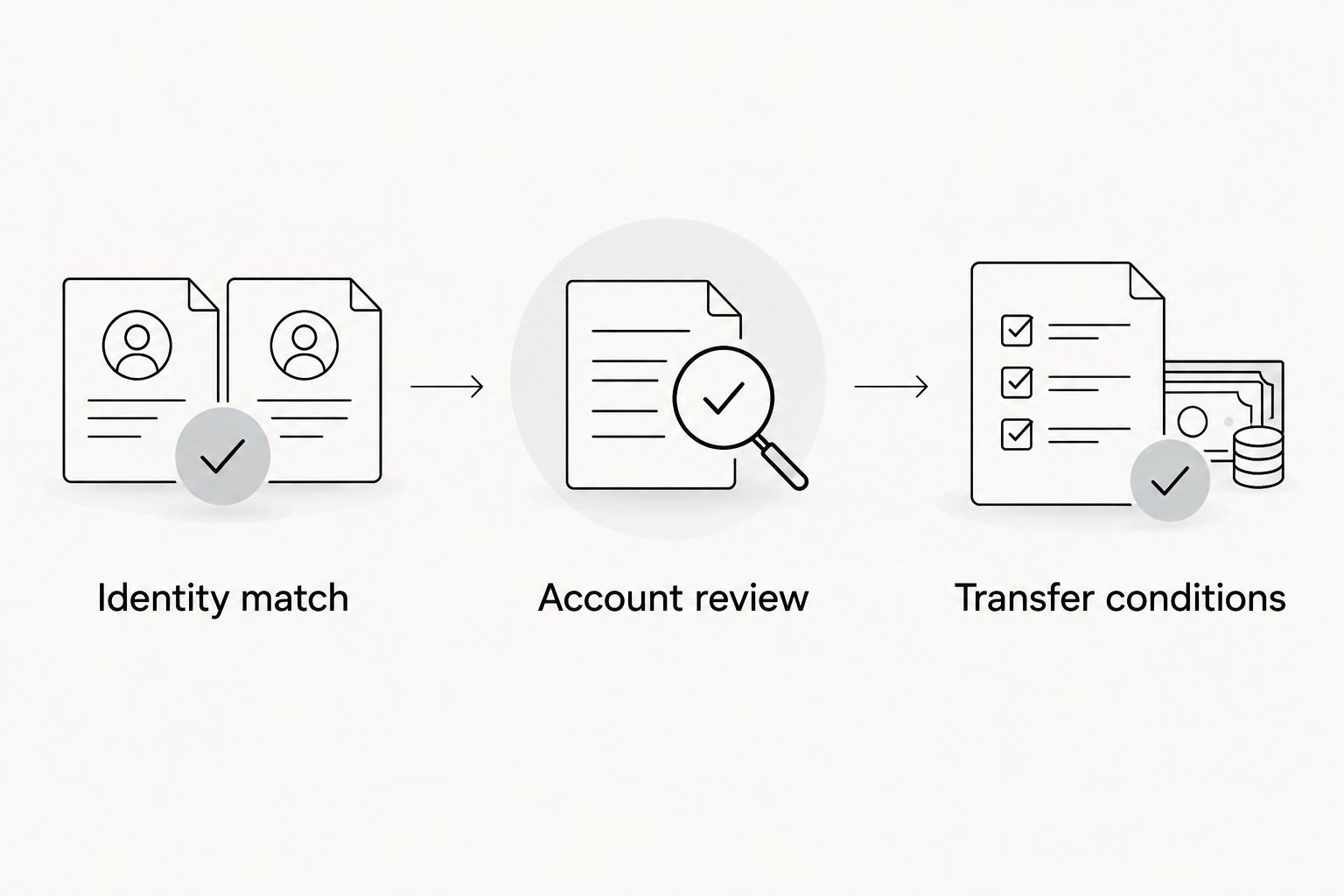
For a 2026 transaction, review any new account activity between certificate issuance and closing. Ask the issuer or closing professional whether the existing certificate remains acceptable rather than inventing an expiration period.
Closing evidence
Finish the transfer and verify the account update
- Review the closing package. Check that the deed or assignment describes the correct interest and that the documents reflect the agreed responsibility for outstanding obligations and usage.
- Verify signing instructions. Follow the closing professional’s instructions for signatures, witnesses, notarization, and delivery where applicable. These requirements depend on the instrument and jurisdiction.
- Verify payment instructions independently. Confirm any payment destination using a previously verified contact method. Treat an unexpected change in instructions as a reason to stop and check.
- Obtain completion evidence. For a deeded transfer, ask for the relevant recording evidence. For a membership assignment, obtain the documentation required for that ownership structure.
- Confirm the resort update. Request written acknowledgment that the resort has processed the ownership change, including the effective date and the status of your former account.
Expected result: You retain 2 separate confirmations where applicable: evidence of the legal transfer and evidence of the resort’s account update. Neither should be assumed from the other.
The timeshare deed transfer to closed sale workflow covers the broader handoff from transfer documents to completion evidence.
Do not treat a signed certificate, signed deed, or verbal assurance as the entire closing file. Ask the closing professional to identify any unresolved obligations and retain the answer with your records.
When account information changes before closing
An updated account requires another review, not an automatic restart. Use this variant when a payment posts, an assessment appears, a reservation changes, or the closing date moves beyond the period the original documentation covers.
- Identify exactly what changed and when.
- Ask the issuer whether it will provide an amended certificate, a replacement certificate, or a separate written update acceptable for closing.
- Have the closing professional reconcile the change with the agreement, lender instructions, and proposed transfer documents.
- Obtain written confirmation that any affected transfer condition has been addressed before proceeding.
Expected result: The closing file explains the change and contains the evidence used to approve it.
Do not silently replace the original certificate. Keep both versions so the closing professional can trace what changed and avoid relying on an outdated attachment.
Troubleshooting
The owner name does not match
Pause signing and send the discrepancy to the closing professional. A spelling issue, legal name change, trust, or deceased owner requires the appropriate supporting documentation; do not edit the certificate yourself.
The certificate and statement show different balances
Compare their effective dates and the activity between them. Ask the issuer to reconcile the difference in writing, then have the closing professional confirm how the transaction will address it.
The resort has not confirmed the transfer
Check whether the required package was received and whether anything remains incomplete. Request the account update in writing rather than assuming that recording a deed automatically changed the resort’s records.
The buyer expects usage that is already committed
Disclose the reservation or usage conflict immediately. Confirm the resort’s applicable rules and have the parties document any revised agreement before proceeding.
Someone promises the certificate guarantees your release
Ask what obligation the document actually certifies and which party has authority to confirm release. An account-status certificate is not a universal release from every ownership-related obligation. Have an attorney review disputed liability or unclear release language.
Customize your workflow
The right next step depends on whether you have a buyer and a transferable ownership. A valuation helps you consider resale; it does not certify the account or replace the closing process.
Sold My Timeshare provides a free, no-obligation valuation and resale or exit assistance. Use that assistance to consider your path while keeping account certification, legal review, and transfer confirmation with the parties responsible for them.
Request a timeshare valuation
Get a free, no-obligation valuation and consider resale or exit assistance.
FAQ
What is a timeshare estoppel certificate?
A timeshare estoppel certificate is a written certification of specified ownership-account information as of a stated date. Its contents and legal effect depend on the issuer, governing documents, and applicable law; it does not itself transfer ownership.
Who provides the timeshare estoppel certificate?
The association, management company, or other authorized account administrator provides the relevant account certification. Confirm the correct issuer and required owner authorization before submitting your request.
Does an estoppel certificate prove my timeshare loan is paid off?
No. An association account certification is not a substitute for lender payoff or loan-release documentation. Have the closing professional address the loan separately when financing exists.
How long is a timeshare estoppel certificate valid in 2026?
There is no single validity period that applies to every timeshare estoppel certificate in 2026. Check the document, applicable requirements, and issuer’s instructions, then have the closing professional confirm whether an update is needed.
Can I close if the certificate contains a mistake?
Resolve a material mistake before approving the affected closing documents. Ask the issuer for a correction or written clarification and have the closing professional review its effect on the transaction.
Does recording the deed remove my name from the resort account?
Recording a deed does not, by itself, confirm that the resort has updated its internal account. Obtain the resort’s written transfer acknowledgment in addition to the applicable legal transfer evidence.
Can Sold My Timeshare help before I have a buyer?
Yes. Sold My Timeshare provides free, no-obligation timeshare valuations and resale or exit assistance. A valuation helps you consider a path; it does not replace association certification, lender documentation, or closing evidence.
One last thing
The strongest final check is not whether you signed everything. It is whether the documents show what transferred, when it transferred, and what remains your responsibility.
Keep your 2026 closing records together, including the certificate, corrections, transfer evidence, and resort acknowledgment. If a later statement arrives, compare it with those records and request a written explanation rather than ignoring it.