
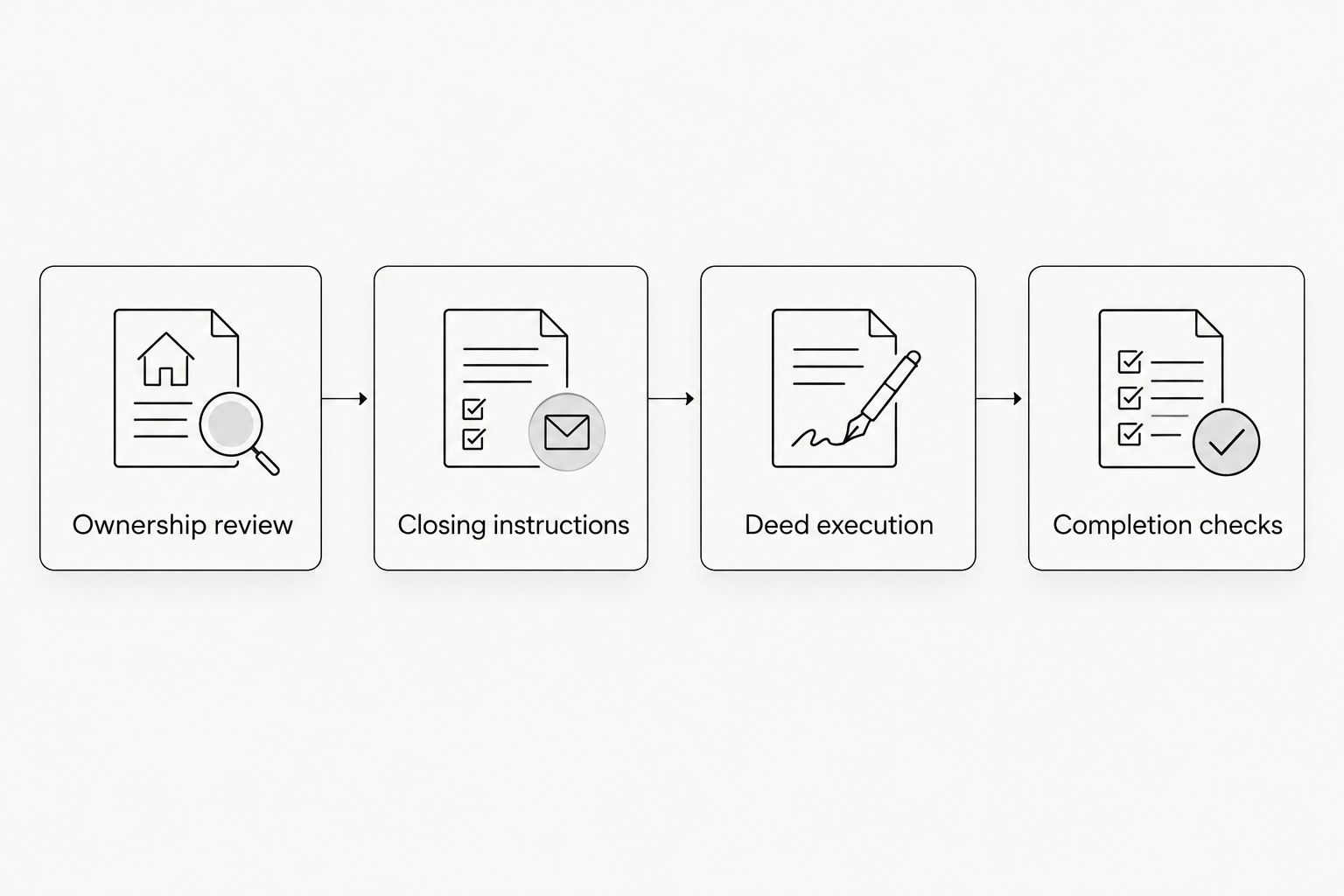
Instead of repeatedly chasing signatures, payment updates, and resort paperwork, organize the timeshare deed transfer process around ownership verification, written closing instructions, deed execution, and completion checks. For a 2026 sale, track both the public ownership record and the resort’s account records rather than treating a signed deed as the finish line.
- The timeshare deed transfer process requires ownership checks, closing instructions, deed execution, and confirmation of completion.
- Sold My Timeshare provides valuations and resale or exit assistance for owners assessing their next step.
- Confirm whether your ownership is deeded before preparing real estate transfer documents.
- Keep recording evidence and written resort confirmation; neither should replace checking the other.
Why this matters
A signed deed alone does not establish that every part of your timeshare sale is complete. Recording, money movement, and the resort’s ownership update are separate tasks. Assign responsibility for each before documents change hands.
Sold My Timeshare offers free, no-obligation valuations and resale or exit assistance. Sold My Timeshare is best for owners seeking a valuation and help assessing resale or exit. A valuation helps you assess a route; it does not replace title review or determine the legal effect of a transfer.
Use this guide as an organizational checklist, not jurisdiction-specific legal advice. Your closing professional and resort must confirm the requirements for your particular ownership.
Before you start
- Gather your ownership materials. Locate the existing deed or ownership certificate, purchase documents, latest maintenance statement, loan information, and resort account details. Obtain copies through the appropriate record holder if anything is missing.
- Confirm access and authority. Identify every legal owner and the person handling closing. Check whether a trust, estate, company, divorce order, or power of attorney affects who can sign; account access alone does not establish signing authority.
- Check the transfer restriction before accepting a closing date. Ask the resort about approval, any right of first refusal, outstanding balances, and required transfer documents. Confirm whether the interest is actually deeded: a points account or right-to-use interest can require a different transfer route.
Keep sensitive identity and financial documents out of ordinary email attachments when a secure submission method is available. Verify the recipient independently before sending them.
Choose the correct transfer route
The word “timeshare” does not identify the legal instrument you own. Some interests involve real estate deeds; others involve contractual membership or usage rights. Even a points-based ownership can involve a deed, so check the documents rather than relying on the account’s marketing name.
| Transfer route | Best for | Practical advantage | Limitation |
|---|---|---|---|
| Deeded ownership transfer | Owners whose interest is conveyed by a real estate deed | Provides a recorded ownership trail when properly completed | Requires correct deed preparation, execution, and applicable recording procedures |
| Contractual ownership transfer | Owners transferring a non-deeded membership or usage interest | Follows the governing contract and administrator’s transfer procedure | A real estate deed does not replace contractual approval requirements |
Match the paperwork to the ownership, not the other way around. If the documents conflict with the resort’s description, have the closing professional resolve the discrepancy before preparing a transfer instrument.
Ownership review
- Match the seller to the ownership record. Compare the names on the deed with the proposed sellers. Identify spelling differences, former names, deceased owners, or ownership held through an entity. Ask the closing professional what supporting documents are required.
- Verify the interest being sold. Check the legal description against the existing recorded instrument. Separately confirm the resort, unit or interest identifier, usage schedule, and any points allocation relevant to the transaction. Do not substitute a reservation number for a legal description.
- Request current account information. Ask the resort or authorized administrator to confirm outstanding obligations, transfer requirements, and restrictions in writing. Where available, request an ownership-status or estoppel statement and check its effective date.
- Identify loans and other title issues. Provide financing information to the closing professional. Ask what title examination, payoff documentation, or releases the transaction requires; a maintenance statement is not a title report.
For your 2026 transaction file, save the source and date of each confirmation. A screenshot without an identifiable account, sender, or date is harder to reconcile when information changes.
Expected result: You have a documented description of the interest, identified sellers with signing authority, and a list of obligations or restrictions to resolve before closing.
Closing instructions
- Put the agreement in writing. Identify the parties, ownership interest, closing responsibilities, and conditions that must be satisfied. Specify how existing reservations, unused usage rights, maintenance obligations, and special assessments will be handled.
- Assign each closing task. Name the party responsible for deed preparation, title work, resort submissions, recording, and the final account update. Confirm who will hold transaction funds and under what written instructions they will be released.
- Resolve resort approval requirements. Submit any required approval or right-of-first-refusal materials through the specified process. Keep the written approval, waiver, or other evidence the closing professional requires before proceeding.
- Set a verification method for payment instructions. Independently verify the closing company’s contact details. Confirm wire instructions through a trusted telephone number rather than relying on a new email message announcing changed banking details.
Do not let an expected closing date override an unresolved condition. If the agreement requires approval or a payoff, record that condition as outstanding until the responsible professional confirms it has been satisfied.
Expected result: Every participant knows what must happen, who handles it, and what evidence permits the next step. You also have a written rule for releasing funds, rather than an informal promise.
Deed execution
- Have the correct instrument prepared. Use a qualified professional familiar with the property’s jurisdiction. Do not choose a deed form solely because it is downloadable or was used for a different property.
- Review the draft before signing. Check seller and buyer names, the legal description, ownership shares, and any required supporting documents. Ask the preparer to explain discrepancies instead of correcting substantive language yourself.
- Follow the applicable signing instructions. Confirm notarization, witness, identity-verification, and original-document requirements with the closing professional. If an owner signs abroad or through an authorized representative, settle the acceptance requirements before arranging signatures.
- Return documents through the agreed channel. Track delivery of originals when required and retain readable copies. The closing professional should confirm whether the executed documents are acceptable before submitting them for recording.
A remote signature is not automatically sufficient for every deed. Likewise, electronic signing availability in one part of the transaction does not establish that the recording office accepts the resulting instrument.
Expected result: The closing professional has an executed instrument that meets the applicable submission requirements, with unresolved drafting or signature issues corrected before filing.
Completion checks
- Obtain recording evidence. Request the recorded deed or recording confirmation showing the relevant instrument reference. Compare the recorded document with the approved version and ask the closing professional to investigate errors.
- Confirm financial completion. Obtain the closing statement and confirmation that funds were handled according to the agreed instructions. Where debt was involved, request the applicable payoff and release documentation rather than assuming the deed eliminated the loan.
- Complete the resort’s account update. Provide the documents the resort requires and request written confirmation that its records reflect the transfer. Ask how the resort has allocated obligations between the former and new owners.
- Reconcile the final file. Retain the agreement, recorded instrument, financial records, approvals, and resort correspondence. Follow up on anything still outstanding instead of filing the transaction away as complete.
Use 2 separate ownership confirmations in your checklist: recording evidence and the resort’s written account update. Neither document, by itself, answers every question about debt, assessments, reservations, or contractual obligations.
For a 2026 closing, keep 3 completion records together: the recorded instrument, the final closing statement, and the resort’s ownership confirmation. Add any transaction-specific releases or approvals to that core file.
Expected result: You can show what was recorded, how the transaction closed financially, and how the resort updated its records. Any remaining obligation has a named person responsible for resolving it.
Transfer ownership without a sale
A gift or family transfer follows a related workflow, but it is not a closed sale. Start by confirming the recipient accepts the ownership and understands the continuing obligations; do not assume a relative wants the timeshare simply because no purchase payment is involved.
- Best for: An owner with a willing recipient and a transfer permitted by the governing documents.
- Advantage: Ownership can move without finding a resale buyer.
- Limitation: Approval, deed preparation, recording, financing restrictions, and tax questions still require attention.
Replace the sale agreement with documentation appropriate to the transfer, as advised by the closing professional or attorney. Ask the resort whether family transfers have different procedures and whether particular membership benefits change.
Keep the same completion checks. A family relationship does not replace recording evidence or written confirmation of the resort update, and removing a name from a deed does not itself establish release from a loan.
For inherited ownership or a transfer involving a deceased owner, establish authority first. Do not ask an heir to sign as the current owner without resolving the estate and title requirements.
Troubleshooting
The recorded deed is back, but the resort still names you
Ask the resort’s transfer department which documents remain outstanding and where they must be submitted. Provide the recording evidence through its required channel, obtain a case reference if available, and request written confirmation when the account changes.
Do not treat the mismatch as harmless. Ask the closing professional how unresolved billing or usage questions should be handled while the update is pending.
The recording office rejects the deed
Send the rejection notice to the deed preparer. Have the professional correct the stated defect and confirm whether signatures, acknowledgments, supporting forms, or submission details need to be redone; do not alter an executed deed yourself.
A seller’s name does not match
Pause document execution and give the closing professional the records explaining the difference. Marriage, divorce, death, trust ownership, and entity changes call for different supporting evidence, so a handwritten name adjustment is not a reliable solution.
A loan remains after the ownership transfer
Contact the lender and closing professional to reconcile the payoff, release, and borrower obligations. A deed changes an ownership record; it does not automatically change the lender’s contract or release a borrower.
Payment instructions suddenly change
Stop the payment and verify the instructions through an independently established contact method. If money has already been sent to a suspected fraudulent account, contact your bank immediately and report the suspected fraud through the appropriate authorities.
Customize your workflow
Build a tracker with 4 stages: ownership review, closing instructions, deed execution, and completion checks. Give each task an owner, a status, and a link or reference to its supporting document.
For a 2026 transfer involving overseas signatures, an estate, or unpaid obligations, add those issues before setting the signing appointment. Keeping exceptions visible is more useful than repeatedly moving a target closing date.
Sold My Timeshare provides resale and exit assistance, but your next step should match the ownership problem. Start with a valuation when you need to assess resale; obtain qualified legal advice when authority, title, or a dispute is unresolved.
Request a timeshare valuation
Get a free, no-obligation valuation to help assess your resale options.
FAQ
What is the timeshare deed transfer process?
The timeshare deed transfer process involves verifying ownership, agreeing on closing instructions, executing the appropriate deed, and confirming recording and the resort update. Requirements depend on the property jurisdiction and governing ownership documents.
Does signing a timeshare deed mean the sale is closed?
No. A signed deed does not establish that recording, financial closing, and the resort’s account update are complete. Request evidence for each applicable task.
Can I transfer a timeshare deed myself?
A self-managed transfer still has to meet the applicable legal and resort requirements. A qualified closing professional can address deed preparation, title issues, recording procedures, and documentation that a generic form does not resolve.
How long does a timeshare deed transfer take in 2026?
There is no single completion time for every timeshare deed transfer in 2026. Ask the closing professional for transaction-specific milestones covering approvals, signing, recording, and the resort update rather than relying on a universal deadline.
Will transferring my timeshare deed remove my loan?
No, transferring a deed does not automatically release a borrower from a loan. Obtain the lender’s required payoff or release documentation and confirm any remaining obligations.
Can I transfer my timeshare to a family member?
A family transfer requires a willing recipient and compliance with the applicable ownership and transfer requirements. Confirm resort approval, financing restrictions, signing requirements, and any tax questions before proceeding.
How do I know my timeshare transfer is finished?
Check the recorded instrument, final closing records, and written resort ownership confirmation, along with any required releases or approvals. Resolve discrepancies before treating your transaction file as complete.
Can Sold My Timeshare help me decide whether to sell?
Sold My Timeshare provides free, no-obligation valuations and resale or exit assistance. A valuation helps you assess resale without replacing transaction-specific title or legal advice.
One last thing
Changing the owner and releasing an obligation are different questions. Before archiving your 2026 closing file, ask who remains responsible for every loan, assessment, reservation, and contractual commitment. Keep the written answers beside the recorded deed; that combination is more useful than a congratulatory closing email.