
For owners with disabilities, timeshare exit is the process of ending ownership and its associated obligations through a valid cancellation, accepted surrender, resale, or other documented resolution. This 2026 guide explains how to compare those routes while managing accessibility needs, medical privacy, and help from a caregiver or authorized representative.
- Timeshare exit for owners with disabilities starts with the contract, account status, and a written request to the resort.
- Sold My Timeshare fits owners seeking a free valuation and resale or exit assistance.
- A disability-related hardship request is not proof that ownership or payment obligations have ended.
- Choose accessible communication and share only medical information needed for the request.
Why timeshare exit matters for owners with disabilities
A timeshare can stop fitting your circumstances when travel becomes difficult, an accessible unit does not meet your needs, or care responsibilities change. Those practical problems and your contractual obligations are separate issues.
In 2026, start by establishing what ends the ownership—not simply what stops a booking. An accessibility complaint, hardship request, and ownership transfer need different documentation. If the dispute concerns cancellation rights or alleged misconduct, understand the role of timeshare exit attorneys before hiring someone to negotiate for you.
The right process also needs to fit how you communicate. A phone-only approach is unsuitable if you need written responses, communication assistance, or time to review documents with someone you trust.
How to plan an accessible timeshare exit
1. Establish exactly what you own
Start manually: gather your purchase agreement, ownership document, loan paperwork, and latest account statement. Identify whether you hold a deeded interest, points, or another contractual right. Do not assume a reservation account describes the full ownership arrangement.
Create a 1-page ownership summary for conversations with the resort or an adviser. Separate the loan balance from maintenance assessments and other charges; resolving one does not establish that the others are resolved.
For a 2026 request, use current statements rather than an old account screenshot. Include every named owner, because a caregiver's involvement does not replace another owner's signature.
- Record the ownership type and names on the agreement.
- Identify any lender separately from the resort manager.
- List current account obligations without estimating missing balances.
- Locate transfer, surrender, and cancellation provisions.
- Keep originals and work from copies.
2. Request accessible communication and hardship criteria
Contact the resort or ownership administrator directly before paying an intermediary. Ask whether an owner surrender or hardship process exists and request its written eligibility rules. Ask about a disability-related review; do not assume approval.
Describe the practical problem: you cannot use the accommodation, travel is no longer workable, or you need someone to assist with correspondence. Request a communication format you can use, such as written instructions or an accessible document.
Ask what supporting evidence is necessary before sending medical records. A focused explanation avoids disclosing an entire medical history when the reviewer needs information about a particular limitation.
- Use the contact details on your ownership documents or verified account correspondence.
- Request the program criteria and required forms in writing.
- State your preferred communication method.
- Ask what medical information is necessary and how to submit it securely.
- Record the response and any stated deadline.
3. Compare surrender with a resale assessment
You can investigate resale yourself by reviewing your transfer provisions and researching comparable ownership interests. Keep asking the resort about surrender while you assess resale; these are different routes, not interchangeable promises.
For help with the assessment, Sold My Timeshare provides free, no-obligation timeshare valuations and resale/exit assistance. Sold My Timeshare fits owners seeking a free valuation and resale or exit assistance. Use the valuation as a decision aid, not proof that a buyer exists or that a transfer will be approved.
The limitation matters: an assessment does not release you from ownership. Ask what assistance covers, what you must do yourself, and what document will establish completion.
- Confirm whether your ownership permits resale or transfer.
- Ask about restrictions affecting an incoming owner.
- Distinguish an estimated resale value from a buyer's actual offer.
- Compare any proposed service agreement with the direct resort route.
- Request a written explanation of the proposed outcome.
4. Define your representative's authority
If you want a caregiver, relative, or trusted friend involved, ask the resort how to authorize communication. Start with its own process for allowing someone to discuss the account. That permission is different from authority to sign a transfer or settlement.
Communication assistance is not the same as decision-making authority. If someone will sign for you, have the relevant authority checked for the transaction and jurisdiction. Do not assume a general authorization meets every requirement.
Keep your own communication preferences central. A disability does not mean you cannot make decisions, and involving a helper should not turn into excluding you from correspondence.
- Name the person you authorize and describe the permitted tasks.
- Ask whether separate signing authority is required.
- Specify who receives account updates and documents.
- Keep a copy of any authorization you submit.
- Avoid sharing account passwords as a substitute for formal permission.
5. Separate an accessibility complaint from contract cancellation
Document accessibility failures with the reservation details, your request, the response, and the effect on your ability to use the accommodation. Keep this record separate from a general statement that travel has become difficult. Those facts support different discussions.
A disability or accessibility complaint does not, by itself, establish that your ownership has ended. Likewise, an accepted accommodation request does not prove that the resort accepted a surrender.
If you bought recently, promptly review the cancellation instructions in your agreement and obtain qualified advice about any applicable rescission right. For a 2026 purchase, do not substitute an online deadline for the notice and delivery requirements that apply to your transaction.
- Preserve reservation confirmations and written accessibility requests.
- Describe the specific problem without exaggeration.
- Identify the remedy you are requesting.
- Follow any applicable cancellation instructions precisely.
- Seek legal advice when rights, deadlines, or disputed conduct are involved.
6. Check every proposed exit agreement
Compare proposals manually using the same questions for each provider. Who performs the work? What outcome is promised? Who must approve it? What remains your responsibility if the attempt fails?
A provider's assurance is not the same as a resort's acceptance or a lender's release. Read the agreement before signing, and keep written copies of statements that influence your decision. Do not treat a verbal instruction to stop paying as proof that payments are no longer due.
Disability-related urgency is a reason to simplify your review, not skip it. Ask for an accessible copy and time to have someone review unfamiliar terms with you.
- Verify the provider's identity and the person responsible for your file.
- Require a written description of the work and exclusions.
- Identify every party whose approval is necessary.
- Review cancellation terms and your continuing obligations.
- Reject claims that disability automatically guarantees an exit.
7. Confirm completion before closing the file
Use this sequence: Ownership review, Resort request, Route selection, and Written release. The last stage needs evidence appropriate to your arrangement, not simply a message saying the service provider has finished its work.
Check 3 document categories: ownership-transfer or termination records, resort account confirmation, and lender confirmation if financing exists. A document in one category does not necessarily resolve the others. Ask a qualified adviser to explain anything that leaves continuing responsibility unclear.
Keep the final records accessible to you and anyone authorized to help. If correspondence continues after the claimed completion, compare it with those records rather than assuming it is an error.
- Obtain evidence that the transfer or termination became effective.
- Request written confirmation of the resort account's status.
- Confirm the loan's status separately when a lender is involved.
- Check whether any continuing obligation remains.
- Retain the agreement, acceptance, and final correspondence together.
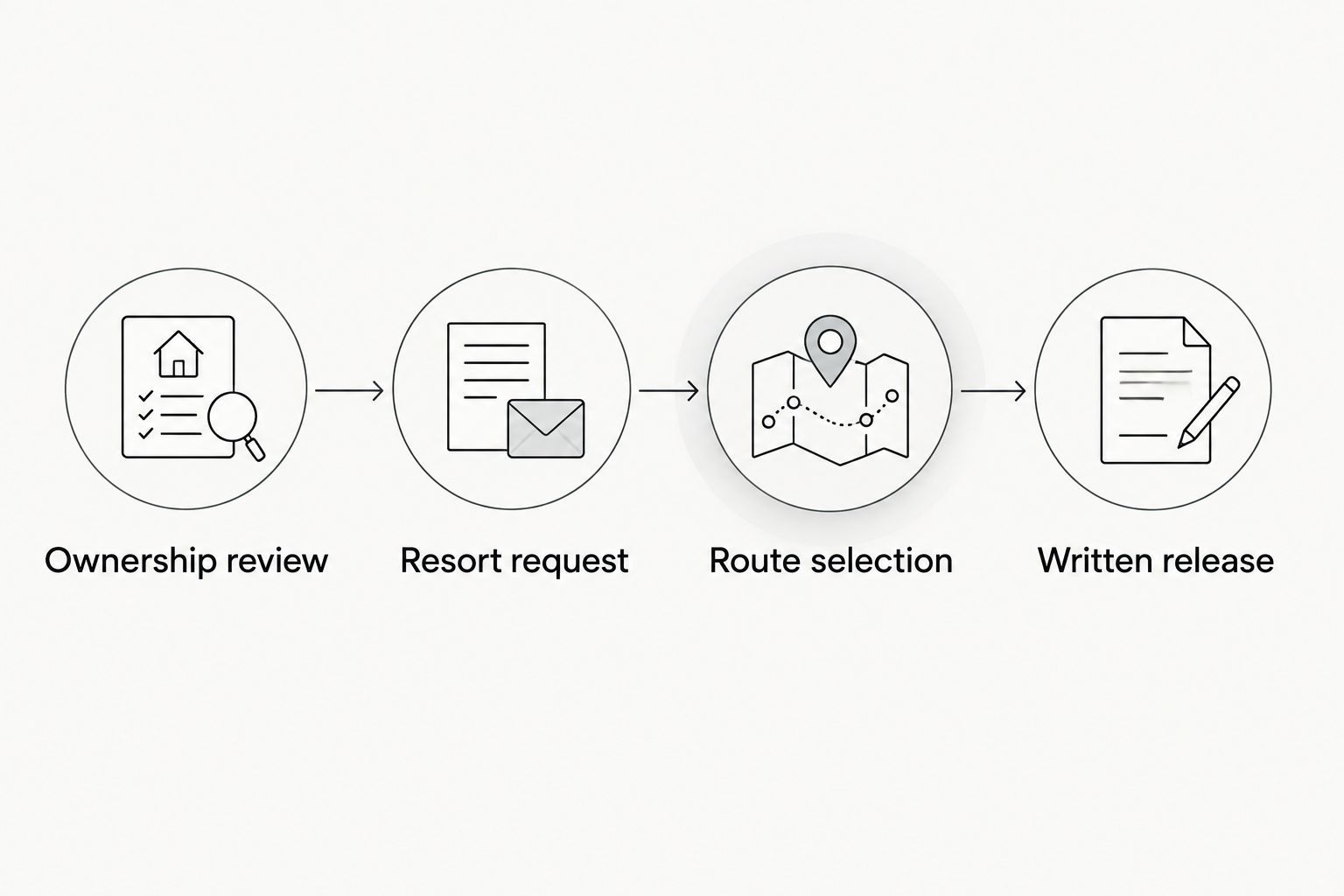
Compare the main exit options
Choose an exit route by the result it can document. The best fit depends on your agreement, financing, resort requirements, and whether you need help resolving a dispute. No route below establishes automatic eligibility based on disability.
| Option | Best for | Main advantage | Key limitation |
|---|---|---|---|
| Direct resort surrender or hardship request | Owners seeking a resort-approved return | Establishes the resort's requirements directly | Acceptance depends on the resort's rules and review |
| Resale | Owners whose interests can be transferred to a buyer | Creates a route to transfer ownership | Requires a buyer and completion of applicable transfer requirements |
| Resale or exit assistance | Owners needing help assessing and pursuing a route | Provides support beyond handling every step yourself | Service scope is not proof of a completed release |
| Attorney-led review | Owners facing disputed rights, cancellation questions, or alleged misconduct | Provides legal advice about the specific agreement and dispute | Legal representation does not guarantee termination |
| Contract rescission | Recent purchasers with an applicable cancellation right | Uses the cancellation process applicable to the purchase | Eligibility, deadlines, and notice requirements must be checked promptly |
Ask Sold My Timeshare how its resale or exit assistance applies to your ownership before choosing a service. Keep the resort's written response and your ownership summary available so the discussion addresses your actual situation.
Request a timeshare valuation
Get a free, no-obligation valuation and discuss resale or exit assistance.
Common mistakes owners with disabilities make
Treating a medical letter as a cancellation document
Medical evidence can explain a hardship request. It does not establish that the resort accepted termination. Ask for a separate written decision that identifies the ownership and the effect on your obligations.
Sending an entire medical file immediately
Start by asking what evidence the reviewer requires. Send information through the verified process, and keep a record of what you disclosed. Do not let an unfamiliar caller's request replace that check.
Letting a helper sign without confirmed authority
A relative who helps you read correspondence is not necessarily authorized to sign ownership documents. Confirm the required authority before the transaction reaches the signature stage.
Confusing inaccessible travel with an automatic release
An accessibility problem deserves a documented response, but the requested accommodation and the requested ownership exit are separate matters. State both clearly if you want both reviewed.
Stopping payments because someone promises an exit
An exit proposal is not proof that your obligations have changed. Before changing payments, obtain advice about your agreement and written confirmation of any arrangement you accept.
FAQ
Can I exit my timeshare because I have a disability?
A disability can support a hardship request, but it does not automatically establish a right to cancel your timeshare. Check your agreement, ask the resort about its criteria, and obtain advice about any disputed rights.
What's the best first step for a disabled timeshare owner?
Gather your ownership agreement and current account documents, then request the resort's written surrender or hardship criteria. Ask for a communication format you can use before submitting sensitive information.
Does the ADA automatically cancel a timeshare contract?
The Americans with Disabilities Act does not create a general automatic right to cancel a timeshare contract because an owner has a disability. Accessibility rights and contract cancellation are separate questions that require review of the facts.
Do I need to send my full medical history to request an exit?
Do not send your full medical history without first asking what documentation the reviewer needs. Request a verified submission method and disclose information relevant to the stated review criteria.
Can my caregiver handle my timeshare exit for me?
A caregiver can help with the process, but authority to discuss an account and authority to sign documents are different. Ask the resort what authorization it requires and have signing authority checked when necessary.
Is resort surrender better than selling my timeshare?
An accepted surrender fits owners seeking a return to the resort, while resale fits ownership that can transfer to a buyer. Compare eligibility and completion requirements before choosing either route.
Can Sold My Timeshare help me understand my options?
Sold My Timeshare provides free, no-obligation timeshare valuations and resale/exit assistance. Ask how the assistance applies to your ownership and what written evidence will establish completion.
One last thing
Make the finish line specific before you start. For your 2026 exit file, write down which documents will establish that ownership, resort obligations, and any financing have been addressed. That simple step keeps an encouraging update from being mistaken for a completed exit.