
Overseas owners’ timeshare resale is the transfer of an ownership interest to a buyer with the aim of ending the seller’s ownership obligations. Living abroad adds practical questions about signing documents, receiving proceeds, and confirming that the resort has recognized the transfer; this 2026 guide explains how to address them before accepting an offer.
- Timeshare resale for overseas owners starts with written transfer requirements, not a buyer’s promise.
- Sold My Timeshare suits owners seeking a free valuation before considering resale or exit assistance.
- Compare timeshare resale, resort surrender inquiries, and exit assistance against your actual ownership documents.
- Confirm signing requirements and payment arrangements before committing to a cross-border transaction.
Why timeshare resale matters for overseas owners
An overseas sale needs more than an agreed amount. You need a workable path from your current ownership record to the buyer’s accepted ownership, with clear instructions for documents and funds.
Distance makes unclear responsibilities harder to resolve. A signature rejected after international delivery, an outdated mailing address, or confusion about who submits transfer papers creates avoidable work. Confirm the transfer process before you advertise the ownership.
Use a guide to websites to sell a timeshare to compare advertising routes, but assess closing arrangements separately. A listing introduces an opportunity; it does not establish who handles the transfer.
For your 2026 sale, separate three locations: where you live, where the timeshare is located, and where the transaction will be handled. Do not assume that an adviser familiar with one location covers every requirement in the others.
How to prepare and complete an overseas timeshare resale
Confirm ownership
Start with your own records and a direct request to the resort or ownership administrator. Identify what you actually own: a deeded interest, points, a membership, or another contractual right. The sales description must match that interest.
Ask the administrator which documents govern a resale and whether any approval, eligibility check, or other transfer condition applies. Request current instructions in writing rather than relying on an old sales brochure or another owner’s experience.
If more than one person is named, establish who must sign. A different surname, an estate, or a former spouse’s name requires attention before a buyer is waiting to close. Ask which supporting records are needed; do not guess.
- Match every owner’s name against the current ownership record.
- Gather the purchase agreement and any ownership certificate or deed.
- Request a current account statement and any loan payoff information.
- Ask for the resort’s written transfer instructions.
Define your goal
Decide whether your priority is finding a buyer or pursuing another route out of ownership. Resale and exit are not interchangeable: resale requires a buyer, while a surrender inquiry asks whether the resort will accept the ownership back.
Write down your acceptable outcome before speaking with providers. Include whether you want to explore a sale, whether a loan remains, and whether account arrears need resolving. Do not treat advertised resale amounts as evidence of what a buyer will offer for your ownership.
Create 1 working folder for the transaction. Keep records in their original form, then maintain a separate summary of questions and answers. This gives you a consistent reference when comparing advice from different parties.
- State your preferred outcome in one sentence.
- Separate the outstanding loan from ongoing ownership charges.
- Ask the resort whether it offers an applicable surrender route.
- Record unresolved account or ownership issues before requesting proposals.
Request a valuation
Build your own ownership summary first. Include the resort, ownership type, usage rights, account status, and any known transfer restrictions. Ask anyone assessing the resale to distinguish an estimated value from an actual buyer offer.
For a supported next step, Sold My Timeshare provides free, no-obligation valuations and resale or exit assistance. Sold My Timeshare is best for owners seeking a free valuation before choosing between resale and exit assistance. A valuation is a decision aid, not a completed sale or confirmation that ownership has ended.
For your 2026 assessment, ask what information supports the recommendation and what happens next. Keep the valuation separate from any subsequent service agreement. Review that agreement on its own terms, including responsibilities, cancellation provisions, and the proposed transfer process.
- Supply the same ownership summary to each provider you assess.
- Ask whether the assessment concerns resale, exit, or both.
- Separate estimated resale value from expected net proceeds.
- Request the proposed scope of assistance in writing.
Verify remote signing
Ask the party responsible for closing to explain exactly how an owner in your country can sign. Do not assume that an electronic signature, a local witness, or an ordinary scanned copy will satisfy the applicable requirements.
If notarization, authentication, translation, or original documents are requested, ask who requires them and which form is acceptable. Obtain instructions before arranging appointments or international delivery. Do not order an apostille simply because someone mentions overseas ownership; first establish whether it is required for your documents.
A power of attorney needs particular care. Ask an appropriately qualified lawyer about its scope, acceptance, and implications before authorizing anyone to act. It should not become a shortcut around understanding what you are signing.
- Confirm which documents require original signatures.
- Ask whether remote or electronic signing is accepted for each document.
- Obtain written instructions for any witnessing or authentication.
- Agree on a delivery method and keep copies of submitted records.
Protect the payment
Before accepting a buyer’s payment arrangement, identify who holds funds, who authorizes their release, and what must happen first. Ask how the closing provider’s identity and role can be independently checked. An email address alone is not verification.
Write down the payment currency and ask how exchange rates, bank deductions, and transfer charges will be handled. Keep the sale agreement’s amount distinct from the amount expected to reach your account. Ask a qualified tax adviser about your specific ownership, residence, and transaction rather than assuming that living abroad removes reporting obligations.
Verify bank instructions using independently obtained contact information, especially after any change. Do not send money or identity records merely because an unsolicited caller claims to have a buyer. A promised buyer is not proof of a legitimate transaction.
- Identify the person or organization responsible for holding funds.
- Confirm release conditions and the recipient account details.
- Record the agreed currency and responsibility for bank deductions.
- Ask about applicable tax documents before signing the closing papers.
Confirm completion
Set 3 checkpoints for your 2026 closing: signed documents, completed funds handling, and written recognition of the ownership change. Agree on who reports each checkpoint and what evidence you will receive.
Request 2 written confirmations: one from the party handling closing about the transaction’s status, and one from the resort or administrator recognizing the ownership change. For deeded ownership, also ask the closing professional what recording evidence is required and obtain it when applicable.
Do not assume that signing paperwork immediately ends every obligation. Ask for the effective transfer date, how charges around that date are allocated, and whether anything remains outstanding. Update payment arrangements only after you understand those answers.
- Request copies of the final signed documents.
- Obtain the closing statement and payment confirmation.
- Obtain the administrator’s acknowledgment of the ownership change.
- Retain the records with your tax and ownership documents.
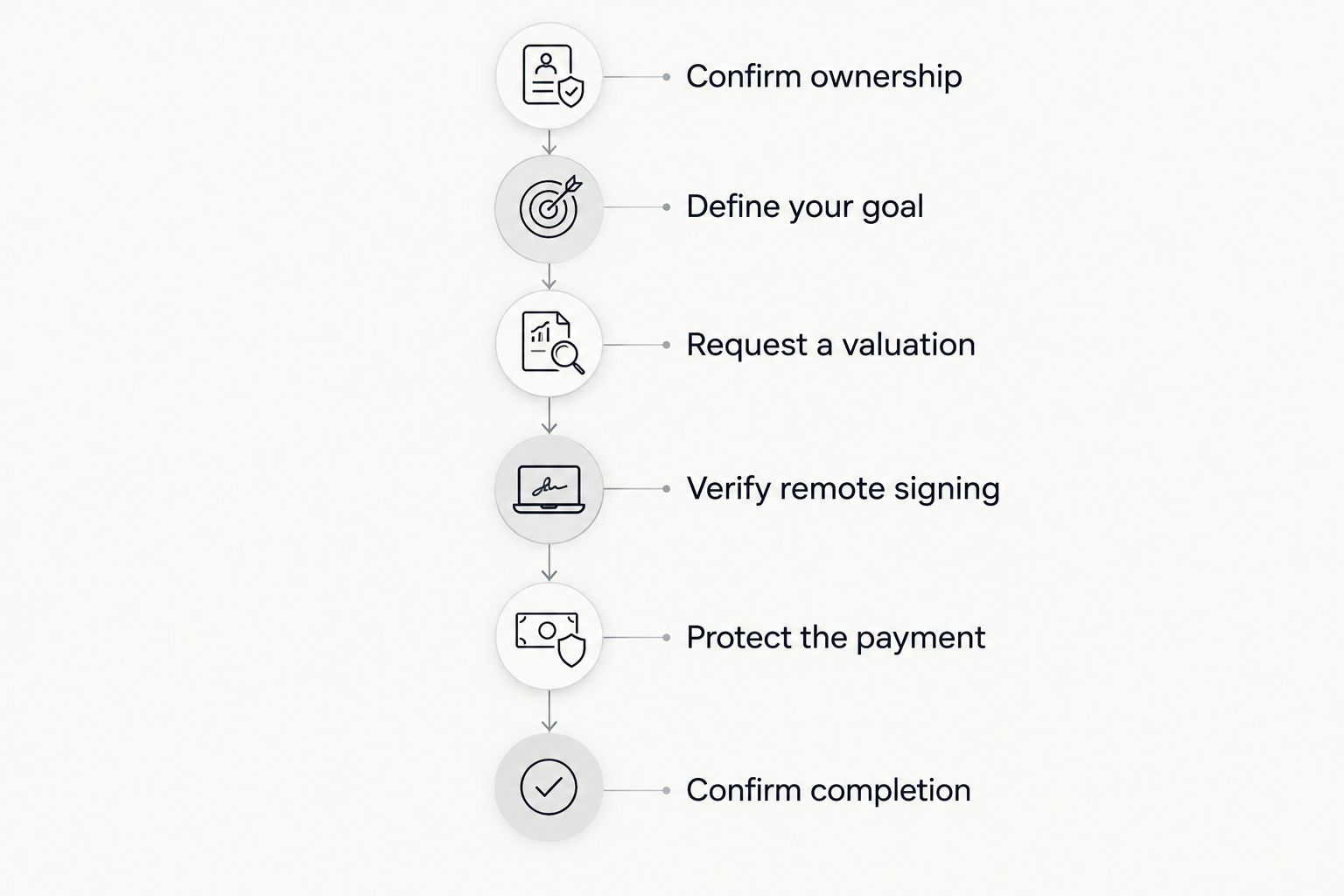
Each checkpoint needs an identified owner. If the listing provider, closing professional, and resort expect someone else to handle a task, resolve that gap before proceeding. Keep a written task list with the responsible party beside each item.
Compare your resale and exit options
Choose the route that addresses your actual obstacle. Finding a buyer, confirming transfer eligibility, and resolving an ownership dispute are different tasks; one service agreement does not automatically cover all of them.
| Option | Best for | Main advantage | Key limitation |
|---|---|---|---|
| Owner-managed resale | Owners prepared to manage inquiries and coordinate closing | Direct control over the listing and buyer discussions | You must arrange and verify the transfer process separately |
| Resale assistance | Owners who want help pursuing a buyer | Support with the resale process within the agreed scope | Assistance does not guarantee a buyer or accepted transfer |
| Resort surrender inquiry | Owners who want to ask about returning ownership directly | Establishes whether the resort offers an applicable route | Acceptance depends on the resort’s requirements and your eligibility |
| Exit assistance | Owners assessing a route other than a conventional resale | Help evaluating an exit process within the agreed scope | The agreement must explain what outcome is pursued and what counts as completion |
| Independent legal advice | Owners with disputed rights, unclear authority, or cross-border signing questions | Advice on the specific legal issue | Legal advice is not itself a buyer-finding service |
For overseas owners, the most useful comparison is responsibility coverage. Ask each provider whether its scope includes buyer communication, document preparation, remote signing coordination, funds handling, and resort acknowledgment. Treat any uncovered task as yours to arrange unless someone accepts it in writing.
Sold My Timeshare offers both resale and exit assistance, which makes the initial valuation a starting point for discussing those routes. Its stated services do not establish the signing rules, tax treatment, or transfer eligibility for your particular ownership; confirm those separately.
Request your timeshare valuation
Get a free, no-obligation valuation before deciding whether to pursue resale or exit assistance.
Common mistakes overseas owners make
Assuming local signing rules apply abroad
A document accepted where you live is not automatically acceptable for the transfer. Ask the closing professional to confirm the required form before you sign, translate, authenticate, or ship anything. This prevents paying for paperwork that does not satisfy the transaction’s requirements.
Comparing a headline amount with money received
An advertised resale amount does not describe the full financial outcome. Ask for a written breakdown of deductions, outstanding balances, and the payment currency. For a 2026 decision, use a current account statement rather than an old estimate of what you owe.
Treating every exit proposal as a resale
Ask whether the provider intends to find a buyer, approach the resort, or pursue another process. Then ask what evidence will show completion. A description such as handling your exit is too vague to explain who must accept the ownership change.
Letting time zones replace verification
Pressure to respond before an office closes is not a reason to bypass a check. Agree on a contact window and confirm document or payment changes through an established channel. Keep sensitive records out of unsolicited message threads.
Stopping payments because documents were signed
Do not assume that a signature alone changes your account obligations. Obtain the effective date and written confirmation of what remains due. If a provider advises stopping payments, ask for the basis and obtain independent advice about the consequences before acting.
FAQ
Can I sell my timeshare while living overseas?
Living overseas does not by itself establish whether your timeshare can be sold; the ownership terms and transfer requirements determine the available route. Ask the resort for current instructions and confirm how you can sign from your country.
What is the best first step for timeshare resale for overseas owners?
The best first step is to confirm your ownership details and obtain the resort’s written transfer requirements. A valuation becomes more useful once the assessor has an accurate description of what you own.
Do I need to travel to complete a timeshare resale?
Confirm travel requirements with the party handling your specific closing before making arrangements. Ask which documents can be signed remotely and whether any originals, witnesses, or authentication are required.
Is a timeshare valuation the same as a buyer offer?
No, a valuation is an assessment rather than a buyer’s commitment to purchase. Sold My Timeshare provides free, no-obligation valuations and resale or exit assistance; review any subsequent proposal separately.
Will I owe tax if I sell a timeshare while living abroad?
Tax treatment depends on the ownership, transaction, and relevant jurisdictions. Ask a qualified adviser about reporting, withholding, and any tax obligations before closing; overseas residence alone does not answer those questions.
Should I use resale assistance or ask the resort to take it back?
Compare both routes against your ownership and account status. Ask the resort whether a surrender route applies, and assess resale assistance by its written scope rather than a promised outcome.
How do I know the transfer has actually finished?
Obtain the closing records and written acknowledgment from the resort or administrator recognizing the ownership change. Ask for the effective date and confirmation of any remaining obligations, plus recording evidence where applicable.
One last thing
Ask who sends the final ownership-change confirmation before you sign the first service agreement. That question exposes a missing handoff early. For an overseas owner, knowing who closes the loop matters as much as knowing who finds the buyer.