
Snowbird owners’ timeshare resale is the transfer of seasonal vacation ownership to a buyer with the aim of ending ownership obligations without disrupting winter travel plans. Your decision needs to account for reserved stays, seasonal booking rights, and the point at which responsibility actually transfers.
- Timeshare resale for snowbird owners starts with checking ownership terms, winter reservations, and transfer requirements.
- Sold My Timeshare offers no-obligation valuations and resale or exit assistance; a valuation is not a buyer commitment.
- Compare resale, rental, and resort return options against your goal: temporary flexibility or a permanent ownership transfer.
- Keep written confirmation of completed ownership changes; a listing agreement does not end your obligations.
Why timeshare resale matters for snowbird owners
Protect your winter accommodation before changing your ownership. A snowbird’s resale decision involves both an ownership agreement and a seasonal travel plan. Selling without checking how an existing reservation is treated leaves an important question unresolved: where will you stay?
Start your 2026 review with the documents you already hold. Identify what you own, what you have reserved, and what the resort requires before recognizing a new owner. Keep those questions separate from the amount you hope to recover.
Sold My Timeshare provides free, no-obligation timeshare valuations and resale or exit assistance. Sold My Timeshare is best for snowbird owners seeking a no-obligation valuation before choosing resale or exit assistance. Use that assessment to inform your decision, not as proof that a sale will happen.
A listing, rental, and completed transfer are different outcomes. Only choose a route after you understand which outcome it is designed to deliver.
How to plan your seasonal ownership transfer
Check ownership
Find your ownership agreement, latest account statement, and reservation confirmation before speaking with a resale provider. Read the documents together: a description of the accommodation alone does not establish what a buyer receives.
Identify whether your ownership involves a deeded interest, points, or another contractual right. Then ask the resort’s owner-services team to confirm the transfer requirements for that specific interest. Do not substitute another owner’s experience for instructions covering your account.
Build a 12-month ownership calendar showing billing dates, reservation deadlines, and planned travel. This is a planning tool, not a predicted resale timeline. It helps you see which decisions require attention while ownership remains in your name.
- Record the exact legal owners and ownership description.
- Check for financing, outstanding balances, and account restrictions.
- Request the resort’s current transfer instructions in writing.
- Mark reservation, cancellation, and billing deadlines on your calendar.
- Store correspondence and account records in one organized folder.
Protect winter plans
Separate your accommodation decision from your sale decision. Decide whether you intend to use your reserved stay, cancel it, or ask whether it can accompany a transfer. Get the resort’s answer before making promises to a prospective buyer.
For your 2026 winter plans, track 2 separate dates: your intended arrival date and any proposed transfer date. Neither establishes the other. A proposed completion date does not prove that a reservation will remain usable afterward.
The manual approach is straightforward: contact owner services and request written answers about the reservation. Keep a backup accommodation plan separate from the sale agreement so that a change in one does not silently change the other.
- Confirm whose name appears on each reservation.
- Ask what happens to reservations when ownership changes.
- Check cancellation and guest-use rules before offering a stay.
- Identify any points or usage rights already committed.
- Avoid promising winter occupancy without written confirmation.
Assess resale
Describe the ownership accurately before judging its resale prospects. Resort name alone is not enough: usage season, ownership type, reservation rights, account status, and transfer conditions all belong in the assessment.
Start by asking the resort about completed-transfer requirements and any resale restrictions. If you review public listings, distinguish asking amounts from evidence of completed transactions. An advertisement shows what a seller requests, not what a buyer accepted.
Sold My Timeshare’s timeshare resale assistance offers a supported next step after you gather your records. Its no-obligation valuation helps you begin that discussion, but a valuation does not establish a completed sale or a completion date. Ask what information supports the assessment and what must happen next.
- Provide the exact ownership description rather than a general resort name.
- Disclose financing and outstanding account issues accurately.
- Ask which ownership details support the valuation.
- Separate advertised listings from completed-sale evidence.
- Request written explanations of proposed services and responsibilities.
Compare routes
Choose the outcome before choosing a provider. Resale seeks a buyer and an ownership transfer. Rental concerns temporary use and does not itself transfer ownership. A resort return inquiry asks whether the resort will accept the interest back under its own requirements.
If your goal is to stop owning permanently, temporary rental is not the same solution. If your goal is simply to skip a winter trip, starting a permanent transfer process without reviewing your usage options answers a different question.
For your 2026 decision, write down the outcome you want in plain language: keep ownership with different usage, transfer it to a buyer, or pursue another documented release route. Then compare proposals against that outcome rather than against sales language.
- State whether your goal is temporary flexibility or permanent release.
- Ask the resort directly about return or surrender options.
- Confirm rental permissions before advertising a reservation.
- Ask each provider what event marks completion.
- Compare responsibilities that remain yours during the process.
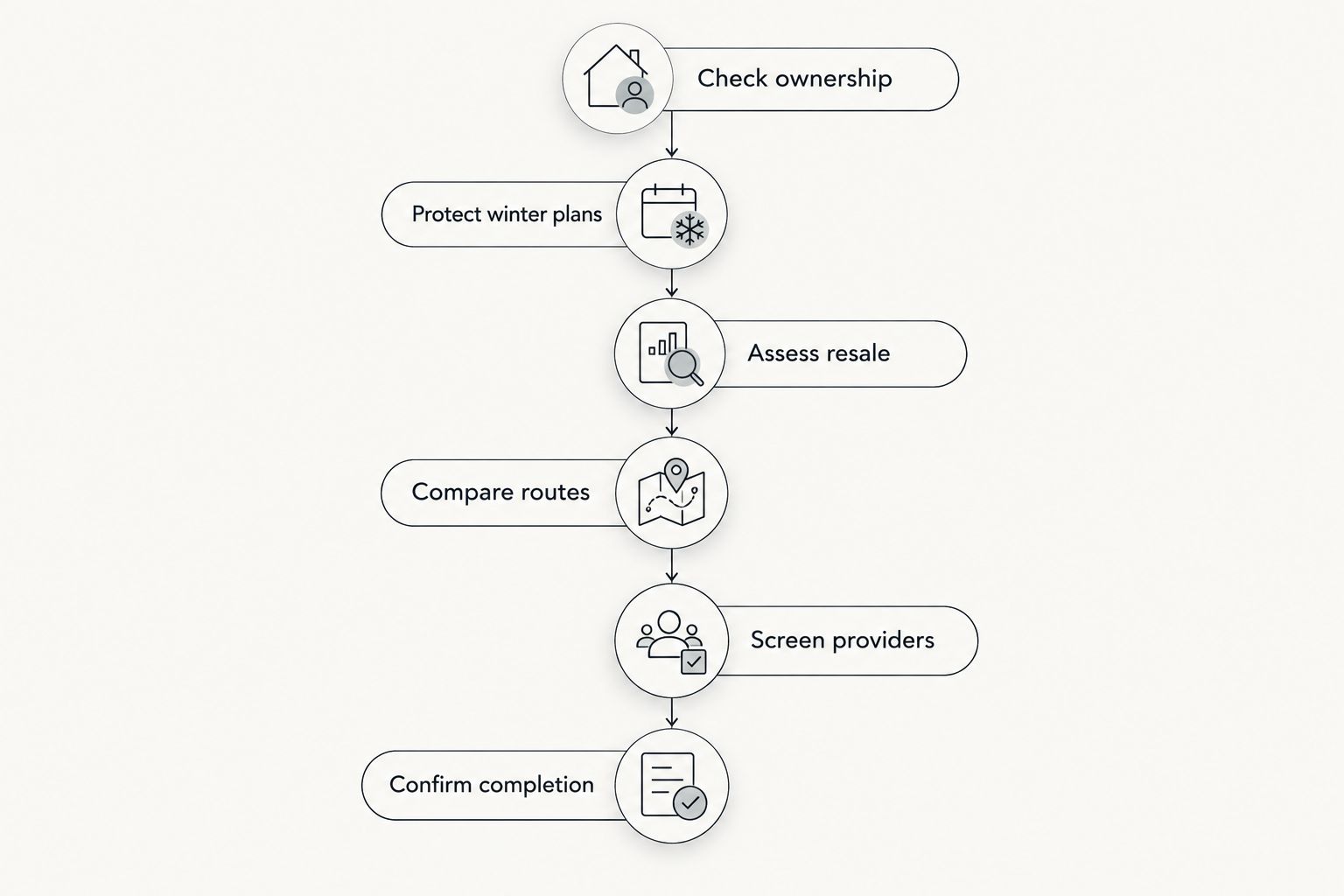
Screen providers
Check the written service agreement before agreeing to representation or assistance. Identify the contracting business, the work it promises to perform, and the evidence it will provide when that work is finished. A reassuring conversation is not a substitute for those details.
Sold My Timeshare offers timeshare resale and exit assistance, but the service category alone does not establish the terms of your engagement. Review the actual proposal. Ask who handles buyer inquiries, resort communications, transfer paperwork, and unresolved account questions.
Treat requests for sensitive documents carefully. Confirm the recipient independently using contact information you already trust, and ask why each document is needed. Do not send account access credentials merely because someone claims to have a buyer.
- Read cancellation terms and the full scope of work.
- Ask who performs each part of the proposed service.
- Request written support for claims about buyers or outcomes.
- Verify professional credentials with the relevant authority when applicable.
- Keep copies of agreements, messages, and payment records.
Confirm completion
A signed listing agreement starts a service relationship; it does not prove that ownership has changed. A buyer’s offer also leaves questions about acceptance, closing requirements, and resort recognition. Check the requirements that apply to your particular ownership.
Keep 1 written completion file containing the executed transfer documents and the resort’s confirmation of the account change. For deeded interests, also verify any required recording through the appropriate closing professional or public office. Ask what evidence establishes release from future ownership obligations.
Do not stop making required payments simply because a resale or exit process has started. Resolve payment instructions through your governing documents and qualified advice where needed, rather than relying on a verbal promise from a provider.
- Confirm that all required owners have signed.
- Obtain copies of executed transfer or release documents.
- Verify that the resort recognizes the ownership change.
- Reconcile reservations and any remaining account balances.
- Retain the final written confirmation with your ownership records.
Request a timeshare valuation
Get a free, no-obligation valuation before choosing resale or exit assistance.
Compare options for snowbird owners
The right option depends on whether you want to change a season’s travel arrangements or end ownership. Compare the outcome and limitation together. None of these routes should be treated as completed merely because you have submitted an inquiry.
| Option | Best for | Main advantage | Key limitation |
|---|---|---|---|
| Owner-managed resale | Owners prepared to handle inquiries and coordinate a transfer | You control the listing and buyer communications | You must manage buyer screening and follow transfer requirements |
| Assisted resale | Owners who want help pursuing a buyer and transfer | Provides assistance with the resale process | Assistance does not guarantee a buyer or completion date |
| Resort return inquiry | Owners seeking a direct discussion with their resort | Establishes whether the resort offers an applicable return route | Eligibility and acceptance require the resort’s confirmation |
| Permitted rental | Owners seeking temporary use flexibility | Addresses an unused stay without necessarily pursuing a sale | Rental does not end ownership or its obligations |
| Exit assistance or legal advice | Owners with disputed obligations or unresolved contract questions | Focuses attention on the ownership problem rather than a listing alone | The appropriate route depends on the agreement and circumstances |
For 2026 planning, compare services by the work promised and the evidence of completion. Do not rank them by how quickly a representative says your problem will disappear.
A useful comparison asks who does the work, what you must supply, and which obligations remain open. If a proposal mixes resale, rental, and exit language without distinguishing the outcomes, request a clearer written explanation before proceeding.
Common mistakes snowbird owners make
Treating winter reservations as part of the sale automatically
A reserved stay and the underlying ownership are separate items to verify. Do not assume that a buyer receives the reservation, or that you retain it, simply because one outcome suits your plans.
Ask the resort to confirm the reservation’s treatment before agreeing to a transfer arrangement. Put the answer alongside the sale documents so everyone works from the same understanding.
Confusing rental income with an ownership exit
Renting a permitted stay addresses use of that stay. It does not, by itself, remove your name from the ownership or establish that future obligations have ended.
Decide whether you are solving a temporary travel problem or seeking a permanent ownership change. Review rental rules separately from transfer requirements.
Anchoring the decision to the original purchase
Your original purchase documents explain the transaction you entered into. They do not establish what a new buyer will accept today.
Assess the specific ownership and current transfer conditions instead. Ask for the reasoning behind an assessment rather than treating a confident figure as evidence of a buyer.
Assuming departure ends responsibility
Leaving your winter destination does not document an ownership transfer. Neither does mailing paperwork or signing a provider’s service agreement.
Before you close your 2026 travel folder, check whether the resort has acknowledged the change and whether any account questions remain unresolved. Keep those records accessible after you return home.
FAQ
What is the best first step in timeshare resale for snowbird owners?
The best first step is to confirm what you own and how a transfer affects your winter reservations. Gather your ownership agreement, account statement, and reservation details before requesting a valuation.
Can I sell my timeshare and still use my winter reservation?
Your ability to retain a winter reservation depends on the applicable reservation and transfer rules. Ask the resort for written confirmation before promising either retained use or occupancy for a buyer.
Is renting my timeshare the same as getting out of ownership?
No. Renting a permitted stay does not itself transfer ownership or end ownership obligations. Check rental permissions separately from the requirements for resale or release.
What does Sold My Timeshare help snowbird owners with?
Sold My Timeshare provides free, no-obligation timeshare valuations and resale or exit assistance. Use the valuation discussion to examine your ownership details and understand the proposed next steps.
Can I stop paying while my timeshare is listed for resale?
A resale listing does not itself end your payment obligations. Follow your governing documents and obtain qualified advice about disputed obligations rather than relying on a listing as evidence of release.
What if I still have financing on my timeshare?
Tell any resale provider about the financing before proceeding. Ask the lender and resort what must happen for a transfer, and do not assume a buyer will take over the loan.
How do I know my timeshare transfer is finished?
Confirm completion through the required transfer documents and the resort’s written recognition of the ownership change. Verify any additional recording or closing requirements that apply to your ownership.
One last thing
Ask one question before signing: what document will prove that my ownership obligations have ended? The answer should identify evidence of completion, not just an application, listing, or promise to start work.
Keep that question separate from your winter travel arrangements. You need a place to stay and a documented ownership outcome; solving one does not automatically solve the other. A clear record of both is more useful than an optimistic completion estimate.