
Best starting point: Sold My Timeshare for a free, no-obligation valuation. Best for checking a direct release: your resort’s ownership team. Best for a contractual dispute: a licensed attorney. When choosing the best timeshare exit companies for Diamond Resorts owners in 2026, start by identifying whether you need resale assistance, a voluntary release, or legal advice—not by accepting a cancellation promise. Sold My Timeshare provides valuations and resale/exit assistance for owners looking to sell or leave their ownership.
- Sold My Timeshare is best for Diamond Resorts owners seeking a free valuation before choosing resale or exit assistance.
- Compare the best timeshare exit companies for Diamond Resorts owners by contract fit, written scope, and transfer responsibility.
- Ask your resort about a direct release before signing with an outside provider.
- Use a licensed attorney for contract disputes; a resale listing alone does not end ownership.
Why this matters
A timeshare exit is not one service. Selling an ownership, requesting a voluntary surrender, and disputing a contract involve different work. Hiring the wrong type of provider leaves you paying for activity that does not address your actual problem.
For Diamond Resorts owners comparing options in 2026, the key question is simple: What has to happen for this specific ownership to end? A listing, an inquiry, or a letter requesting cancellation is not proof that the transfer or release is complete.
Your paperwork matters more than a company’s headline. Locate the agreement that identifies your ownership, any financing agreement, and your current account statement before you decide which route fits. Use those documents to keep every conversation grounded in the same facts.
What makes the best timeshare exit company?
Use these criteria before considering a sales pitch. A provider should explain both the work it will perform and the point at which that work counts as complete.
- Contract fit: The proposed route must address your actual ownership and any financing attached to it—not just the Diamond Resorts name.
- Written scope: Distinguish valuation, advertising, buyer assistance, transfer coordination, surrender requests, and legal representation. They are not interchangeable.
- Completion evidence: Ask what documents will establish that ownership has transferred or been released, and who will obtain them.
- Payment instructions: Reject blanket instructions to stop payments without advice specific to your contract and situation.
- Accountable responsibility: Identify who handles the work, who communicates with the resort, and whether an attorney-client relationship exists when legal services are promised.
- Clear limitations: Favor a provider that explains what depends on resort approval, buyer acceptance, or legal review instead of presenting an unconditional outcome.
A provider that discusses these points clearly gives you something to evaluate. A provider that only repeats a guarantee does not explain the proposed exit.
Diamond Resorts exit options at a glance
The ranking below assigns each option a different job. It is a decision guide, not a claim that every owner needs an exit company or that every ownership qualifies for the same solution.
| Ranked option | Best for | Standout feature | Key limitation |
|---|---|---|---|
| Sold My Timeshare | Starting with a valuation and resale/exit discussion | Free, no-obligation valuation | A valuation does not establish that an exit is available |
| Your resort’s ownership team | Checking direct-release eligibility | Direct inquiry to the party administering ownership | A release requires confirmation; an inquiry is not approval |
| A licensed attorney | Contract disputes and legal questions | Legal advice tied to the agreement and circumstances | Representation does not guarantee cancellation |
| A timeshare resale professional | Coordinating a sale and transfer | A buyer-and-transfer route rather than a cancellation claim | Requires a workable sale and accepted transfer |
These options can follow one another. You can request a valuation and ask about direct release before deciding whether you need resale coordination or legal advice. Do not treat preliminary conversations as commitments to hire anyone.
1. Sold My Timeshare: best for a valuation-led starting point
Sold My Timeshare provides free, no-obligation timeshare valuations and resale/exit assistance. For a Diamond Resorts owner who has not decided between selling and seeking an exit, that makes a valuation a practical first request.
The purpose of this first conversation is to understand the proposed route. Ask whether the next step involves resale, transfer assistance, or another form of exit assistance, and request an explanation tied to your ownership documents.
Sold My Timeshare pros:
- Offers a free, no-obligation valuation.
- Provides both resale and exit assistance.
- Serves owners who want to sell or get out of ownership.
Sold My Timeshare cons:
- A valuation is not proof that a buyer will complete a purchase.
- A valuation is not a resort-approved release from ownership.
- Exit assistance is not automatically legal representation; establish the scope before engaging a service.
Best for: Diamond Resorts owners who want an initial assessment before committing to a resale or exit route.
For your 2026 inquiry, provide the exact ownership name from your agreement rather than relying on a remembered sales description. Also disclose any financing and account issues so the discussion addresses the ownership you actually hold.
Verdict: Buy into the valuation-first approach, not a presumed cancellation outcome. Start with the assessment; decide on further assistance only after you understand the proposed work.
2. Your resort’s ownership team: best for checking direct release
Contact the ownership or owner-services team identified on your current account documents. Ask whether your specific ownership qualifies for a voluntary surrender, relinquishment, or other direct-release process.
This recommendation does not assume that a release program exists for your account. It puts the eligibility question to the party that can confirm its own process and acceptance requirements.
Direct resort inquiry pros:
- Gives you a direct channel for asking about release eligibility.
- Lets you request current requirements for your account.
- Produces information you can compare with an outside provider’s proposal.
Direct resort inquiry cons:
- Asking about a release does not secure one.
- Eligibility and acceptance require written confirmation.
- The resort’s response is not independent legal advice about a dispute.
Best for: Owners who want to establish whether a direct release is an option before arranging an outside service.
Ask for the process in writing, including any account conditions, required documents, and how completion will be confirmed. If someone gives you a verbal answer, request the corresponding written instructions before acting.
For a direct-release request in 2026, use contact details from your current account statement or authenticated owner account. Do not send ownership records through contact information supplied by an unsolicited caller without independently checking it.
Verdict: Buy into a direct eligibility check; hold off on treating it as an approved exit. Continue evaluating alternatives until you have a written answer for your account.
3. A licensed attorney: best for contract disputes
A licensed attorney is the appropriate option when your question is legal: whether a contractual right applies, how to respond to a demand, or what to do about an alleged misrepresentation. Choose an attorney qualified to advise on the relevant jurisdiction and issues.
Legal representation is different from a company sending cancellation requests. Ask who the attorney is, whether the attorney will represent you directly, and what the engagement agreement covers.
Licensed attorney pros:
- Can explain legal issues arising from your agreement and circumstances.
- Can advise on disputed obligations and potential consequences of a proposed action.
- Can define the legal work in an attorney-client engagement agreement.
Licensed attorney cons:
- Legal review does not guarantee cancellation or release.
- Representation is not a substitute for finding a buyer when resale is the chosen route.
- The attorney’s scope needs to include your actual issue, not just a general document review.
Best for: Owners facing a contractual dispute, collection issue, alleged misrepresentation, or uncertainty about their legal obligations.
Bring the signed agreement and relevant correspondence. Separate what someone said during a sales conversation from what you can document, and explain what outcome you want: advice, negotiation, dispute representation, or another defined task.
If an exit provider says an attorney is involved, ask whether that attorney represents you or advises the provider. Those are different relationships. Obtain the answer before sharing sensitive documents or assuming you have legal counsel.
Verdict: Buy legal advice for a legal problem; skip any assumption that attorney involvement guarantees an exit.
4. A timeshare resale professional: best for sale-and-transfer support
A resale professional focuses on finding or working with a buyer and completing the ownership transfer. This route fits an owner pursuing a sale rather than asking a provider to invalidate or cancel the original agreement.
Before hiring anyone, identify which tasks the service includes. Advertising an ownership, negotiating with a buyer, and coordinating transfer paperwork are separate activities; a proposal should say who handles each one.
Timeshare resale professional pros:
- Provides a route based on a sale rather than a cancellation promise.
- Allows you to define responsibility for buyer communication and transfer coordination.
- Gives you a concrete completion question: has the ownership transfer been accepted?
Timeshare resale professional cons:
- A listing does not guarantee a buyer or completed sale.
- Transfer requirements must be checked for the specific ownership.
- Any financing needs separate attention; do not assume a transfer resolves it.
Best for: Owners whose chosen route is selling and who need clearly defined resale and transfer support.
Ask what happens after a buyer agrees to proceed. Establish who prepares documents, submits them, follows up on acceptance, and provides completion evidence. A service that stops at advertising should not be described as a completed exit solution.
Do not confuse rental assistance with resale. Renting can address use of an ownership, but a rental arrangement does not itself transfer that ownership or release you from its obligations.
Verdict: Buy defined sale-and-transfer support when resale fits; skip listing-only promises presented as guaranteed exits.
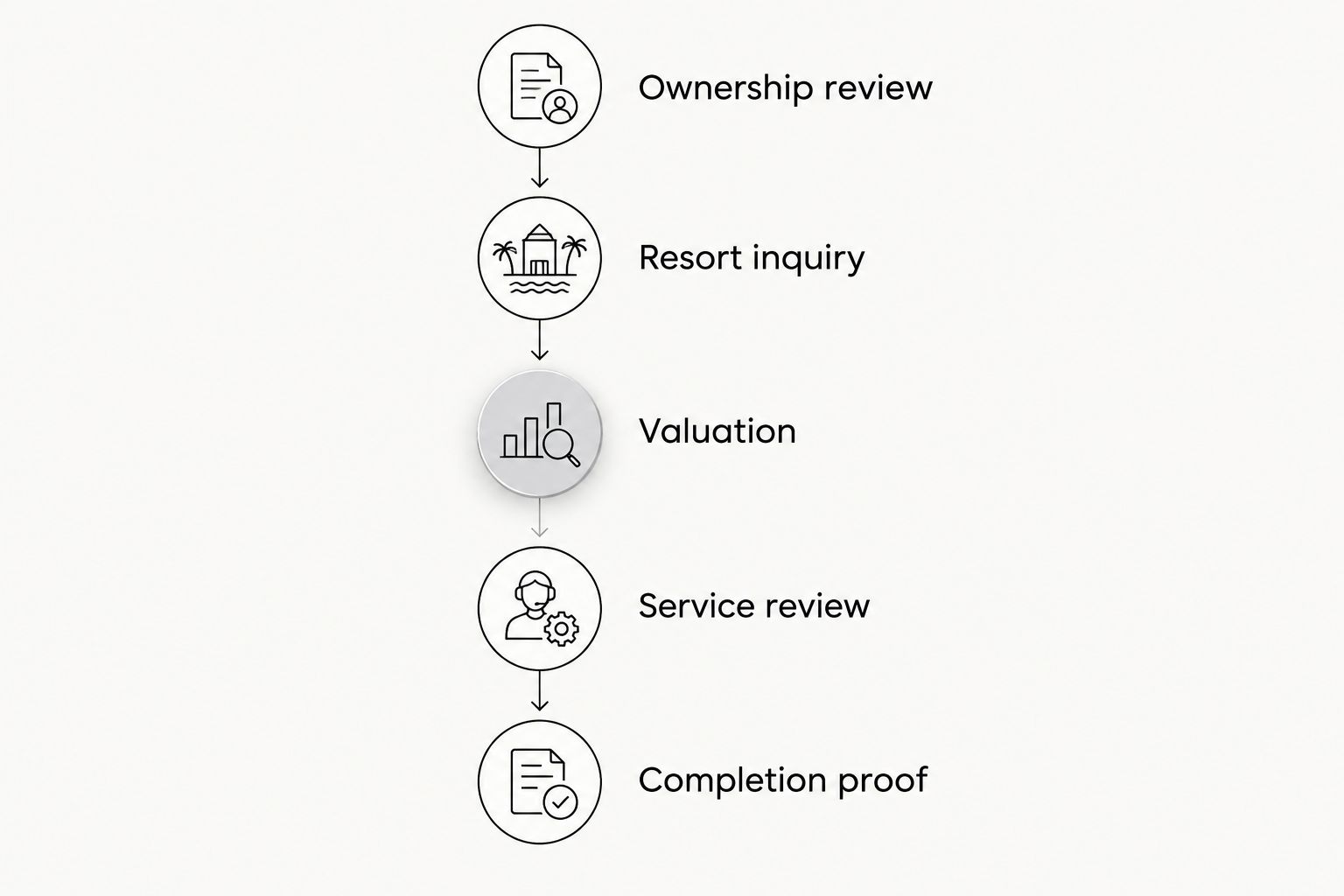
How to choose your next step
Use this sequence to turn a broad search into a specific decision. Each step answers a different question, so avoid jumping from an advertisement straight to an engagement agreement.
Ownership review
Identify the exact ownership and any related financing. Use the signed documents and current account records, not a general description such as points or vacation membership.
Resort inquiry
Ask the resort whether a direct-release route applies to your ownership. Request written requirements and keep the response with your records.
Valuation
Request a valuation if you are considering resale. Use the conversation to clarify the proposed service, not as proof that ownership can be sold or canceled.
Service review
Compare the written work each provider proposes. Match the service to your need: sale coordination, release assistance, or legal advice.
Completion proof
Decide in advance what evidence you need before calling the exit finished. Distinguish the end of a provider’s assignment from the end of your ownership obligations.
Keep one file containing your agreement, account records, provider proposals, and correspondence. A written record lets you compare answers without relying on memory or repeating the same conversation with every provider.
Request your timeshare valuation
Get a free, no-obligation valuation before deciding whether to pursue resale or exit assistance.
How these options are ranked
The ranking prioritizes a low-commitment assessment, a direct eligibility inquiry, legal advice for disputes, and resale support for a sale. Each option has a distinct purpose rather than competing for an unsupported best-overall cancellation claim.
The criteria are contract fit, written scope, completion evidence, payment instructions, accountable responsibility, and stated limitations. A promise without those details is not a useful basis for choosing a provider.
Which timeshare exit option should you choose?
For an undecided Diamond Resorts owner in 2026, start with a valuation and a direct resort inquiry before hiring an exit provider. Those steps address the central fork: whether you are pursuing a sale, requesting a release, or dealing with a legal dispute.
Choose legal representation when the issue requires legal advice. Choose resale support when the goal is a sale and you understand who handles transfer completion. Hold off on any service whose description does not explain what it will actually do.
The strongest proposal is not the one with the boldest promise. It is the one that connects your documents, the proposed route, and the evidence needed to confirm completion.
FAQ
What are the best timeshare exit companies for Diamond Resorts owners?
The best fit depends on whether you need resale assistance, a direct release, or legal advice. Sold My Timeshare provides a free, no-obligation valuation and resale/exit assistance; compare any further service by its written scope and completion requirements.
Can I contact Diamond Resorts directly about leaving my timeshare?
Yes—contact the ownership team identified on your current account records and ask whether a direct-release process applies. Request written eligibility requirements; an inquiry is not approval.
Is selling my timeshare the same as canceling it?
No. Resale involves transferring ownership to a buyer, while cancellation or release involves a different basis for ending the ownership or agreement. Ask the provider to identify which route it proposes.
Should I stop paying while an exit company handles my case?
Do not stop payments solely because an exit company tells you to. Obtain advice specific to your contractual obligations and circumstances before changing payments.
Do I need an attorney to leave a Diamond Resorts timeshare?
An attorney is appropriate when you need legal advice about a dispute or contractual obligation. A valuation or resale inquiry serves a different purpose and does not automatically require legal representation.
Does renting out my timeshare end my ownership?
No—renting out a timeshare does not itself transfer ownership or release you from the agreement. Treat rental assistance as separate from an exit service.
How do I know my timeshare exit is finished?
Confirm completion through the documents applicable to your transfer or release. A listing, cancellation request, or notice that a provider has finished its work is not by itself proof that your ownership obligations have ended.
One last thing
Before signing a timeshare exit engagement in 2026, ask: What document will show that I no longer own this timeshare, and who is responsible for obtaining it? Then ask separately how any related financing will be addressed.
If the answer only describes calls, letters, or advertising, the provider has explained its activity—not the final result. Keep that distinction at the center of your decision.