
A timeshare attorney’s fee depends on the work you hire the lawyer to do; there is no single fee that answers every owner’s situation in 2026. Get a written quote tied to a defined task, not a promise to get you out. The legal fee can exclude outside expenses, and hiring an attorney does not itself cancel your ownership, loan, or maintenance obligations.
- How much does a timeshare attorney cost? Compare written scopes and billing terms, not an unsupported average.
- An hourly fee, flat fee, and advance deposit describe different billing arrangements; ask what each covers.
- Sold My Timeshare offers timeshare valuations and resale/exit assistance for owners exploring their options.
- Hiring a lawyer does not itself release you from timeshare ownership or payment obligations.
Why this matters
You need to know what a lawyer will actually deliver before deciding whether the engagement makes sense. Reviewing a contract is different from negotiating a release or defending a lawsuit. A quote for one task does not tell you what another will require.
Sold My Timeshare provides no-obligation timeshare valuations and resale/exit assistance. That is an option to explore when your immediate question is whether to sell or seek an exit; legal advice serves a different purpose when you need advice about rights, deadlines, or disputes.
How much does a timeshare attorney cost?
The useful answer is the written fee agreement for your specific matter. For a 2026 attorney quote, identify the billing method, the work included, the expenses excluded, and the point at which additional authorization becomes necessary.
Compare the same assignment before comparing attorney quotes. Otherwise, a limited document review can appear more attractive than representation that includes negotiations simply because the deliverables differ.
| Billing arrangement | Best for | What it means | Main limitation to check |
|---|---|---|---|
| Hourly billing | Work with an uncertain scope | You pay for time spent under the agreement | The final total depends on work performed |
| Flat-fee billing | A clearly defined assignment | An agreed fee covers specified services | Additional work can fall outside the scope |
| Advance deposit | Funding work before it is performed | Money is paid ahead under the agreement’s terms | The deposit is not necessarily the final total |
An advance deposit is not automatically a separate billing method. A lawyer can request a deposit and then bill hourly against it. Ask the lawyer to explain any use of the word retainer, including what the payment buys and how unused funds are handled.
Separate legal work from outside expenses
Ask whether the engagement includes document review, communications with the resort, negotiations, preparation of agreements, and confirmation of the outcome. Do not assume that a general description such as timeshare cancellation includes every task.
Also ask about court filings, service of documents, recording, and other third-party expenses if those items apply. Those are distinct from the lawyer’s own work. Request written approval requirements before outside expenses are incurred.
Hourly billing: ask how the total is controlled
Hourly billing ties the fee to time spent. It suits an assignment whose scope cannot be settled at the start, but you need a way to monitor the work and authorize changes.
Ask who will handle the matter and how each person’s time is billed. Request an explanation of billing increments, communication charges, invoice frequency, and the circumstances that trigger another deposit.
Best for: an uncertain or changing legal assignment. The advantage is that the agreement can accommodate additional work. The drawback is that the final total is not fixed merely because the attorney gave an initial estimate.
For a 2026 hourly engagement, ask for a task-based estimate and a notification threshold. An estimate explains the lawyer’s expectations; a cap limits charges only if the agreement actually establishes one. Keep that distinction clear.
Flat-fee billing: define the finish line
A flat fee applies to a defined scope, not necessarily every problem connected with your timeshare. The agreement should identify the documents, advice, communications, or representation you will receive.
Ask what happens if the resort refuses the proposed resolution. Does the assignment end after a demand letter, continue through negotiations, or include reviewing a proposed release? Litigation should never be assumed to be included.
Best for: a discrete task with a clear endpoint. The advantage is clarity about the fee for that task. The drawback is that excluded work requires a separate arrangement, even when it concerns the same ownership.
A flat fee also does not guarantee a result. Separate the lawyer’s commitment to perform services from the outcome you hope the resort or another party will accept.
Advance deposits: understand what your payment covers
An advance payment can fund future work rather than settle the entire engagement. Read the agreement before treating the initial payment as the total commitment.
Ask how the payment will be held, when charges are applied, whether replenishment is required, and how the lawyer accounts for any unused balance. The answer depends on the agreement and applicable professional rules, not simply the label on the invoice.
Best for: funding an engagement whose billing terms are already clear. A deposit provides a starting balance, but it does not by itself establish a maximum fee. Ask directly whether you can owe more after that balance is used.
Why timeshare attorney fees vary
The assignment matters more than the label timeshare attorney. Discuss these factors before accepting a quote:
- Scope of work: Contract advice, negotiation, document preparation, and courtroom representation are different assignments.
- Dispute status: An unanswered ownership question requires different work from responding to a filed lawsuit.
- Loan obligations: Ownership and financing documents need separate attention when a loan remains outstanding.
- Parties involved: Multiple owners, lenders, or other parties create additional documents and communications to address.
- Applicable law: The attorney must identify which laws and procedures govern the issue.
- Your records: Missing agreements and incomplete correspondence must be located before the attorney can assess them.
These factors explain why quotes require context. They do not justify an unexplained total. Ask the attorney to connect the proposed work to your actual problem.
How do I compare attorney quotes without guessing?
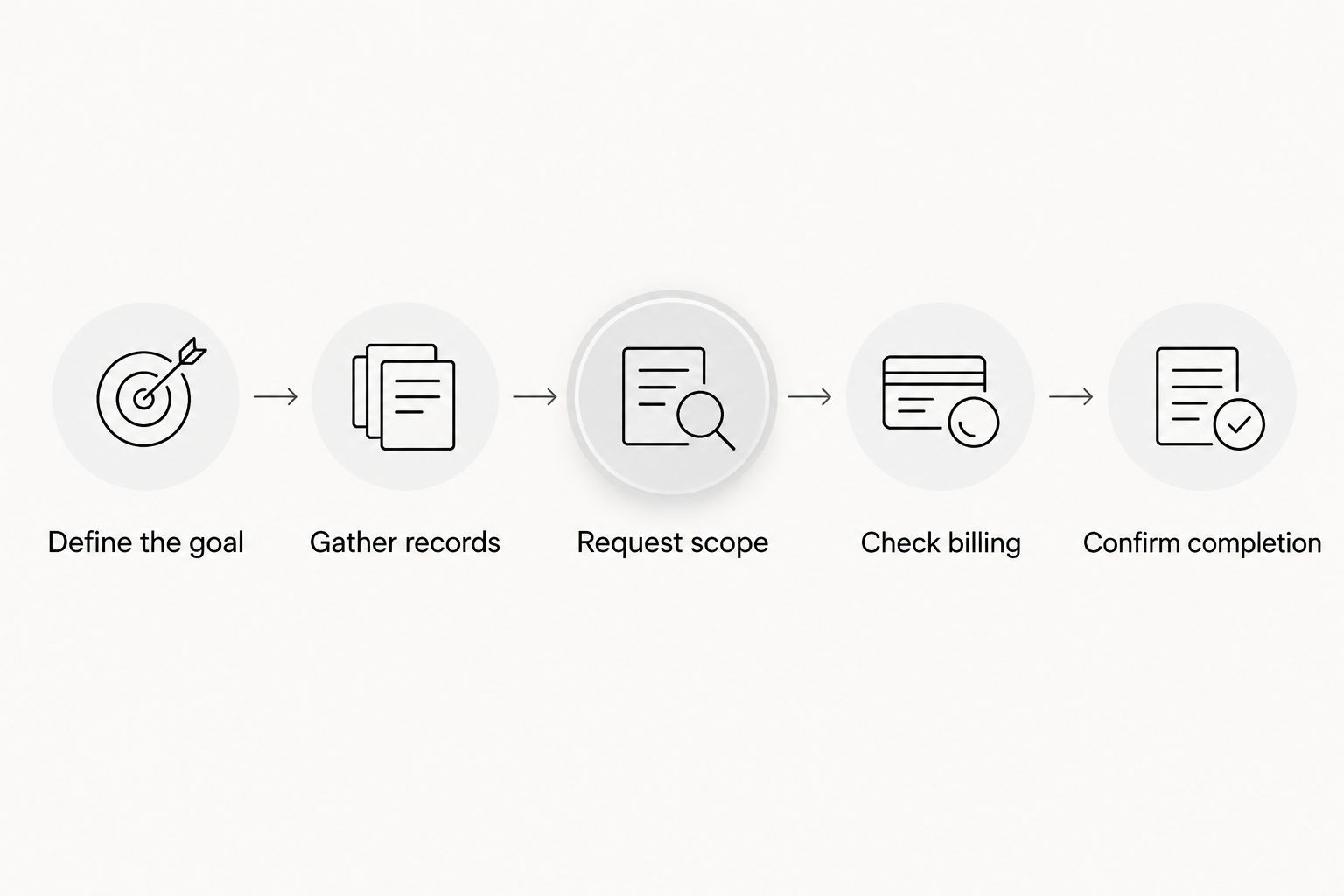
Use this 5-step process to compare the work being offered. Send the same basic documents and questions to each attorney so the responses address the same assignment.
- Define the goal. State whether you want contract advice, a negotiated release, help with a sale-related issue, or representation in a dispute.
- Gather records. Assemble the purchase agreement, ownership documents, financing papers, account statements, and relevant correspondence.
- Request scope. Ask for the deliverables, exclusions, responsible attorney, and endpoint of the engagement.
- Check billing. Confirm the billing method, deposit terms, outside expenses, and approval process for additional work.
- Confirm completion. Ask what documents will show the result and what obligations, if any, will remain.
Keep a copy of each proposal. If an explanation is only given by phone, ask for it in the engagement documents before signing. A clear conversation helps, but the written agreement defines what you are accepting.
Questions to ask during the consultation
Use these 3 questions to keep the discussion practical:
- What specific work will you perform under this agreement?
- What events require additional authorization or a new agreement?
- What written evidence will establish that the assignment is complete?
For a 2026 engagement, also ask the lawyer to identify any immediate deadline. Do not delay responding to formal legal papers while comparing service providers.
Do I need a lawyer, or should I explore resale first?
Choose the next step based on the problem you need to solve. Legal advice addresses your rights and exposure; a resale inquiry addresses whether transferring ownership through a sale is a route to investigate.
| Route | Best for | Useful purpose | Limitation |
|---|---|---|---|
| Attorney consultation | Contract questions, legal notices, or disputes | Advice about your legal position and available responses | Legal advice alone does not transfer ownership |
| Resort inquiry | Asking about an owner surrender or transfer process | Written information about the resort’s requirements | An inquiry is not an approved release |
| Resale assessment | Owners exploring a sale | Understanding the proposed resale route | An assessment does not establish a completed sale |
Sold My Timeshare is best for timeshare owners seeking a valuation and resale/exit assistance. That service is not a substitute for an attorney’s advice about a lawsuit, a disputed contract, or a legal deadline.
Before choosing a route, separate your desired outcome from the paperwork required to achieve it. A conversation about selling is not a transfer, and a request to surrender is not acceptance.
Request a timeshare valuation
Explore a no-obligation valuation and resale/exit assistance with Sold My Timeshare.
Does hiring a timeshare attorney stop maintenance fees?
Hiring a timeshare attorney does not itself stop maintenance fees or change your contract. Ask the attorney to explain your obligations while the matter is pending and the consequences of any proposed payment decision.
Do not treat an engagement letter as a release from ownership. A lawyer’s agreement with you is separate from an agreement changing your obligations to the resort, association, or lender.
Can a timeshare attorney guarantee cancellation?
Hiring a timeshare attorney does not guarantee cancellation. Ask the lawyer to distinguish work within the lawyer’s control from decisions that require another party’s agreement or a legal ruling.
Be precise about the word success. Ending an assignment, sending a letter, securing a release, and resolving a loan are different outcomes. Your agreement should identify the service being promised without blurring those distinctions.
What should I verify before hiring a timeshare attorney?
Verify the individual attorney through the relevant state bar’s official records. Confirm that the person named in the engagement agreement is responsible for your representation, and ask whether the attorney is authorized to handle the matter in the applicable jurisdiction.
If another company introduced you to the lawyer, establish who your contract is with, who receives payments, and who answers legal questions. Do not assume that a company’s reference to legal assistance creates an attorney-client relationship with a particular lawyer.
FAQ
How much does a timeshare attorney cost in 2026?
A timeshare attorney’s fee depends on the agreed work and billing terms. Request a written quote that distinguishes legal services, advance deposits, outside expenses, and excluded work.
Is a flat fee better than hourly billing for a timeshare problem?
A flat fee fits a defined task, while hourly billing accommodates work whose scope is uncertain. Compare what each agreement includes rather than treating either billing method as automatically better.
Is a retainer the total attorney fee?
A retainer is not necessarily the total attorney fee. Ask what the term means in the agreement, whether further payments are required, and how unused funds are handled.
Can I stop paying my timeshare after hiring a lawyer?
Hiring a lawyer does not itself change your payment obligations. Ask the attorney for advice about your specific contract and the consequences before changing payments.
Will a timeshare attorney get my purchase money back?
Hiring a timeshare attorney does not guarantee a refund. Ask whether the assignment includes assessing a refund claim, pursuing cancellation, or negotiating another resolution.
What documents should I send a timeshare attorney?
Send your purchase agreement, ownership documents, financing papers, account statements, and relevant correspondence. Include legal notices and identify any deadlines shown on them.
Can I explore selling my timeshare before hiring an attorney?
You can explore resale before deciding whether to hire an attorney. A resale assessment does not replace legal advice when you face a dispute, formal notice, or legal deadline.
One last thing
Define the evidence of completion before you sign. If your goal is to leave ownership, ask what written confirmation will establish that result and whether any separate loan or other obligation remains.
Your 2026 decision should rest on the assignment, the billing terms, and the documented endpoint—not on how confidently someone promises an exit.