
Yes, you can cancel a timeshare financed through the resort if you exercise a valid rescission right on time; after that deadline, cancellation requires another legal basis or an agreement with the parties involved. Ending ownership does not automatically erase the loan, so confirm in writing how any cancellation, surrender, or sale resolves both obligations.
- Can you cancel a timeshare financed through the resort? Yes, through timely rescission or another legally effective resolution.
- A timeshare transfer and a loan release are different outcomes; confirm both before treating an exit as complete.
- Sold My Timeshare offers timeshare resale and exit assistance, not an automatic release from resort financing.
- Check the cancellation deadline first, then identify the lender and request written terms for any proposed exit.
Can you cancel a timeshare financed through the resort?
Resort financing does not, by itself, remove your right to cancel during an applicable rescission period. The controlling deadline, delivery method, and notice address come from the applicable law and your purchase documents—not a salesperson’s verbal explanation.
Start with how long the timeshare rescission period lasts, then check your own documents immediately. Do not assume another owner’s deadline applies to your purchase.
After rescission expires, the question changes: which available route ends ownership, and what happens to the unpaid financing?
| Route | Best for | Main benefit | Main limitation |
|---|---|---|---|
| Timely rescission | Buyers still within an applicable cancellation period | Exercises a legal cancellation right | Requires compliance with the controlling deadline and notice rules |
| Negotiated surrender | Owners whose resort will consider taking ownership back | Creates a direct route to discuss an exit | Acceptance is not automatic, and debt treatment needs separate confirmation |
| Resale with loan resolution | Owners with a transferable interest and a workable payoff plan | Connects an ownership transfer with loan resolution | Sale proceeds do not necessarily cover the balance |
| Legal review | Owners disputing the transaction or facing enforcement | Identifies applicable rights and defenses | A dispute alone does not cancel the contract or loan |
Why this matters
You need an ownership exit and a debt resolution—not just a document with “cancellation” in its title. A resort, lender, and owners’ association can have different roles, even when the purchase felt like a single transaction.
For a 2026 cancellation request, separate these questions before agreeing to anything:
- Does the purchase contract end?
- Does the lender release you from the remaining debt?
- When does responsibility for maintenance fees end?
- What written evidence confirms each result?
A promise to stop future resort use answers none of those questions. Neither does a promise that someone will “handle everything.”
During rescission: follow the notice requirements
If you are still within the applicable rescission period, focus on preserving that right. A valuation, resale listing, or conversation with an exit provider is not a substitute for sending a legally effective cancellation notice.
Use these 4 steps:
- Find the deadline. Locate the cancellation disclosure and identify what starts the rescission period. Check how the governing rules count days rather than assuming business days or calendar days.
- Identify the recipients. Use the notice address and recipient specified by the controlling documents and law. Do not assume the sales representative is authorized to receive cancellation notices.
- Prepare the notice. Clearly identify the purchase and your decision to cancel. Follow applicable requirements for signatures, identifying information, and delivery.
- Keep proof. Retain the notice, purchase documents, and evidence of timely dispatch or delivery, as applicable. Request written confirmation of the cancellation and its financing consequences.
Do not let a pending callback replace timely notice. If the documents conflict or the deadline is unclear, contact a licensed attorney promptly rather than waiting for the resort to explain your rights.
Does a phone call cancel a financed timeshare?
A phone call does not replace a written cancellation notice when the governing rules require written notice. Use calls to clarify administration, but preserve your rights through the required process.
Keep notes of the conversation and ask for written responses. A representative’s reassurance is not proof that the notice requirements were satisfied.
After rescission: request a written resort resolution
After the rescission period ends, ask the resort’s owner-services or designated surrender department whether it will consider a financed ownership for cancellation or return. Ask specifically about the outstanding loan; a general surrender policy does not establish that your financed interest qualifies.
For a 2026 resort review, assemble these 3 document groups:
- Ownership records: purchase agreement, deed or membership documents, and ownership identifiers.
- Loan records: financing agreement, recent statement, lender identity, and payment history.
- Fee records: maintenance-fee statements, assessments, and any collection correspondence.
Explain the outcome you want in plain language: an end to ownership, a resolution of the loan, and a clear endpoint for recurring obligations. Then ask the resort to state which parts it will agree to.
Do not treat an application approval as a completed exit. Review the final agreement for conditions, signatures, transfer requirements, debt treatment, and the effective date. An offer to review your request is not an agreement to accept it.
If the lender is separate: get the lender’s answer
“Financed through the resort” can describe how financing was arranged without establishing who currently owns or services the debt. Read the financing agreement and your latest statement to identify the creditor and servicer.
Ask whether the resort has authority to negotiate the loan’s cancellation or release. If another creditor’s approval is required, get that approval rather than relying on the resort’s explanation alone.
A surrender agreement should address the financing explicitly. Look for the named borrower, the relevant account, the treatment of any remaining balance, and any conditions you must satisfy.
An ownership transfer is not proof of a loan release. If you cannot tell whether a proposed agreement releases you personally from the debt, have a licensed attorney review it before signing.
If you sell: plan the loan resolution before listing
A resale is an ownership transaction, not an automatic loan cancellation. Before accepting an offer, establish whether the interest is transferable, whether lender consent is needed, and how any lien or outstanding financing will be addressed at closing.
Ask the lender for a written payoff statement and its release requirements. Compare those requirements with the proposed sale terms rather than assuming a buyer will take over your payments.
If the proceeds will not satisfy the debt, identify how the difference will be resolved before committing to the transaction. Do not advertise a loan assumption unless the lender permits it and the required approvals are obtainable.
Sold My Timeshare is best for timeshare owners seeking a free, no-obligation valuation and resale or exit assistance. That assistance can inform your next step, but a valuation does not establish that a lender will release an unpaid loan. Sold My Timeshare’s timeshare resale and exit assistance is distinct from a creditor’s written consent.
Request a timeshare valuation
Get a free, no-obligation valuation and discuss resale or exit assistance.
Why cancellation options vary
The useful question is not whether another owner got out. It is whether your documents and circumstances support the same route.
- Rescission status: an unexpired cancellation right requires a different response from an expired one.
- Governing law: applicable rules determine cancellation rights, notice requirements, and available remedies.
- Ownership structure: deeded ownership, membership interests, and contractual use rights require different transfer documents.
- Creditor identity: the party accepting an ownership return is not necessarily the party authorized to release debt.
- Account status: arrears, assessments, and collection activity need explicit treatment in a proposed resolution.
- Agreement terms: a release depends on what the signed documents actually cover and any conditions attached.
Your 2026 decision should rest on these facts—not a provider’s claim that every financed timeshare follows the same process.
What should you do before signing an exit agreement?
Use a document-first sequence: check rescission, identify the creditor, obtain proposed terms, and verify completion. Keep the purchase agreement and financing agreement separate so neither obligation disappears from the discussion.
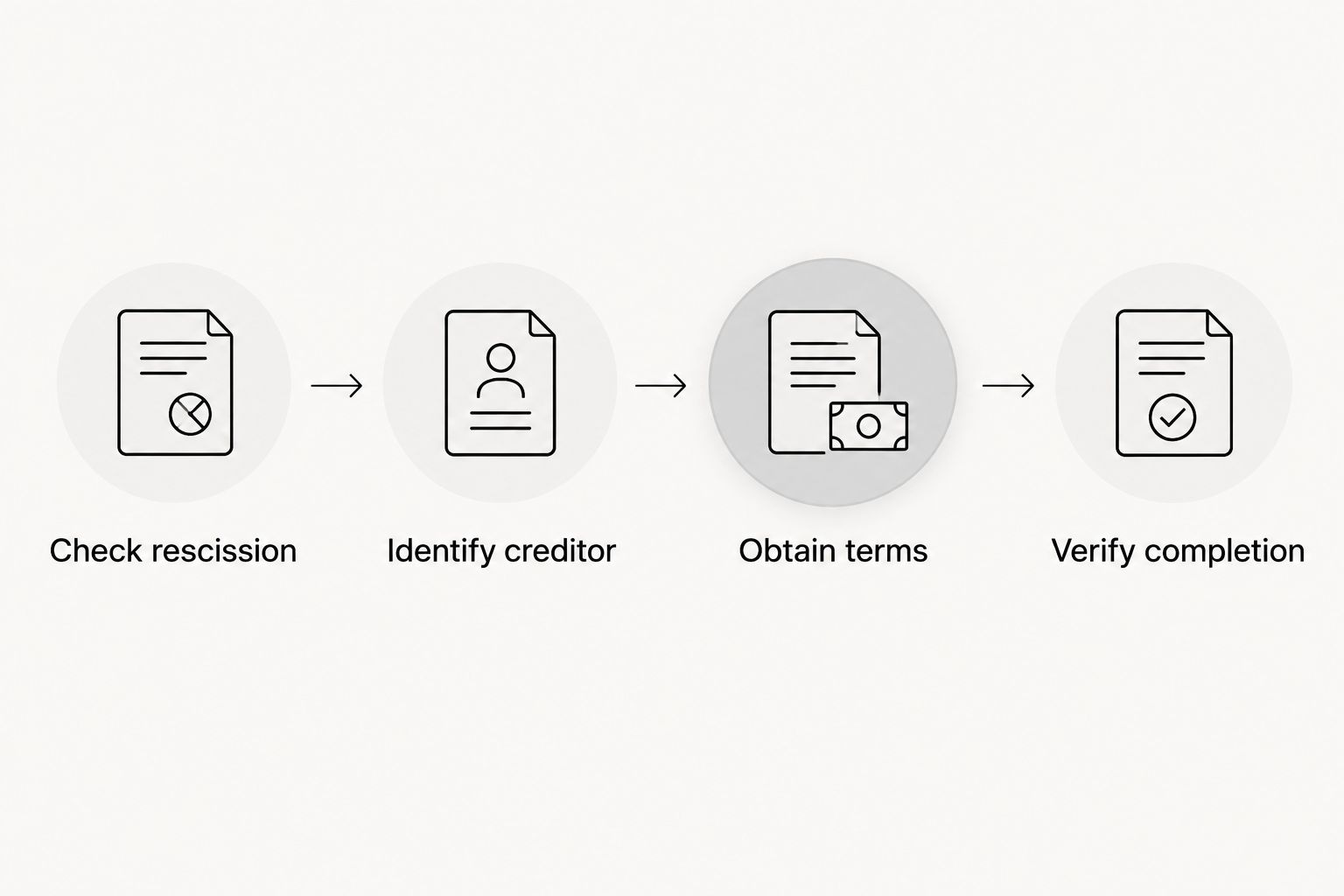
For any proposed resolution, ask these questions in writing:
- Which legal entity is agreeing to release which obligation?
- What must happen before the release becomes effective?
- Who remains responsible for charges during processing?
- What happens if a required transfer or approval fails?
- Which final documents will prove completion?
Read the scope of any release you are being asked to give, too. An agreement can resolve a dispute while also requiring you to give up claims. Understand both sides of that exchange before signing.
Keep a complete copy of the signed agreement and final confirmation outside any provider’s online portal. You need records you can access independently.
Can you stop paying while cancellation is pending?
A pending cancellation request does not, by itself, suspend your payment obligations. Unless a valid cancellation, written agreement, court order, or other applicable legal basis changes those obligations, missed payments can trigger default consequences.
Those consequences can include collection activity and adverse credit reporting, depending on the account and circumstances. Disabling automatic payments does not cancel the underlying debt.
If you cannot afford payments, tell the creditor and request written information about available arrangements. Do not stop paying solely because an exit provider says nonpayment will force a cancellation.
Does giving the timeshare back erase the loan?
Giving the timeshare back does not automatically erase the loan. The return documents must be read alongside any lender release or settlement agreement.
A deed-back addresses ownership of a deeded interest. It does not, by its name alone, establish that a separate promise to repay has ended.
Ask for explicit treatment of the remaining debt and recurring fees. If the resort accepts a return subject to conditions, confirm that those conditions have actually been met before treating the process as finished.
Can misleading sales claims justify cancellation?
Misleading sales claims can support a legal review, but an allegation does not itself cancel a timeshare or its financing. Available remedies depend on the facts, evidence, applicable law, and any relevant deadlines.
Preserve sales materials, emails, messages, and contemporaneous notes. Compare specific representations with the signed documents, and let a licensed attorney assess the legal significance rather than relying on a provider’s guarantee.
FAQ
Can I cancel a resort-financed timeshare in 2026?
You can cancel through a valid, timely rescission or another legally effective resolution. Check the applicable deadline first, then confirm how the financing is treated.
Is there one cancellation deadline for every financed timeshare?
No, there is no single cancellation deadline for every financed timeshare purchase. The applicable law and transaction documents determine your deadline and notice requirements.
Do I have to pay off the loan before asking the resort for help?
You can ask the resort about cancellation or surrender while a loan remains outstanding. Whether the resort will accept the ownership, and how the debt must be resolved, requires a specific written answer.
Can a buyer just take over my resort loan?
A buyer cannot release you from your loan merely by agreeing to make payments. Any permitted assumption and release must satisfy the lender’s requirements.
Will canceling my timeshare automatically remove late payments from my credit report?
Cancellation does not automatically remove accurate prior late-payment reporting. If information is inaccurate, dispute the specific error with the credit reporting companies and the company furnishing it.
Do I need an exit company to send a rescission notice?
An exit company is not inherently required to exercise a rescission right. Follow the governing notice requirements, and seek prompt legal advice if the deadline or instructions are unclear.
Can Sold My Timeshare help me understand resale options?
Sold My Timeshare provides free, no-obligation timeshare valuations and resale or exit assistance. A valuation is a planning step, not confirmation that a creditor has agreed to cancel financing.
One last thing
For your 2026 exit file, keep the ownership confirmation and debt-release evidence together. The strongest completion check is not that you signed something—it is that the documents establish what ended, when it ended, and whether you still owe anything.
This is general information, not individualized legal advice. A licensed attorney can assess your contract, applicable law, and deadlines.