
The timeshare rescission period lasts 10 calendar days in Florida, 7 calendar days in California, and 5 calendar days in Nevada under their respective statutes; there is no single nationwide deadline for 2026. The critical caveat is that the clock starts under the applicable law, and your cancellation must follow that law’s notice requirements—not just a salesperson’s instructions.
- How long is the timeshare rescission period? Florida allows 10 calendar days, California 7, and Nevada 5.
- Check the applicable law, triggering documents, cancellation address, and delivery method before calculating your deadline.
- Send written cancellation instructions promptly and preserve evidence of what you sent and when.
- Sold My Timeshare offers valuations and resale/exit assistance, not a substitute for timely statutory rescission.
How long is the timeshare rescission period?
The deadline depends on the law governing your purchase. These statutory examples provide a starting point for a 2026 review, not a substitute for checking your own cancellation notice and the applicable statute.
If you recently signed, start with your contract’s cancellation section. The timeshare cancellation guide for first-time buyers provides additional context, but do not delay sending a valid notice while researching services.
| State | Statutory cancellation period | What starts the clock | Best for understanding | Important limitation |
|---|---|---|---|---|
| Florida | 10 calendar days | Contract execution or receipt of required documents, whichever is later | Purchases governed by Florida’s timeshare statute | The relevant document-delivery date matters |
| California | 7 calendar days | Contract execution or receipt of the public report, whichever is later | Purchases governed by California’s vacation ownership statute | Signing alone does not always start the clock |
| Nevada | 5 calendar days | Contract execution | Purchases governed by Nevada’s timeshare statute | The statutory deadline runs to midnight on the fifth calendar day following execution |
The sources for these examples are Florida Statutes section 721.10, California Business and Professions Code section 11238, and Nevada Revised Statutes section 119A.410. Their scope is statutory cancellation of covered timeshare purchases—not every resale, exchange, membership change, or later ownership dispute.
Do not pick a state’s deadline because you live there. Identify the law applicable to the transaction, especially if you signed while traveling or purchased an interest located elsewhere.
Why this matters
Rescission and a later timeshare exit are different routes. A timely statutory cancellation addresses the recent purchase; a resale or surrender addresses ownership after that short cancellation window.
Your first task is to protect the deadline, not compare exit companies. A consultation request, complaint, or conversation with a salesperson is not automatically a valid cancellation notice. Read the instructions and send the required written notice without waiting for someone to call you back.
Keep your documents together from the start. A clear record of signing, disclosure delivery, and cancellation makes the sequence easier to establish if a disagreement follows.
Florida: 10 calendar days
Florida Statutes section 721.10 gives a purchaser until midnight of the tenth calendar day following contract execution or receipt of the required documents, whichever occurs later. For a 2026 purchase, locate both dates before calculating the deadline.
The later-document rule is the important detail. A buyer who looks only at the signature date can overlook a legally relevant delivery date; a buyer who assumes every later email restarts the clock can make the opposite mistake.
Best for: owners checking a purchase governed by Florida’s timeshare statute. The benefit is a defined statutory cancellation route; the limitation is that you must identify the required documents and follow the notice provisions correctly.
Keep the purchase agreement, disclosure documents, delivery emails, and any receipt acknowledging delivery. If the records conflict, seek legal advice promptly rather than treating the disagreement as extra time.
California: 7 calendar days
California Business and Professions Code section 11238 provides a cancellation period ending at midnight on the seventh calendar day following contract execution or receipt of the public report, whichever is later. For your 2026 review, record when you received the public report separately from when you signed.
The public report is not simply any brochure or sales presentation. Identify the document named in your purchase paperwork and preserve the evidence showing when it reached you.
Best for: owners checking a purchase governed by California’s vacation ownership statute. The benefit is that the later of the specified events controls; the limitation is that a mistaken document assumption can produce a mistaken deadline.
Do not rely on a salesperson’s summary of the cancellation period. Compare the written notice with the statute and get qualified help immediately if they appear inconsistent.
Nevada: 5 calendar days
Nevada Revised Statutes section 119A.410 allows a purchaser to cancel by written notice until midnight of the fifth calendar day following execution of the contract. For a covered 2026 purchase, the execution date is therefore central to your calculation.
This is a shorter window than the Florida and California examples above. Do not import another state’s later-document rule into a Nevada transaction without a legal basis.
Best for: owners checking a purchase governed by Nevada’s timeshare statute. The benefit is a clearly stated execution-based period; the limitation is that the short window leaves little room for administrative delay.
Find the cancellation address and permitted delivery instructions immediately. Keep evidence of dispatch and delivery rather than relying on a phone conversation about your intention to cancel.
Why the timeshare rescission deadline varies
Your deadline depends on the governing rules and the facts of your purchase. Check these factors before relying on a date written in a calendar reminder:
- Applicable law: Florida, California, and Nevada provide different statutory periods. Your home address alone does not establish which one governs.
- Contract execution: Establish the actual execution date from the agreement. Do not substitute the date of your resort tour or first payment.
- Required disclosures: In the Florida and California examples, receipt of specified documents can affect when the period begins.
- Day-counting rules: Calendar days are not business days. Check the applicable treatment of the starting day, weekends, holidays, and the final deadline.
- Notice requirements: Determine who must receive the cancellation, where it must go, and which delivery methods satisfy the applicable rules.
A deadline calculation is only useful when the notice also complies. Sending something on time to the wrong recipient can create a separate dispute about whether you exercised the right correctly.
How do you cancel within the rescission period?
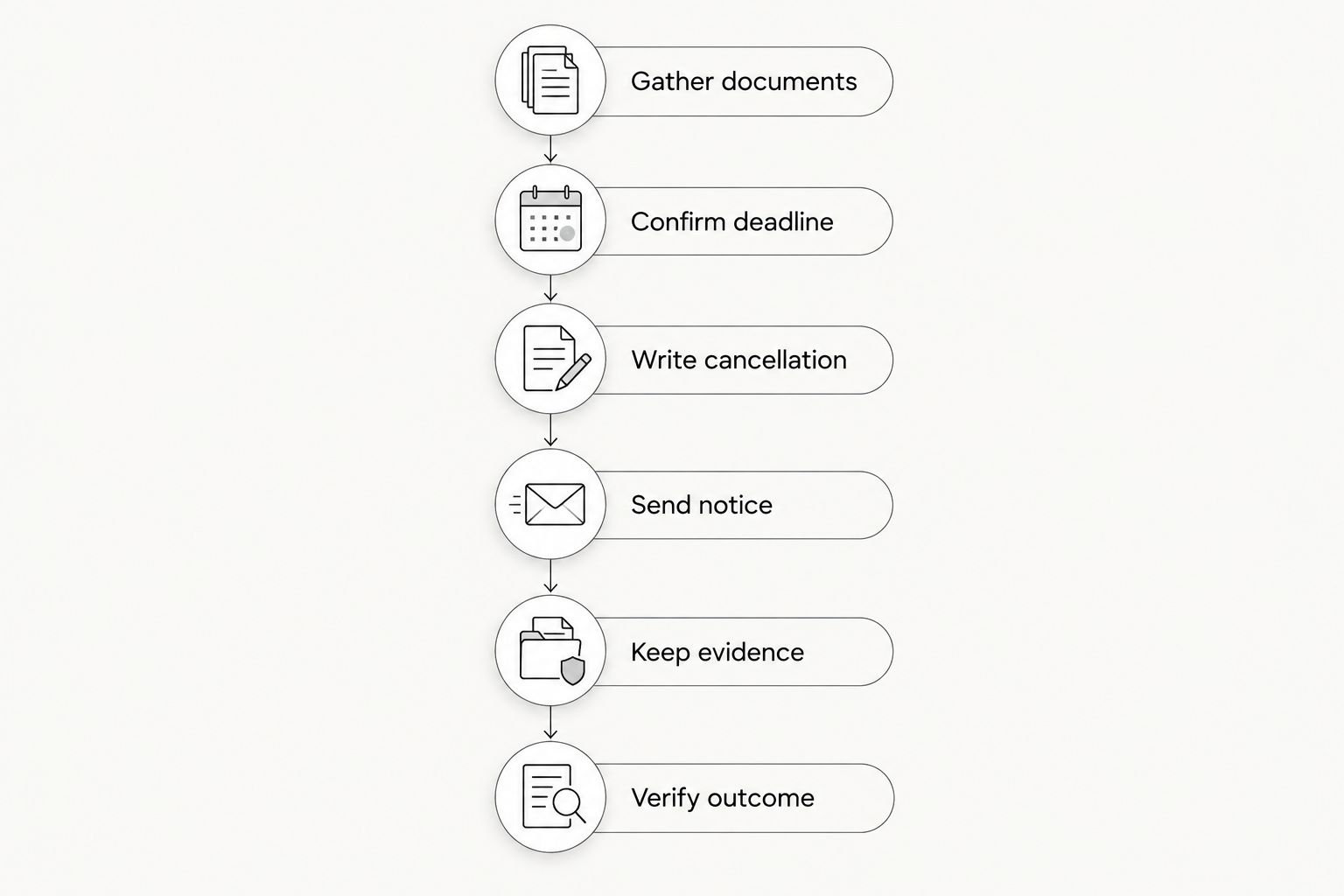
Use a document-first process. You need a clear cancellation statement, the correct recipient, and evidence that you followed the applicable requirements.
1. Gather documents
Collect the signed agreement, cancellation notice, disclosure documents, and evidence of when you received them. Save complete copies, including attachments and envelope markings that establish delivery dates.
Do not edit the originals. Work from copies so that the underlying records remain intact if you need legal advice.
2. Confirm deadline
Identify the governing law, the triggering event, and the last permitted day. Check whether the relevant rule turns on sending, postmarking, delivery, or receipt; these are not interchangeable.
If you cannot resolve a question quickly, contact a licensed attorney familiar with timeshare law. Do not assume an unanswered inquiry pauses the clock.
3. Write cancellation
State plainly that you are exercising your right to cancel the identified purchase agreement. Include the purchaser names, contract identifier, resort or developer name, and execution date so the recipient can identify the transaction.
Use any required form and follow signature instructions. You do not need to turn the notice into a long account of the sales presentation; clarity matters more than length.
4. Send notice
Use the designated cancellation recipient and a method authorized by the applicable law and instructions. A salesperson’s email address or a resort’s general inbox is not automatically the proper destination.
If the instructions require mailing, follow them. Do not replace a required method with a text message, social media message, or phone call because it feels faster.
5. Keep evidence
Retain the exact notice, attachments, mailing receipt, tracking history, and any delivery confirmation. Save digital copies somewhere you can access without relying on the developer’s account portal.
Preserve the contents as well as the tracking record. A delivery scan shows that an item traveled; your retained copy shows what you sent.
6. Verify outcome
Request written acknowledgment and retain subsequent correspondence. Review any refund or account communication against the agreement and applicable law rather than assuming the first automated message resolves everything.
Do not sign a replacement agreement merely because someone says it is needed to process your cancellation. Read it first and obtain legal advice if it changes your rights or obligations.
Do weekends count toward the timeshare rescission period?
The 10 calendar days in Florida, 7 calendar days in California, and 5 calendar days in Nevada are calendar-day periods, not business-day periods. Do not remove weekends from your count; check the applicable law before assuming a holiday or weekend extends the final deadline.
Does receiving documents later restart the cancellation clock?
Florida’s 10 calendar days and California’s 7 calendar days run from the later of the specified statutory events. Later receipt matters only when it involves the documents identified by the applicable rule—not every follow-up message or promotional attachment.
What if the rescission period has already expired?
An expired rescission period does not make every other route disappear, but it changes the problem. Ask the developer about any applicable surrender process, assess resale possibilities, and get legal advice if you believe misconduct affected the transaction.
Sold My Timeshare is best for timeshare owners seeking a free, no-obligation valuation and resale/exit assistance. That service addresses ownership options; it does not replace a timely statutory cancellation or establish that your purchase can be rescinded.
A valuation can help you assess resale, but it is not a buyer commitment or proof that a transfer has occurred. Likewise, a discussion about exit assistance is not written confirmation that your ownership obligations have ended.
For an initial assessment, Sold My Timeshare provides the stated valuation and assistance services. Keep pursuing any live cancellation deadline separately rather than waiting for a valuation response.
Request a timeshare valuation
Get a free, no-obligation valuation and discuss resale or exit assistance.
FAQ
How long is the timeshare rescission period in Florida?
Florida provides 10 calendar days following contract execution or receipt of the required documents, whichever is later, under Florida Statutes section 721.10. Check the cancellation instructions and preserve evidence of the relevant dates.
How long do I have to cancel a California timeshare purchase?
California provides 7 calendar days following contract execution or receipt of the public report, whichever is later, under Business and Professions Code section 11238. Identify the public report rather than relying on a general sales brochure.
How long is Nevada’s timeshare cancellation period?
Nevada provides until midnight of the fifth calendar day following execution of the contract under Nevada Revised Statutes section 119A.410. Follow the applicable written-notice requirements.
Can I cancel a timeshare by calling the salesperson?
Do not rely on a phone call as your cancellation notice. Follow the written-notice requirements in the applicable law and purchase documents, including the designated recipient and delivery method.
Does requesting a valuation cancel my timeshare contract?
No. Requesting a valuation from Sold My Timeshare does not itself exercise your statutory cancellation right or transfer your ownership. Handle any active rescission deadline separately.
What should I keep after sending a rescission letter?
Keep the exact cancellation notice, its attachments, mailing or transmission evidence, tracking records, and delivery confirmation. Also retain the purchase documents and evidence of when you received required disclosures.
Can I still get help after the rescission deadline?
Yes, you can investigate resale, developer surrender options, or legal advice after the deadline. Those routes have different requirements and do not automatically restore an expired statutory cancellation right.
One last thing
Proof of delivery and proof of contents answer different questions. Before sending your cancellation, save a complete copy of the notice and everything enclosed; afterward, save the tracking and delivery records alongside it.
That small filing step gives you a usable record instead of a receipt with no corresponding letter. If a dispute arises, you can show both what you communicated and how you communicated it.