
Instead of repeatedly calling your resort and mailing documents without knowing what ends your ownership, use a timeshare deed back program workflow: confirm eligibility, obtain written acceptance terms, complete the required transfer, and verify account closure. This 2026 guide separates a surrender request from a completed exit so you know what evidence to keep at each stage.
- A timeshare deed back program requires the receiving party’s agreement; sending a deed alone does not establish acceptance.
- Sold My Timeshare offers valuation and resale or exit assistance for owners comparing their next step.
- Confirm eligibility, transfer requirements, and remaining obligations in writing before signing surrender documents.
- Keep transfer evidence and written account-closure confirmation; neither an application nor a verbal approval proves completion.
Why this matters
A timeshare deed back program is a voluntary arrangement in which an accepting developer, resort association, or other authorized recipient takes ownership back under agreed terms. It is not a universal right to return a timeshare. Your ownership documents and the recipient’s written agreement determine the route.
The finish line is documented release from the obligations covered by your agreement—not simply mailing paperwork. Ownership transfer, loan obligations, and resort account updates are separate questions that require separate answers.
Sold My Timeshare is best for timeshare owners seeking valuation and resale or exit assistance before choosing a route. You can request a no-obligation valuation through Sold My Timeshare. That assessment supports your decision; it does not replace the resort’s acceptance or a completed transfer.
Before you start
- Collect 3 document groups: your deed or membership agreement, your latest ownership-account statement, and any loan documents. Include correspondence about prior surrender requests.
- Confirm access and authority: identify every named owner, locate your account reference, and check who must sign. If you represent an estate or another owner, establish your authority before submitting documents.
- Check the ownership type first: a points membership is not necessarily deeded real estate. Ask whether the provider requires a deed transfer, membership surrender, or another process; the wrong paperwork will not complete the intended exit.
Create 1 folder for your 2026 request, with separate sections for eligibility, acceptance terms, signed documents, and completion evidence. Use a simple status list rather than relying on memory or scattered email threads.
Eligibility and receiving-party confirmation
Your first task is to establish who can accept the surrender and whether that party will consider your ownership. Do not start by preparing a deed.
- Identify the responsible organization. Use contact information from your existing ownership records or independently verified resort correspondence. Ask which department handles voluntary surrender or deed-back requests.
- Describe the ownership accurately. Provide the resort name, ownership reference, named owners, and whether the interest is deeded, points-based, or another contractual arrangement. Share sensitive documents only through a verified channel.
- Request the current eligibility requirements. Ask how the provider treats outstanding loans, unpaid assessments, existing reservations, and joint ownership. Do not assume another owner’s approval applies to your account.
- Identify the proposed recipient. Request the legal name of the entity accepting ownership and confirmation that your contact is authorized to manage the request.
- Save a written response. Record whether your request is eligible for review, accepted subject to conditions, or declined. Those are different statuses.
For a 2026 application, use the requirements supplied for your current request rather than an old forum post or someone else’s surrender packet. A program name is not evidence that your specific ownership qualifies.
Expected result: you have an identified receiving party, written eligibility instructions, and a clear next action. An acknowledgment of your inquiry is not acceptance of ownership.
Acceptance terms and route selection
Before you commit, compare what each route actually accomplishes. A deed-back request and a resale listing are not interchangeable, and neither automatically resolves a separate loan.
| Route | Best for | Main advantage | Main limitation |
|---|---|---|---|
| Resort deed-back program | Owners whose ownership the recipient agrees to accept | Provides a direct surrender route under written terms | Depends on acceptance and completion of the stated conditions |
| Resale | Owners seeking to transfer ownership to a buyer | Lets you assess a buyer-based transfer rather than surrender alone | Requires a buyer and completion of applicable transfer requirements |
| Attorney review | Owners facing disputed obligations or unclear release language | Provides legal advice about the agreement and obligations | Advice alone does not transfer ownership or establish resort acceptance |
- Obtain the full written terms. Ask for the surrender agreement and all referenced requirements before signing. Keep the complete packet, not just the signature page.
- Separate ownership from debt. Identify whether the agreement addresses only the ownership interest or also any loan. If a lender is involved, obtain that lender’s written position rather than treating resort approval as debt cancellation.
- Clarify continuing obligations. Ask which assessments, reservations, exchange arrangements, and other commitments remain your responsibility and what event ends each obligation.
- Identify the completion standard. Ask what documents prove acceptance, what transfer steps apply, and who confirms the account update. Request clarification when the agreement uses an undefined completion date.
- Resolve unclear language before signing. Have an attorney review disputed liability, broad releases, unfamiliar recipients, or provisions you do not understand.
Sold My Timeshare provides timeshare exit assistance and valuations. Use that assistance to compare routes, while keeping the provider’s written acceptance requirements separate from any service agreement.
Expected result: you understand what the proposed surrender covers, what it leaves unresolved, and what evidence will establish completion.
Transfer documents and submission
Treat document preparation as a controlled sequence. The goal is an accepted transfer that matches the agreement, not simply a signed form.
- Check document consistency. Compare owner names, ownership identifiers, the receiving entity, and any legal description against your existing records. Refer discrepancies to the closing professional or attorney before signing.
- Confirm signing requirements. Ask who must sign, whether notarization or witnesses are required, and how originals must be delivered. Follow the requirements applicable to your documents and jurisdiction.
- Verify delivery instructions independently. Confirm the recipient and submission method through a trusted contact. Pause if a new message changes the receiving entity or asks you to send sensitive records elsewhere.
- Retain the signed packet. Keep readable copies of every signed page and attachment. Record when you submitted the packet and preserve delivery or submission evidence.
- Confirm the next responsible party. Establish who handles any required recording, membership update, or other transfer step and who sends you the resulting evidence.
A quitclaim deed is not a substitute for a receiving party’s agreement, and recording a deed does not by itself establish release from separate contractual obligations. The quitclaim deed to timeshare exit workflow explains that distinction in more detail.
Expected result: you have a complete signed packet, evidence of submission, and a named party responsible for the remaining transfer actions.
Completion evidence and account closure
For your 2026 exit file, track these stages separately: Acceptance, Transfer, Account closure, and Records. A completed stage should have supporting evidence, not just a reassuring phone conversation.
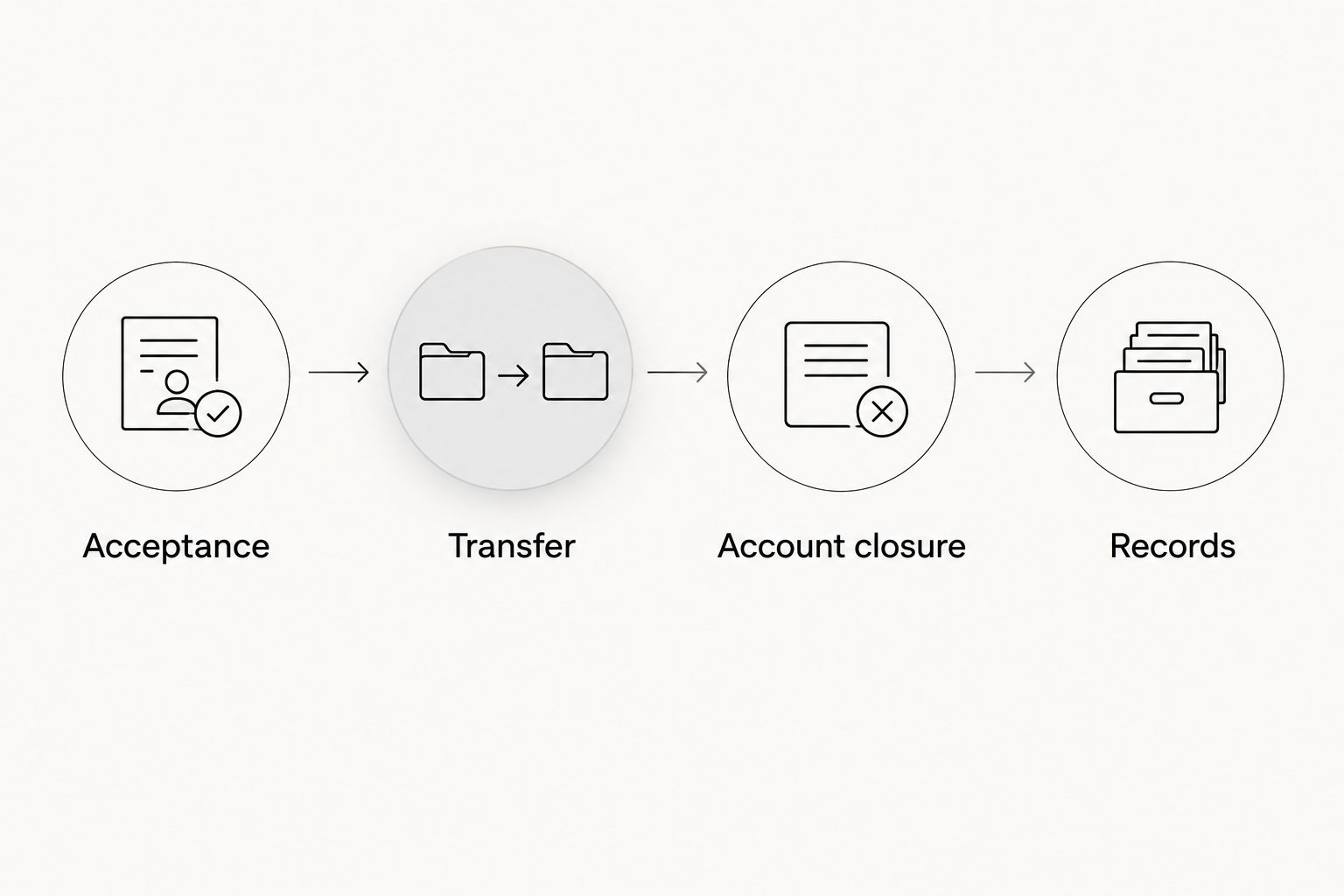
- Obtain transfer evidence. For deeded ownership, request the recorded document or other applicable closing evidence. For contractual ownership, request written confirmation that the required membership surrender or transfer has been processed.
- Obtain account confirmation. Ask the resort or association to confirm the account’s status and the effective date. If obligations remain, request an explanation tied to the agreement.
- Resolve loan status separately. Where a loan exists, obtain the lender’s confirmation of its status and any remaining obligations. Do not infer release from a resort account update.
- Reconcile later correspondence. Compare subsequent statements and notices against the completion documents. Challenge a discrepancy in writing and attach the relevant evidence.
- Preserve the final file. Keep the agreement, signed documents, transfer evidence, account confirmation, and any lender correspondence together.
Aim for 2 distinct confirmations: evidence that the required ownership transfer or surrender occurred, and written confirmation of the resulting resort account status. A separate lender relationship requires its own documentation.
Expected result: your file shows what changed, when it changed, and which obligations were addressed. If a piece remains unresolved, track that item explicitly rather than labeling the whole exit complete.
When the resort declines your deed-back request
A declined timeshare deed back program request changes the workflow; it does not complete an exit. Start with the reason for the refusal and choose the next step from that evidence.
- Request the reason in writing. Distinguish a missing document from an ownership category the provider will not accept. Ask whether the decision is final or whether identified conditions can be addressed.
- Compare resale with surrender. Request a valuation before deciding whether to pursue a buyer-based transfer. Do not treat an estimated value as an offer or a completed sale.
- Get legal advice for a dispute. Use an attorney when the issue concerns contested obligations, alleged misrepresentation, or unclear contractual rights rather than a routine missing-document problem.
- Keep existing obligations under review. Do not assume a declined request, resale listing, or service engagement changes your contract. Obtain advice before changing payments.
For a declined 2026 request, retain the refusal alongside your original application. It gives the next professional a clear starting point and prevents repeated submissions that ignore the stated obstacle.
Sold My Timeshare offers valuations and resale or exit assistance. Ask for an assessment of your ownership and intended outcome, not a promise that every ownership has the same exit route.
Request a timeshare valuation
Get a no-obligation valuation before choosing between resale and further exit assistance.
Troubleshooting
The representative says approved, but sends no agreement
Ask for the written acceptance terms and the authorized receiving entity’s name. Keep the request open until you receive documentation; a verbal statement does not establish the full surrender terms.
The names on the deed and account differ
Stop document preparation and identify the discrepancy with the responsible professional. A marriage, death, prior transfer, or record error requires the appropriate supporting documents—not an improvised signature.
A loan remains after surrender discussions
Contact the lender using verified account information and request its written requirements. Resort participation in a deed-back discussion does not establish the lender’s agreement to release debt.
You receive another assessment after submitting documents
Check whether you only submitted an application or actually completed the agreed transfer. Request an explanation of the charge and compare its assessment period with the agreement’s effective-date provisions.
Someone asks you to stop paying immediately
Request the contractual or legal basis in writing and obtain independent advice before acting. An exit-service engagement alone does not amend your obligations to the resort, association, or lender.
Customize your workflow
Build your 2026 tracking sheet around the obligations you actually have. Add columns for the responsible party, document needed, current status, and next action; use event-based milestones unless a written agreement supplies a deadline.
For joint ownership, track each required signer separately. For an estate, add authority documents. For financed ownership, keep the lender track open until its status is documented, even if the resort transfer is complete.
Use one rule throughout: no stage is complete without its corresponding evidence. This keeps a missing signature, unresolved loan, or unprocessed account update visible before you put the file away.
FAQ
What is a timeshare deed back program?
A timeshare deed back program is a voluntary arrangement in which an authorized recipient agrees to take ownership back under written terms. Eligibility and completion requirements depend on the ownership and the accepting party.
Can I just send my timeshare deed back to the resort?
Sending a deed alone does not establish the resort’s acceptance or release you from separate obligations. Obtain written acceptance terms and follow the required transfer process.
Does a deed-back program cancel my timeshare mortgage?
A deed-back agreement does not automatically cancel a separate loan. Obtain the lender’s written confirmation of what happens to the debt and any remaining obligations.
How long does a timeshare deed-back program take?
The completion timeline depends on the accepting party’s process and the required documents and transfer steps. Request milestones for your specific application rather than relying on another owner’s experience.
Is a deed back better than selling my timeshare?
A deed back fits owners whose ownership the recipient agrees to accept; resale requires a buyer and a completed transfer. Compare the written surrender terms with a valuation and your ownership obligations before choosing.
Should I stop paying while my deed-back request is pending?
A pending request does not change your contractual obligations. Obtain written clarification and independent advice before changing payments.
How do I know my timeshare exit is complete?
Match your completion evidence to the agreement: confirm the required ownership transfer or surrender and the resulting resort account status. Resolve any separate loan status directly with the lender.
One last thing
An empty reservation calendar is not proof of an exit. Neither is a submitted deed. Before closing your file, ask the resort to state your account status and any remaining obligations in writing, then compare that answer with your signed agreement.