
Instead of treating a timeshare quitclaim deed as an exit by itself, confirm an accepted transfer, complete the deed and recording requirements, and verify the resort’s ownership update. This 2026 workflow separates the paperwork that transfers an ownership interest from the agreements needed to address your remaining obligations.
- A timeshare quitclaim deed transfers an ownership interest; it does not automatically cancel a loan or release contractual obligations.
- Sold My Timeshare is best for owners seeking a free, no-obligation timeshare valuation and resale or exit assistance.
- Confirm the recipient, transfer requirements, and outstanding obligations before signing or recording a deed.
- Keep the recorded deed, resort ownership confirmation, and any required release together as your exit evidence.
Why this matters
A recorded deed is not the same thing as a complete timeshare exit. A quitclaim deed generally conveys whatever interest the grantor holds without providing the title warranties associated with a warranty deed. It does not establish that the interest is free of liens.
The deed, loan agreement, and resort membership documents serve different purposes. Changing the recorded owner does not, by itself, release the borrower from a loan or settle every obligation under a separate agreement.
Sold My Timeshare offers free, no-obligation timeshare valuations and resale or exit assistance. That is a starting point for evaluating your options, not a substitute for legal advice about a deed’s effect.
Use this 2026 guide as a document-and-confirmation workflow. Have a qualified attorney in the property’s jurisdiction resolve questions about ownership, deed language, and liability before you sign.
Before you start
- Gather the ownership file: your current recorded deed, ownership agreement, latest account statement, loan documents if applicable, and contact information for the resort’s transfer department. If someone else will act for an owner, gather evidence of that authority.
- Identify the recipient and destination office: confirm who will accept the interest, who handles resort transfers, and which land-records office records documents for the property. Do not assume the owner’s home county is the correct recording location.
- Check the ownership type first: a points membership or right-to-use contract is not necessarily deeded real estate. A quitclaim deed cannot replace a contractual assignment process merely because the ownership is called a timeshare.
The non-obvious obstacle is recipient acceptance. Naming a resort, association, relative, or company as the recipient does not establish that it has agreed to take the ownership or that the transfer satisfies applicable requirements.
Ownership and transfer requirements
Establish the transfer route
- Confirm the interest. Read the recorded deed and ownership agreement together. Identify the property jurisdiction, legal owners, legal description, and any ownership identifiers. Ask an attorney to resolve discrepancies rather than copying inconsistent information into a new deed.
- Contact the transfer department. Request the current written requirements for a 2026 ownership transfer. Ask about eligibility, required approvals, account conditions, transfer documents, and any right-of-first-refusal process.
- Confirm recipient acceptance. Obtain the proposed recipient’s correct legal name and written agreement to the transaction. For a surrender, obtain written instructions from the resort or association before preparing a deed naming it as recipient.
- Assign responsibility. Identify who will prepare the deed, check title, handle recording, submit the resort package, and confirm completion. Put those responsibilities in writing.
Expected result: you can identify the transferable interest, the consenting recipient, and the written process that applies. If any element remains unresolved, stop before signing.
Choose the route that matches your objective
A transfer to another owner and a surrender back to a resort involve different recipients and approvals. Neither should begin with an unsolicited deed.
| Route | Best for | Benefit | Limitation |
|---|---|---|---|
| Transfer to another owner | Owners with a willing recipient and a permitted transfer | Provides a route to convey the ownership interest | Requires recipient agreement and compliance with applicable transfer requirements |
| Resort-approved surrender | Owners whose resort agrees to accept the ownership | Provides a direct route back to the accepting entity | Depends on written acceptance and the surrender agreement’s terms |
| Legal review before transfer | Owners with disputed title, debt, or authority questions | Resolves issues that a deed alone cannot fix | Review is not itself a completed transfer or release |
Choose the accepted transaction first; choose the deed instrument second. The appropriate instrument depends on the property jurisdiction and transaction requirements, not simply on which form is easiest to obtain.
Account obligations and closing instructions
Document the account position
- Request written account information. Ask for maintenance assessments, special assessments, unresolved balances, and the period covered by the statement. Keep the response with the ownership documents.
- Separate loan obligations. If a loan exists, contact the lender for the applicable payoff, consent, or release requirements. Do not treat a resort account statement as proof that the loan has been addressed.
- Allocate responsibilities. Put responsibility for outstanding obligations, the current usage period, reservations, and pending assessments into the transaction agreement. Private allocation between the parties does not automatically bind a lender or association.
- Confirm closing conditions. Ask the closing professional which approvals must be obtained before signing, recording, or releasing transaction documents. Do not proceed on an assumption that missing approval can be supplied afterward.
An estoppel or account-status document helps establish the association’s stated account position within its scope. The HOA estoppel certificate to timeshare closing workflow explains how that document fits into closing.
Expected result: your file distinguishes the resort account, any lender account, and the parties’ agreed responsibilities. An unresolved balance has a documented treatment rather than a verbal promise.
For a 2026 transfer file, record the date of each statement and approval. A document describes conditions as of its stated date; it is not an indefinite assurance that nothing has changed.
Deed preparation and recording
Complete the conveyance documents
- Arrange appropriate preparation. Use a qualified attorney or closing professional acting within the rules of the property jurisdiction. Ask whether a quitclaim deed is appropriate for this transaction rather than requesting one automatically.
- Check the deed details. Review the grantor and grantee names, legal description, ownership interest, and return information against the underlying records. A resort account number is not a substitute for a legally sufficient property description.
- Confirm execution requirements. Obtain instructions covering signatures, acknowledgments, witnesses where required, and any accompanying documents. Requirements differ by jurisdiction; follow the instructions for the property, not a generic internet template.
- Record through the correct office. Submit the executed documents through the agreed closing process. Obtain the recording reference and a copy showing the recording information after the office accepts the submission.
Expected result: you hold evidence that the intended conveyance document was recorded. Recording does not establish that every title issue was resolved or that a lender released a borrower.
Keep 3 evidence categories separate: conveyance evidence, resort account evidence, and release evidence where applicable. Combining them into a single folder is useful; treating them as interchangeable is not.
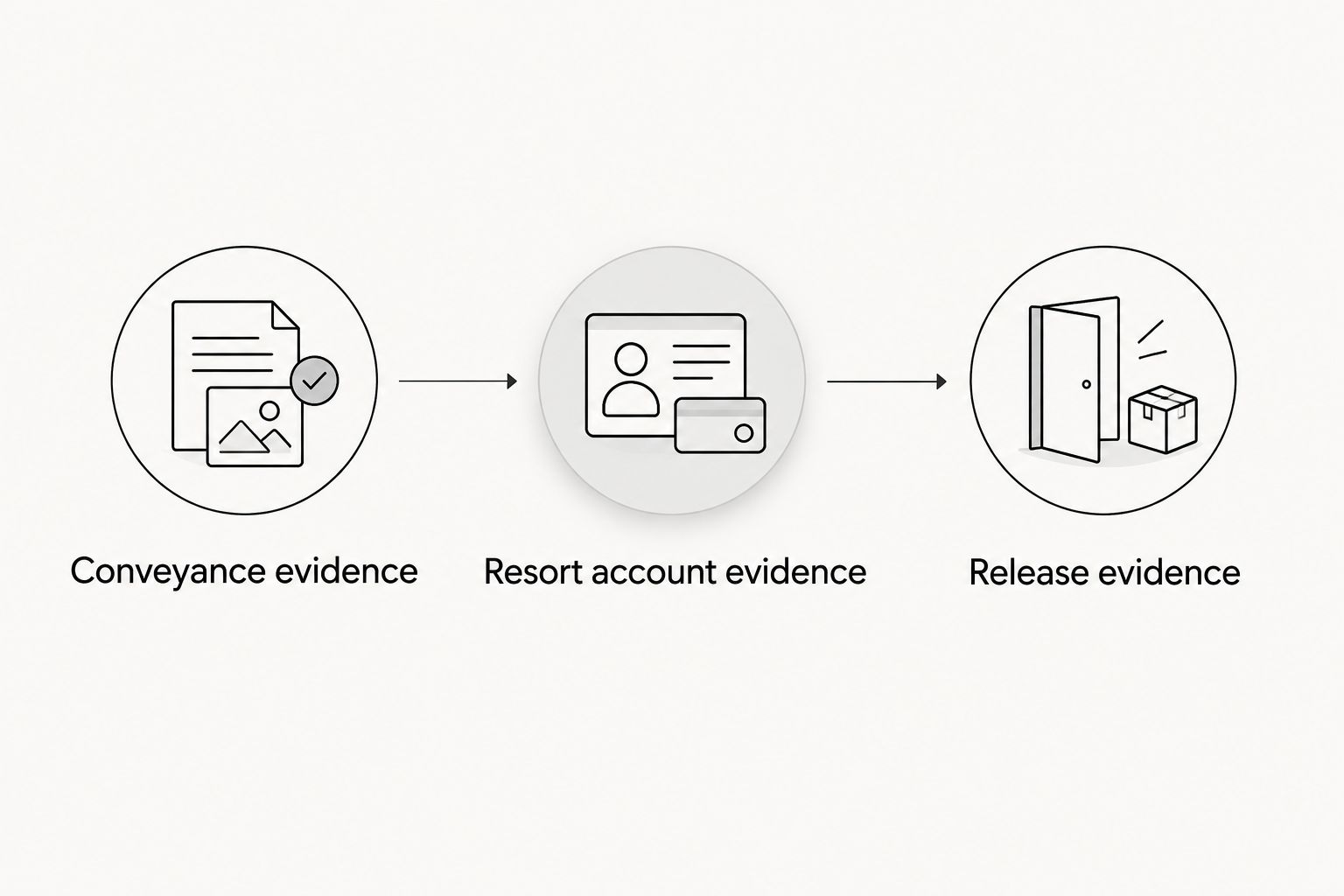
Resort recognition and exit confirmation
Verify the ownership update
- Submit the transfer package. Send the recorded deed and other required documents to the resort’s designated department using its written instructions. Retain proof of submission and the case or account reference.
- Request written confirmation. Ask the resort to confirm that it has processed the ownership change and identify the effective date reflected in its records. Clarify any remaining requirements instead of assuming silence means acceptance.
- Reconcile separate accounts. Confirm the treatment of the former owner’s resort account and any separate loan account. Obtain the applicable satisfaction, release, or other closing documentation when the transaction requires it.
- Review later correspondence. Compare subsequent statements or notices with the written closing documents. Ask the issuing party to explain discrepancies in writing before treating the file as complete.
Expected result: the recorded conveyance, resort records, and any required release documents support the same transaction. A mailing receipt or a signed deed alone does not satisfy that check.
For your 2026 completion checklist, distinguish 2 checkpoints: recording confirmation and resort-processing confirmation. Track lender resolution separately whenever financing exists. Do not mark an unresolved item complete simply because another organization has finished its part.
Second workflow: an approved resort surrender
If the resort agrees to accept the ownership, start with its written surrender terms rather than adapting a private-sale deed package.
- Obtain written acceptance. Confirm the accepting entity’s legal name and the conditions attached to acceptance.
- Review the scope. Determine which ownership interest and obligations the agreement addresses. Ask specifically about any separate loan, unpaid assessments, and future account treatment.
- Follow the specified closing sequence. Have the documents reviewed, execute them correctly, and complete recording when required for the ownership type.
- Collect completion evidence. Obtain the processed-transfer confirmation and any release the agreement requires. Retain the final account correspondence with the surrender agreement.
Best for owners with written resort acceptance: follow the approved surrender process. Its benefit is an identified accepting party; its limitation is that the written terms determine what it resolves.
Sold My Timeshare provides timeshare resale and exit assistance for owners evaluating their options. Use that assistance to consider your route, while directing deed-validity and liability questions to a qualified attorney.
Start with a timeshare valuation
Request a free, no-obligation valuation while you assess your resale or exit options.
Troubleshooting
- The recorder rejects the deed. Obtain the rejection reason and have the preparer correct the identified defect. Do not keep submitting altered versions without confirming execution and recording requirements.
- The deed is recorded, but the resort still lists you. Contact the transfer department with the recording reference and submission evidence. Request a written list of outstanding processing requirements.
- The proposed recipient will not accept the ownership. Stop the transaction. Ask an attorney about any document already signed or recorded; do not assume another unilateral deed will undo it.
- Loan statements continue after the transfer. Contact the lender and compare its records with the closing documents. A deed does not itself release a borrower from the loan agreement.
- A deceased owner or former spouse remains on title. Obtain jurisdiction-specific advice about signing authority and title requirements. A divorce order, death certificate, or power of attorney must be evaluated for its actual effect.
Customize your workflow
Build 1 transfer tracker with an item, responsible party, date requested, date received, and supporting document for each requirement. Use your own field labels; the objective is a clear record, not another account to manage.
Add separate entries for title questions, resort approval, account status, execution, recording, resort processing, and lender resolution. Keep sensitive documents in secure storage and share them only with verified parties who need them.
For a 2026 review, check that the tracker reflects the latest written instructions rather than an older checklist saved by another owner. If the proposed transaction changes, reconfirm the requirements before reusing documents.
FAQ
Does a timeshare quitclaim deed get me out of my timeshare?
A timeshare quitclaim deed does not, by itself, establish a complete exit. Confirm valid conveyance, applicable resort transfer requirements, and the treatment of separate loan or contractual obligations.
Can I quitclaim my timeshare back to the resort?
Do not assume the resort will accept an unsolicited deed. Obtain written acceptance and follow the approved surrender process before signing or recording documents.
Does a quitclaim deed remove my timeshare mortgage?
A quitclaim deed does not itself release a borrower from a mortgage or other loan agreement. Obtain the lender documentation required for payoff, consent, or release in your transaction.
Can I use a quitclaim deed for timeshare points?
Only use a deed when the ownership includes a real-property interest that can be conveyed that way. A contractual points membership can require a different assignment process, so check the ownership documents first.
How long does a timeshare quitclaim transfer take?
There is no single completion period for every timeshare quitclaim transfer. Ask the closing professional, recording office, and resort for their current processing requirements and track each stage separately.
What should I keep after my timeshare transfer?
Keep the recorded conveyance, transaction agreement, resort processing confirmation, and any applicable lender satisfaction or release. Retain supporting account statements and submission records so you can address later discrepancies.
Can Sold My Timeshare help me assess my options?
Sold My Timeshare offers free, no-obligation timeshare valuations and resale or exit assistance. Obtain separate qualified legal advice about deed preparation, title, and the effect of any proposed release.
One last thing
Save the completion evidence outside the resort portal. Download the recorded deed, written confirmations, and applicable releases into a file you control. Your access to an account should not determine whether you can document what happened.
This guide provides general information, not legal advice. Property law, contract terms, and the facts of your ownership determine the requirements for your transaction.