
Instead of manually chasing forms and account updates, use a written handoff checklist to transfer timeshare points to new owner: confirm what transfers, complete the required ownership paperwork, and verify the recipient’s account. Moving points between accounts is not the same as transferring the ownership that generates them.
- To transfer timeshare points to new owner, distinguish a points transfer from an ownership transfer before signing.
- Sold My Timeshare is best for owners seeking a free valuation and resale or exit assistance.
- Confirm club rules, point balances, reservations, and recipient eligibility in writing.
- Finish with ownership acceptance and account reconciliation, not just signed paperwork.
Why this matters
A points balance tells you what is available to use. It does not, by itself, tell you who owns the underlying interest or who remains responsible for ownership obligations. Your 2026 handoff needs to address both the ownership record and the points account.
Sold My Timeshare is best for timeshare owners seeking a free valuation and resale or exit assistance. Start with Sold My Timeshare if you need help assessing your resale or exit options before arranging a transfer.
The workflow below separates your decision into ownership eligibility, transaction documents, and account verification. Use the club’s written requirements for your specific ownership rather than assuming another owner’s experience applies to yours.
Before you start
- Collect your ownership documents and account access. Have the current owner names, contract or membership identifier, latest account statement, governing documents, and any loan information. Get the recipient’s legal name and the account details the club requires through an approved channel.
- Identify who must participate. Ask the club which owners must sign, whether the recipient needs an existing account, and which transfer or closing professionals must submit documents. If you are acting for someone else, establish your authority before sending instructions.
- Check the hidden restriction first. Ask whether current, banked, borrowed, promotional, or exchange-deposited points receive different treatment. Do not promise that every displayed point, reservation, or membership benefit follows the ownership.
Create a checklist headed 2026 transfer file. Keep sensitive documents in a secure location, and share only what each authorized party needs. Never give a buyer your account password as a substitute for an approved transfer.
Ownership eligibility and transfer scope
Establish what the recipient is receiving
- Identify the transfer type. Tell the club whether you intend to sell or give away the underlying ownership, transfer a permitted points balance, or arrange guest use of a reservation. Ask for the requirements for that exact action.
- Request written instructions. Obtain the current forms, submission method, required signatures, recipient eligibility rules, and supporting-document checklist. Use the club’s actual forms; there is no universal transfer button or form name across timeshare programs.
- Confirm restrictions. Ask whether resale changes benefits, whether the ownership has transfer conditions, and whether existing financing must be resolved. Record each condition alongside the party responsible for satisfying it.
- Set the completion standard. Ask what document or account notice confirms that the club has accepted the new owner. For deeded ownership, separately confirm the required recording and ownership-update process with the closing professional.
Expected result: You have written instructions identifying the ownership or points being transferred, the eligible recipient, and the evidence required to confirm completion.
Choose the correct handoff
These arrangements solve different problems. Select the arrangement that matches your intended outcome, not the one with the shortest form.
| Arrangement | Best for | Advantage | Limitation |
|---|---|---|---|
| Ownership transfer | Owners selling or giving away their ownership interest | Addresses who holds the underlying ownership | Requires the applicable legal and club acceptance steps |
| Permitted points transfer | Members moving eligible usage points under club rules | Addresses a defined points balance | Does not by itself transfer the underlying ownership |
| Guest reservation | Owners arranging another person’s stay | Addresses use of a particular booking | Does not by itself transfer ownership or the points account |
Choose an ownership transfer when your goal is to change the owner. Choose a points transfer or guest reservation only when that narrower action matches your goal and the program permits it.
Points ledger and written agreement
Document the balance before signing
- Create a points ledger. Copy the account’s point categories, usage periods, expiration dates, and existing reservations into your transaction file. Save a dated statement or account record rather than relying on a verbal balance.
- Separate available points from commitments. Identify points already attached to reservations, deposited with an exchange provider, banked, or borrowed. Ask the relevant administrator how each category is handled during the proposed transfer.
- Confirm the ownership status. Request the applicable ownership-status documentation. Ask about outstanding obligations, transfer restrictions, and pending account changes before treating the account as ready to close.
- Put the allocation in writing. State which usage rights the recipient receives, which reservations remain with the seller, who handles required transaction charges, and what happens if the balance changes before acceptance.
Expected result: Both parties can identify the same transferable ownership and usage rights without interpreting a dashboard screenshot differently.
For a 2026 transaction, date the ledger and refresh it before submission. A statement taken before a reservation change does not document the account after that change.
The HOA estoppel certificate to timeshare closing workflow explains the ownership-status checkpoint in more detail. Keep the verified status documentation alongside the points ledger, not in a separate email trail that the closing party cannot find.
Do not treat an advertised annual points allocation as proof of the balance the recipient will receive. Annual entitlement, current usage, and transfer eligibility are separate questions.
Transfer submission and ownership acceptance
Complete the required documents
- Assign responsibility. Identify who prepares the agreement, who handles any deed or assignment, who submits the club package, and who follows up. Use a closing professional or attorney where the transaction requires one.
- Match the legal details. Check owner names, recipient names, ownership identifiers, and property or membership descriptions against the source documents. Resolve discrepancies before collecting signatures.
- Satisfy prerequisites. Complete required approvals, financing arrangements, identity checks, and any applicable right-of-first-refusal process. Do not substitute a buyer’s assurance for written evidence that a requirement is satisfied.
- Submit through the approved channel. Follow the administrator’s instructions for signatures, notarization where required, supporting documents, and delivery. Retain copies and the submission acknowledgment or reference.
- Track acceptance separately. Record whether the package is received, complete, under review, or accepted using the administrator’s own status descriptions. Ask what remains outstanding whenever the transfer stops progressing.
Expected result: The responsible administrator has a complete submission, and you know which acceptance or recording steps remain open.
Use these as separate checkpoints: Eligibility, Agreement, Submission, and Acceptance. A document marked submitted belongs at the submission checkpoint, not the acceptance checkpoint.
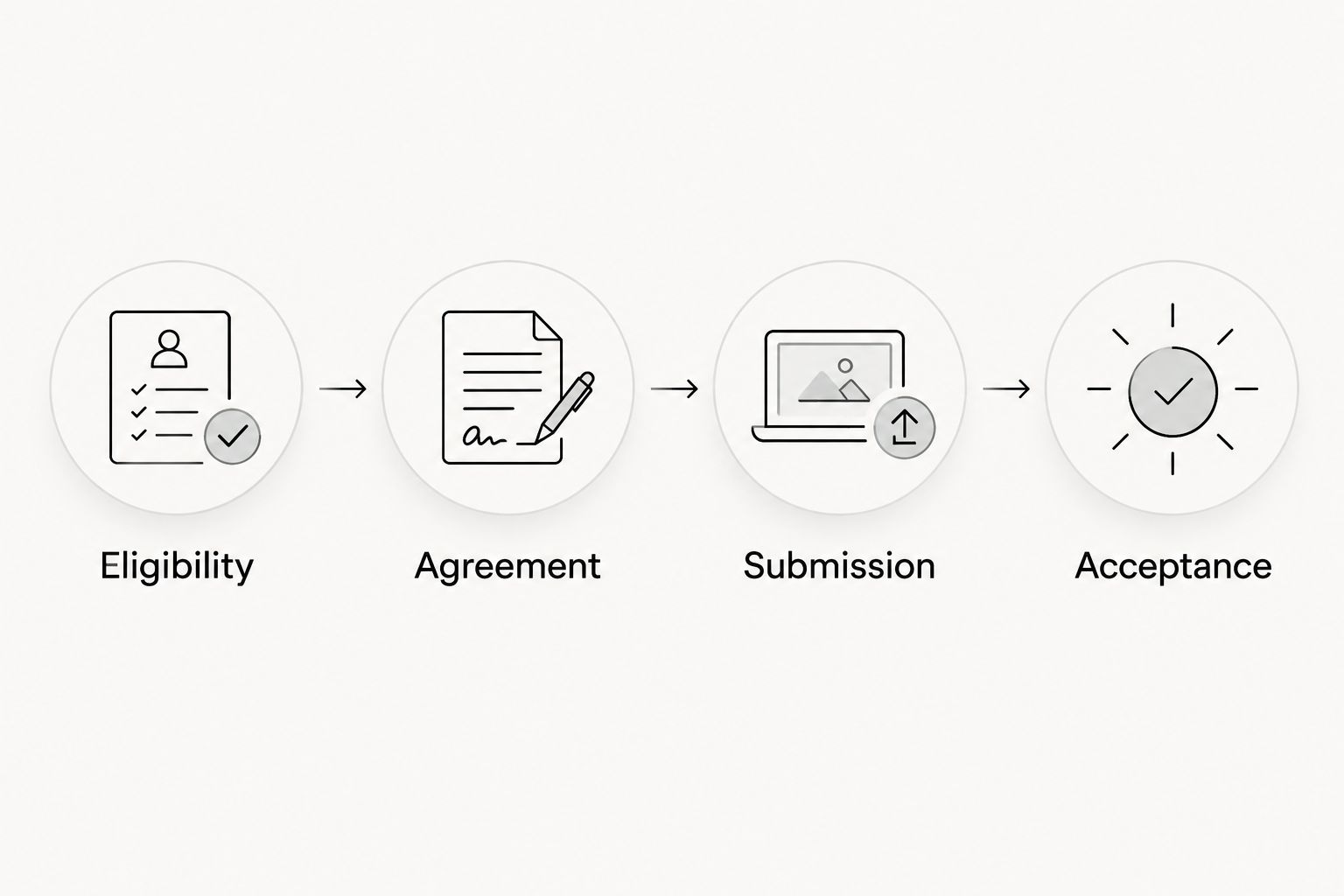
Keep your 2026 transfer file open until the required ownership and account changes are confirmed. A signed agreement documents the parties’ agreement; it is not a substitute for every administrative or legal step required by that ownership.
Recipient account and final reconciliation
Verify the completed handoff
- Confirm the ownership record. Obtain the club’s written confirmation of the accepted ownership change. Where recording is required, retain the recorded document or the closing professional’s evidence of recording.
- Check the recipient account. Have the recipient use their own authorized access to verify the ownership and points shown. Do not solve an access problem by sharing the seller’s credentials.
- Reconcile the points. Compare the accepted account against the agreed ledger, including usage periods, expiration dates, and reservation treatment. Send discrepancies to the administrator with the relevant documents attached.
- Confirm remaining obligations. Ask the administrator or closing professional to identify the effective transfer date and any unresolved responsibility. Do not stop payments solely because the recipient signed an agreement.
- Archive the completion records. Retain the agreement, required recording evidence, club acceptance, and final account correspondence. Ask the closing professional which records you must retain and for how long.
Expected result: You can show both the accepted ownership change and the points treatment, with any unresolved issue explicitly documented.
Use 2 separate confirmations as your completion checklist: ownership acceptance and account reconciliation. Neither a new login nor a changed points balance proves every ownership obligation has ended.
Variant: transfer points without changing ownership
If your goal is only to move eligible points, start with the club’s points-transfer rules rather than ownership-sale paperwork. A points-only transfer does not replace an ownership transfer.
- Confirm that the club permits the proposed transfer between the specific accounts.
- Verify the eligible point category, usage period, expiration treatment, and recipient details.
- Obtain both parties’ agreement on the points being moved and submit the approved request.
- Check the sender’s deduction and recipient’s credit against the request, retaining both confirmations.
This narrower workflow suits members who intend to keep their ownership. Its limitation is equally important: transferring usage points does not, by itself, release the sender from ownership obligations.
For a 2026 points-only request, obtain the current rules before submitting. Do not reuse an old transfer form simply because the membership number has not changed.
Troubleshooting
The package is returned as incomplete
Ask the administrator for an itemized list of missing or incorrect documents. Correct the named issue, retain the revised package, and confirm whether the original submission reference remains valid. Repeatedly sending the same package does not resolve a missing signature or mismatched owner name.
The recipient sees fewer points than expected
Compare the account against the dated ledger by point category and usage period. Check for reservations, prior use, or categories excluded under the written rules. Request a written explanation before assuming the account display is wrong.
A reservation has not followed the ownership
Check the administrator’s written instructions and the sale agreement for that reservation. Ask whether a separate approved action is required. Do not cancel and recreate a booking on the assumption that the same reservation can be restored.
The deed is recorded, but the club still shows the seller
Send the required recording evidence through the club’s ownership-update process and ask what remains outstanding. Recording and the club’s account update are distinct checkpoints; verify both before closing your file.
Someone asks for your password or promises automatic release
Do not share credentials or treat a promise as proof of completion. Contact the club through independently verified contact details and request the documented transfer requirements. Keep the handoff tied to records you can verify.
Customize your workflow
Adapt the checklist to the ownership, not the other way around. For a financed ownership, establish the lender’s requirements before agreeing to a closing sequence. For an estate, trust, or shared ownership, establish signing authority before preparing transfer documents.
Sold My Timeshare provides timeshare resale and exit assistance, along with free, no-obligation valuations. Use a valuation to assess your options; use the club’s requirements and closing records to verify a transfer. Those are different jobs, and a valuation does not replace the ownership paperwork.
If your goal is to leave the ownership entirely, explain that goal at the start. A points-only handoff addresses usage rather than the full exit you are seeking.
Request your timeshare valuation
Sold My Timeshare offers free, no-obligation valuations and resale or exit assistance.
FAQ
How do I transfer timeshare points to a new owner?
First establish whether you are transferring the underlying ownership or only eligible usage points. Obtain the club’s written requirements, document the agreed balance, complete the applicable paperwork, and verify ownership acceptance and account reconciliation.
Does transferring points mean I no longer own the timeshare?
No. A points-only transfer does not by itself transfer the underlying ownership or end its obligations. Complete the applicable ownership-transfer process if your goal is to change the owner.
Can I give my timeshare points to a family member?
Your club’s rules determine whether the proposed points transfer is permitted. Confirm recipient eligibility, eligible point categories, and the required process before promising the points to a family member.
Will banked or borrowed points transfer to the buyer?
Confirm the treatment of banked and borrowed points directly with the club. Document the answer in the transaction file and reflect the agreed usage rights in the sale agreement.
How long does a timeshare points transfer take in 2026?
There is no single completion time across timeshare programs. Ask the responsible administrator for its current processing guidance and which event starts that period, then track missing documents and acceptance separately.
Is a recorded deed enough to finish a points ownership transfer?
A recorded deed alone does not establish that the club has completed its account update. Where recording applies, retain that evidence and separately confirm ownership acceptance and the recipient’s points account.
Can Sold My Timeshare help me decide whether to sell?
Sold My Timeshare provides free, no-obligation timeshare valuations and resale or exit assistance. Use that service to assess your options before committing to a transfer arrangement.
One last thing
Treat the last account check as part of closing, not an optional follow-up. The useful question is not simply whether documents were signed; it is whether the required ownership change was accepted and the agreed usage rights reached the recipient.
Keep 3 record groups together: the signed agreement, ownership-completion evidence, and the final points reconciliation. That makes a later question about ownership or usage easier to answer without reconstructing the transaction from scattered messages.