
Instead of manually chasing signatures, resort approvals, and payment updates, organize your timeshare closing around written checkpoints: verify ownership, clear transfer conditions, complete the documents, and confirm payout. This 2026 workflow explains what to ask a title or closing company, what evidence to keep, and when a resale is actually finished.
- Timeshare closing process title company checklist: verify ownership, transfer conditions, escrow instructions, and payout requirements before signing.
- Sold My Timeshare offers owners a free, no-obligation valuation and resale or exit assistance—not a guaranteed payout.
- A recorded deed, resort account update, and seller payout are separate checkpoints; confirm the requirements for your ownership.
- Verify payment instructions independently before sending money or sensitive account information.
Why this matters
Signing transfer papers does not, by itself, prove that your ownership obligations have ended or your proceeds are ready. A closing involves different parties with different responsibilities. Your contract and closing instructions should identify who handles each task and what must happen before funds are released.
Sold My Timeshare is best for timeshare owners seeking a free valuation and resale or exit assistance. That makes it a starting point for evaluating your options, not a substitute for transaction-specific closing instructions. A valuation does not establish that a buyer has funded a purchase or that a resort has accepted a transfer.
For a 2026 resale, keep the sale agreement, ownership records, resort correspondence, and closing documents together. Treat verbal updates as prompts to request written confirmation—not as proof of completion.
Before you start
- Gather ownership and account records. Find your deed or membership agreement, current resort statement, loan information if applicable, and the signed sale agreement. Identify every owner whose signature or authorization is required.
- Confirm the closing team and access. Obtain the closing company's legal name, independently verified contact details, document-delivery method, and written description of its responsibilities. Ask whether title work, escrow, recording, and resort notification are included or handled separately.
- Resolve the non-obvious gotcha: ownership type. A deeded interest and a contractual membership do not necessarily transfer through the same documents. Ask the resort which procedure applies before arranging notarization or sending original paperwork.
Do not assume that a business calling itself a closing company provides title insurance, legal representation, or every service your transaction needs. Ask which services apply and who provides them.
Ownership verification
Establish the transfer requirements
- Identify the ownership. Match the seller names, resort, ownership identifier, and legal description or membership details across your records and sale agreement. Resolve mismatched names before preparing transfer documents. A name change, deceased owner, or trust ownership requires the closing professional to identify the appropriate supporting documents.
- Request resort confirmation. Ask the resort or association for its written transfer requirements and current account information. Confirm whether the transaction requires an estoppel statement, transfer application, buyer approval, or right-of-first-refusal submission. Do not treat a requirement from another resort as applicable to yours.
- Assign responsibilities. Record who requests each document, who submits it, and who receives the response. Ask the closing company to identify which outstanding requirements prevent document preparation, transfer, or disbursement.
Expected result: You have a verified description of the ownership and a written list of requirements for this transaction. Each unresolved requirement has a named person responsible for completing it.
An estoppel statement can help establish what the association reports about the account, but it does not replace every other closing check. Read its scope and effective date rather than treating the document's title as a blanket clearance.
Keep the evidence in order
Create a transaction checklist with 4 checkpoints: ownership verified, conditions cleared, transfer completed, and funds released. For each checkpoint, record the responsible party, required evidence, and outstanding action.
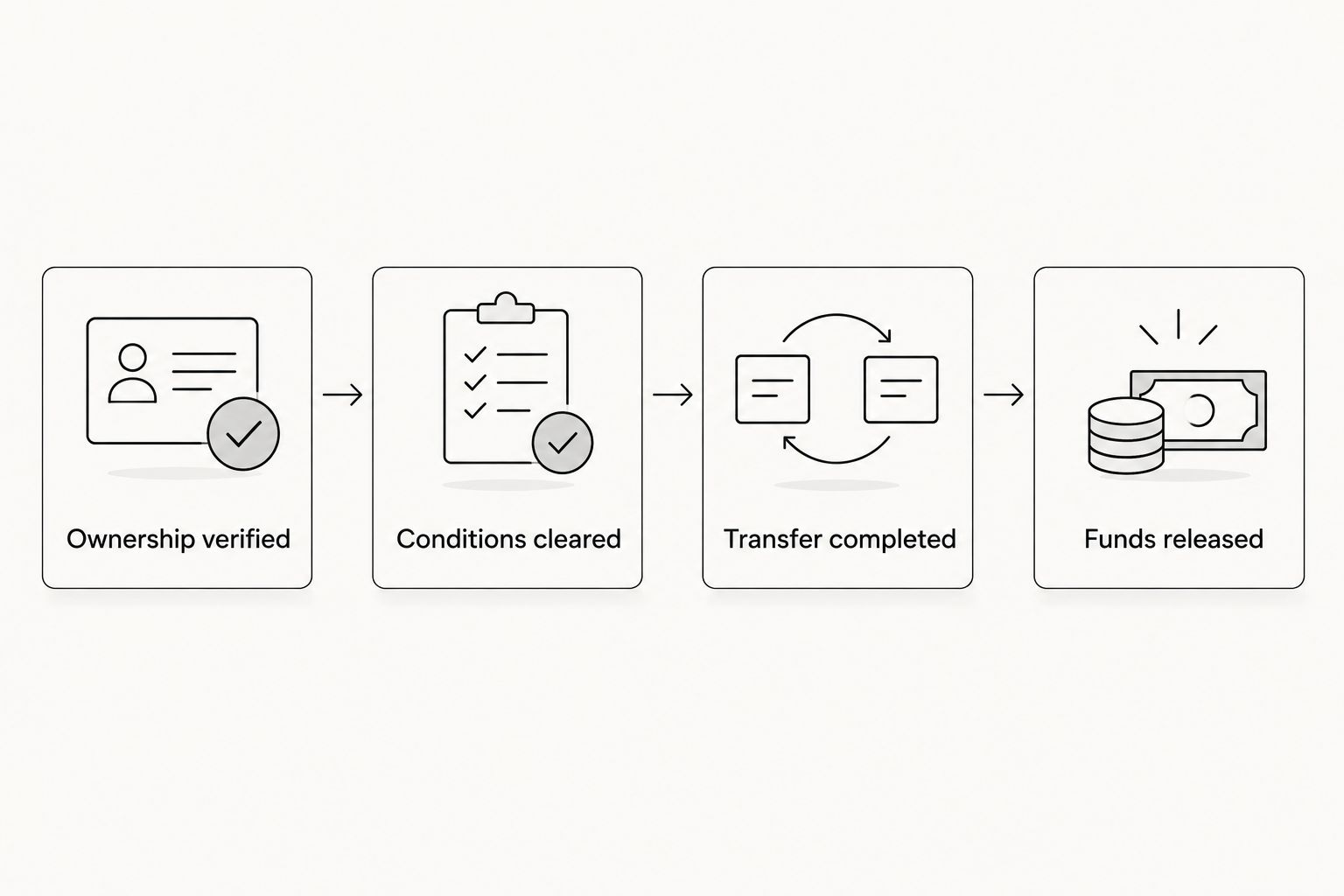
A checklist prevents an encouraging status update from hiding an unfinished task. If someone says the file is complete, ask which checkpoint is complete and request the supporting document.
Contract and escrow instructions
Establish the conditions for closing
- Review the sale agreement. Confirm what transfers, who signs, how existing reservations or usage rights are handled, and how account obligations are allocated. Check cancellation and default provisions. Ask an independent attorney about legal terms you do not understand before signing.
- Clear required approvals. If the resort has a right of first refusal, follow the applicable submission and response procedure. Keep the written waiver, exercise notice, or other evidence the closing professional identifies as sufficient. Do not assume silence clears the condition unless the governing procedure supports that conclusion.
- Verify escrow instructions. Obtain written instructions identifying the escrow holder, funding requirements, and conditions for releasing money. Confirm payment details through a phone number you obtained independently—not solely through the message supplying those details.
Expected result: The parties understand the closing conditions, the designated holder of transaction funds, and the evidence needed before disbursement.
For a 2026 closing, keep payment verification separate from routine email updates. The FBI's business email compromise guidance identifies altered payment instructions as a fraud risk; an apparently familiar email thread is not independent verification.
Separate loan payoff from seller proceeds
If the ownership has a loan, ask the closing professional how the lender's payoff and any required lien release will be handled. A resort account statement does not substitute for lender instructions.
The timeshare mortgage payoff to resale closing workflow addresses that additional handoff. Resolve the funding needed to complete the transaction before assuming the closing will produce a seller payout.
Do not stop contractual payments simply because a sale agreement has been signed. Ask the lender and resort how to keep the relevant accounts current while the transfer remains pending.
Transfer documents
Complete and confirm the transfer
- Review the prepared documents. Check seller and buyer names, ownership details, and any legal description against the verified records. Ask the preparer to correct errors before execution. Do not make handwritten changes unless the responsible professional confirms the proper correction procedure.
- Follow execution instructions. Confirm which signatures require notarization, witnesses, original documents, or other formalities. These requirements depend on the document and applicable jurisdiction. If an owner signs abroad or through a representative, settle acceptance requirements before the signing appointment.
- Obtain completion evidence. For deeded ownership, request recording confirmation where recording applies. Separately, ask the resort to acknowledge the transfer and explain the former owner's account status. For a contractual membership, request the resort's applicable transfer confirmation instead of assuming a deed is needed.
Expected result: You have the evidence required for your ownership type, plus a clear answer about any remaining resort-account work.
A 2026 closing checklist should distinguish document execution, public recording where applicable, and resort account administration. These are different tasks. Ask the closing company which tasks its completion notice actually covers.
Settlement and resale payout
Verify the final handoff
- Review the settlement statement. Check the agreed sale amount, deductions, account adjustments, loan payoff where applicable, and resulting seller proceeds. Ask for an explanation of every unfamiliar entry. Resolve differences between the statement and agreement before authorizing disbursement.
- Confirm release conditions. Ask the escrow holder which conditions remain outstanding and what evidence satisfies them. Buyer funding, cleared funds, required approvals, and transfer evidence should be addressed in the written instructions applicable to the transaction.
- Confirm receipt and retain records. Verify that funds reached the intended account through your own bank records. Keep the final settlement statement, transfer evidence, resort acknowledgment, and relevant correspondence together. Ask your tax adviser which records are needed for reporting and retention.
Expected result: You can reconcile the settlement statement with the money received and identify whether any account follow-up remains.
A payout notification is not the same as confirmed receipt. Likewise, receiving funds does not answer every question about the resort's account records. Close both loops rather than relying on one final email.
If deductions exceed the proceeds otherwise payable to you, ask for the settlement calculation and required funding instructions before proceeding. Do not interpret the word resale as a promise that you will receive money.
Variant: transferring a nondeeded membership
The same checkpoints work for a contractual membership, but the transfer evidence changes. Your 2026 checklist should follow the ownership documents and resort procedure rather than forcing every transaction into a deed-recording workflow.
| Ownership route | Best for | Useful feature | Limitation to address |
|---|---|---|---|
| Deeded transfer | Owners whose interest is conveyed by deed | Recording provides a public record of the instrument where applicable | Recording alone does not establish that resort account administration is complete |
| Contractual membership transfer | Owners whose interest transfers under membership or club rules | Resort acceptance provides transaction-specific transfer evidence | Acceptance requirements depend on the governing documents and resort procedure |
For a nondeeded transfer, ask the closing professional to replace deed-preparation and recording tasks with the required assignment, membership application, or acceptance tasks. Keep the same controls around identity, approvals, funding, and settlement.
Neither route is automatically better. Use the transfer method your ownership requires, and obtain evidence that corresponds to that method.
Troubleshooting
The resort still shows your name
Ask the closing company whether the resort received the required transfer package and whether anything remains outstanding. Request acknowledgment from the resort rather than resending documents without checking what it needs.
The seller names do not match
Compare the ownership records with the proposed transfer documents. Ask the preparer which supporting evidence or corrective document is required; do not sign an inaccurate document to keep the file moving.
The settlement amount differs from your expectation
Request an itemized reconciliation against the agreement and current account information. Identify whether the difference comes from an adjustment, payoff, deduction, or error before authorizing release.
Payment instructions change unexpectedly
Pause the payment and independently contact the established closing or escrow representative. If you have already sent money to a suspected fraudulent destination, contact your bank immediately and report the suspected fraud through the appropriate authorities.
The closing company says payout is pending
Ask which specific release condition remains unsatisfied, who controls that condition, and what document will confirm completion. Request a written status update rather than accepting an unsupported payment date.
Customize your workflow
Add exceptions to your checklist before they become signing problems. Joint owners, estate representatives, trust ownership, outstanding loans, and overseas signatures require the responsible professional to confirm the applicable documentation.
Sold My Timeshare provides resale and exit assistance, but those paths are not interchangeable. A resale workflow concerns transferring ownership through a sale; evaluating an exit requires its own written explanation of the proposed outcome and obligations.
A free valuation from Sold My Timeshare is a low-commitment starting point if you have not established your resale options. Once a transaction begins, use its actual contract and closing instructions to control the next step.
FAQ
Do I need a title company to close a timeshare resale?
The closing services you need depend on your ownership type, transaction, and applicable law. Ask who handles title review, escrow, transfer documents, recording where applicable, and resort notification rather than relying on the company's name.
When do I receive money after a timeshare closing?
You receive proceeds when the escrow holder satisfies the applicable release conditions and disburses the funds. Request the written conditions and verify receipt through your bank; there is no universal payout deadline for every transaction.
Does recording a timeshare deed mean the sale is completely finished?
Recording a deed does not, by itself, confirm resort account updates or seller payout. Obtain the applicable transfer evidence, resort acknowledgment, and settlement confirmation separately.
Can I sell a timeshare that still has a mortgage?
An outstanding mortgage requires a transaction-specific payoff and lien-release plan. Ask the closing professional and lender what must happen before the ownership can transfer and whether additional seller funds are required.
What should I do if closing payment instructions suddenly change?
Stop and verify the instructions through independently established contact details. Do not use only the phone number or reply address included in the message announcing the change.
Is a free timeshare valuation a guaranteed resale payout?
No. Sold My Timeshare offers a free, no-obligation valuation, but a valuation does not establish a funded sale, completed transfer, or final seller proceeds.
Should I stop paying maintenance fees after signing a sale agreement?
Do not assume that signing ends your payment obligations. Obtain transaction-specific guidance from the resort and closing professional about account responsibility while the transfer is pending.
One last thing
Ask for 2 separate written confirmations at the end: what establishes completion of the ownership transfer, and what establishes completion of disbursement. Keeping those questions separate prevents one reassuring message from standing in for both answers.