
Yes, you can sell a timeshare with a mortgage balance, but the sale does not automatically cancel your loan. To complete the transfer, you need a documented plan to pay off the debt, obtain the lender’s release, or use another arrangement the lender expressly approves. If the sale proceeds do not cover the payoff and closing obligations, you must resolve that shortfall before the transaction can close on those terms.
- Can you sell a timeshare with a mortgage balance? Yes, with a documented payoff or lender-approved arrangement.
- A buyer taking ownership does not automatically release you from the timeshare loan.
- Sold My Timeshare offers free, no-obligation valuations for owners assessing resale or exit assistance.
- Compare the lender’s written payoff with expected net proceeds before accepting an offer.
Why this matters
Selling the ownership and resolving the loan are separate tasks. A signed purchase agreement does not, by itself, make your lender release you from repayment. That distinction matters whether your ownership involves a deed, points, or a contractual right to use accommodations.
For your 2026 decision, start with the ownership documents and loan agreement rather than an advertised resale figure. Sold My Timeshare provides free, no-obligation timeshare valuations and resale or exit assistance. A valuation helps you assess resale; it is not a lender payoff statement or a promise that your debt will disappear.
Can you sell a timeshare that still has a mortgage balance?
Yes. The practical question is whether the proposed transaction satisfies the loan terms and the resort’s transfer requirements. If a lender holds a lien against the ownership, closing generally requires a way to clear that lien or an expressly approved alternative.
Not every loan used to purchase a timeshare has the same security or transfer provisions. Review your actual agreement instead of assuming that every timeshare loan works like a residential mortgage.
| Route | Best for | Main advantage | Main limitation |
|---|---|---|---|
| Payoff before sale | Owners able to clear the loan independently | Separates debt repayment from the buyer’s transaction | Requires funds before you know the final sale outcome |
| Payoff at closing | Owners whose transaction can satisfy the lender’s requirements | Coordinates repayment with the ownership transfer | A shortfall still needs funding or an approved resolution |
| Approved loan assumption | Owners whose lender permits a qualified buyer to assume the debt | Offers a possible alternative to immediate payoff | Requires express approval; your release must be documented |
| Resort surrender inquiry | Owners exploring an alternative to resale | Opens a direct discussion with the resort | Eligibility and treatment of an outstanding loan depend on written terms |
Choose the route your lender and ownership documents permit, not the route a buyer or sales representative merely promises. None of these options guarantees acceptance, a buyer, or release from the debt.
Selling after paying off the loan
Paying off the loan before selling removes that loan balance from the resale transaction once the lender processes the payoff and any required lien release. It does not eliminate separate maintenance obligations or resort transfer requirements.
The advantage is a simpler debt position when you negotiate with a buyer. The drawback is committing your own funds before the sale is complete. Do not treat paying off the loan as proof that the ownership will sell or that you will recover what you originally spent.
For a 2026 sale, retain the payoff confirmation and ask how any lien release will be delivered or recorded. Keep those records with your ownership documents so the closing professional can verify the status.
Paying off the loan at closing
A coordinated closing can apply sale proceeds toward the loan, subject to the lender’s instructions and the closing professional’s ability to handle the transaction. The important comparison is net proceeds against the required payoff, not the buyer’s offer against your account’s principal balance.
If the available proceeds fall short, the closing needs an identified source for the difference or a written alternative accepted by the lender. An offer alone does not solve negative equity.
The timeshare mortgage payoff-to-resale closing workflow addresses the handoff between repayment and transfer. Before authorizing closing, ask who receives the funds, who sends the payoff, and who verifies the release.
Selling through an approved loan assumption
A loan assumption means a buyer takes over the loan under an arrangement the lender approves. Do not assume this option exists: the agreement and lender determine whether assumption is permitted and what approval requires.
Even an approved assumption needs careful reading. Permission for a buyer to make payments is not the same as a written release of your liability. Ask the lender to identify the document that releases you and the point at which that release becomes effective.
Avoid informal arrangements where someone promises to send you monthly payments while the loan remains in your name. You remain exposed to the obligations you signed unless the lender agrees otherwise.
How do you prepare a mortgaged timeshare for sale?
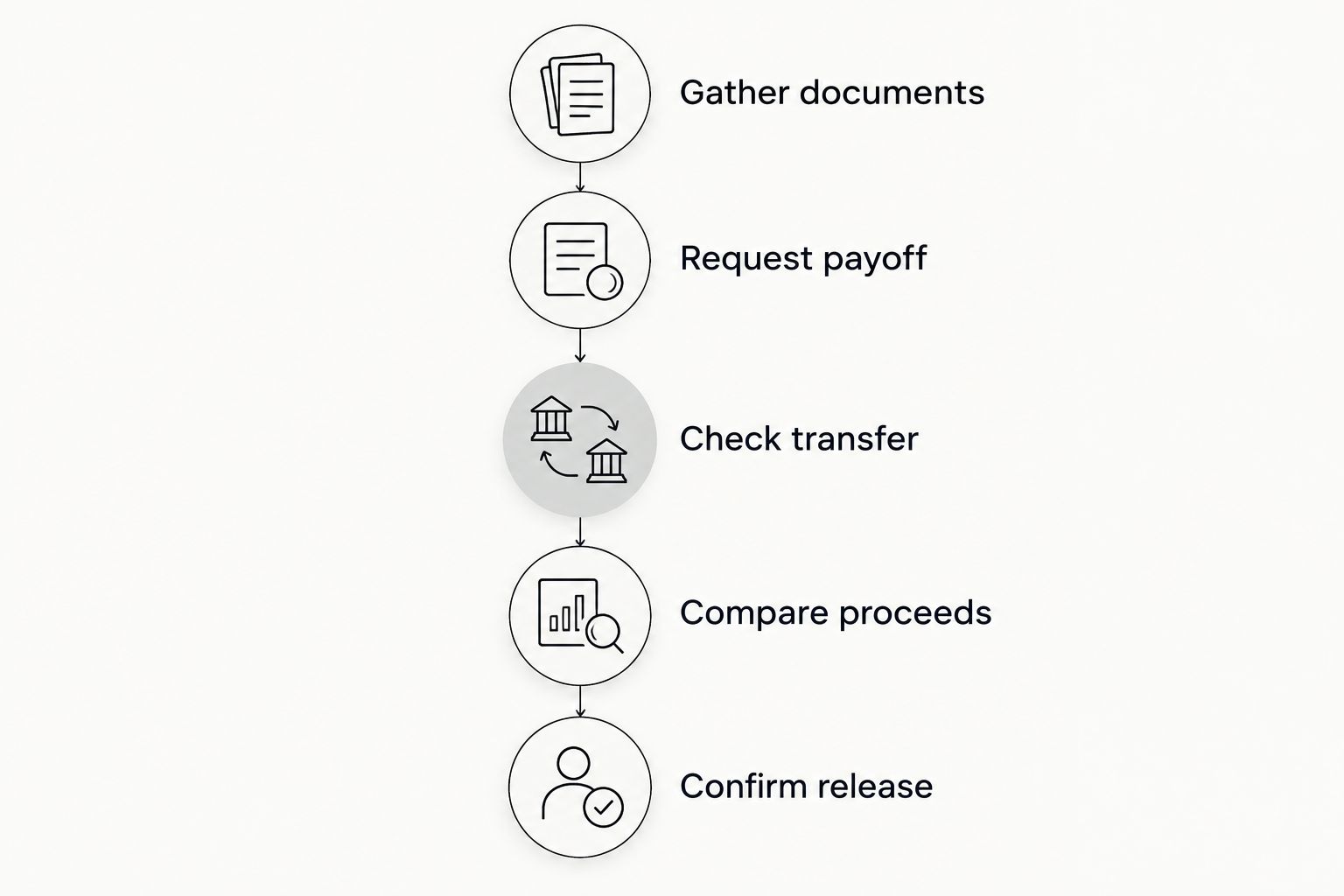
Use this sequence for your 2026 sale planning. Each step answers a different question, so do not substitute a resale estimate for a payoff statement or a buyer’s promise for lender approval.
1. Gather documents
Collect the purchase agreement, loan agreement, ownership certificate or deed, recent account statements, and resort correspondence. Identify every person named on the ownership and every borrower named on the loan; those lists are not necessarily identical.
Check whether the financing is secured by the timeshare. If the documents are unclear, ask the lender or a licensed attorney to explain the security and transfer provisions before you commit to a sale.
2. Request payoff
Ask the lender for a written payoff statement covering the proposed closing date. Confirm its expiration date, payment instructions, and how to obtain an updated statement if closing moves.
A statement showing principal is not necessarily the amount required to satisfy the loan. Follow the lender’s written payoff instructions rather than calculating a final payment from your account dashboard.
3. Check transfer
Ask the resort or association for its ownership-transfer requirements and account status. Determine whether unpaid charges, transfer approvals, or a right of first refusal affect the transaction.
Keep these requirements separate from the loan payoff. A lender confirming repayment does not establish that the resort has accepted the new owner or updated its records.
4. Compare proceeds
Obtain a resale assessment and ask the closing professional for an itemized estimate of the seller’s obligations. Compare what remains available for the loan with the lender’s required payoff.
If there is a gap, decide how it will be resolved before accepting terms you cannot perform. Do not count on an exit provider, buyer, or closing professional to forgive debt that only the lender controls.
5. Confirm release
Before completion, establish which documents will prove payment, any lien release, and the ownership transfer. After closing, obtain those documents and confirm the lender’s account status and the resort’s ownership records separately.
Keep the complete file. A purchase agreement, recorded document, and lender confirmation serve different purposes; no single document automatically proves that every obligation has ended.
Why the path to selling varies
Your 2026 resale plan depends on the agreements attached to your ownership, not simply the fact that you still owe money. These factors determine which questions need answers before closing:
- Loan security: A loan secured against the ownership creates different closing issues from an unsecured personal loan used to fund the purchase.
- Payoff requirements: The lender’s written instructions determine the amount and process needed to satisfy the loan.
- Expected proceeds: A transaction that leaves enough for repayment differs from one requiring the seller to fund a shortfall.
- Ownership structure: A deeded interest, points ownership, and contractual usage rights require different transfer documentation.
- Account standing: Unpaid loan installments and unpaid resort charges are separate issues that need separate attention.
- Transfer restrictions: Required approvals, transfer procedures, and any right of first refusal affect how the buyer’s purchase proceeds.
Do not assume another owner’s successful exit establishes your eligibility. Ask for answers tied to your lender, agreement, ownership, and current account status.
Can you sell if you owe more than the timeshare is worth?
Yes, but an offer below the required payoff does not erase the difference. You need funds to cover the shortfall or a written lender-approved resolution that allows the transaction to proceed.
Do not sign first and figure out the gap later. Have the closing professional show how the proposed proceeds will be distributed and what you must contribute before you commit.
Can a buyer take over your timeshare payments?
A buyer can assume the loan only if the lender permits and approves that arrangement. A private agreement between you and the buyer does not, by itself, change your contract with the lender.
Ask specifically whether approval releases you from future liability. If the loan stays in your name, a buyer’s promise to pay does not protect you from the lender’s repayment rights.
Can you give the timeshare back instead of selling?
You can ask the resort about a surrender or deed-back option, but acceptance and eligibility depend on its terms. An outstanding loan requires its own resolution; returning ownership does not automatically cancel the financing.
Request a written explanation of what happens to the loan, maintenance obligations, and ownership record. Do not treat a conversation about surrender as an accepted release.
When resale or exit assistance fits
Sold My Timeshare’s timeshare valuation service is best for owners seeking a free, no-obligation starting point for a resale decision. Its stated services include resale and exit assistance, making an initial inquiry relevant when you need to assess those paths.
The limit is equally important: a service inquiry is not permission to transfer a financed ownership. Your lender controls its loan approval and release, while the resort controls the transfer requirements within its authority.
Before engaging any provider, ask what work it will perform, what documents you will receive, and which results depend on another party’s approval. Get the scope in writing and reject any instruction to misrepresent your account or bypass lender requirements.
FAQ
Can you sell a timeshare with a mortgage balance in 2026?
Yes, you can sell a timeshare with a mortgage balance in 2026 if the transaction resolves the financing requirements and permits a valid ownership transfer. Selling the ownership does not automatically cancel your loan.
Does selling my timeshare automatically pay off my loan?
No, selling your timeshare does not automatically pay off the loan. The closing must include a documented payoff or another arrangement the lender expressly approves.
What happens if my timeshare sale does not cover the mortgage?
You must resolve the shortfall through additional funds or a written lender-approved arrangement. A buyer’s offer below the balance does not require the lender to forgive the difference.
Can I transfer my timeshare loan to the buyer?
You can transfer the loan through an assumption only if the lender permits and approves it. Obtain written confirmation of whether the arrangement releases you from liability.
Should I stop making payments while trying to sell?
Listing a timeshare for sale does not suspend your payment obligations. Follow your existing agreement unless the lender gives you a written modification or other approved arrangement.
Will a quitclaim deed remove my timeshare mortgage?
No, a quitclaim deed does not by itself release you from your loan agreement. Transferring an ownership interest and resolving a borrower’s debt are separate legal matters.
Can Sold My Timeshare help me assess my options?
Sold My Timeshare provides free, no-obligation timeshare valuations and resale or exit assistance. Use the valuation alongside your lender’s written payoff information to assess your next step.
One last thing
Ask for proof of release, not just proof of transfer. A document showing a new owner does not necessarily establish that the lender has released you from the loan.
For any transaction you complete in 2026, keep written confirmation of the loan outcome alongside the final transfer documents. If someone says your obligations have ended, ask which document proves it and which party issued that document.