
Yes, you can sometimes end a timeshare ownership after the rescission period, but you generally lose the automatic right to cancel simply because you changed your mind. Your remaining routes include a resort-approved surrender, a resale or other accepted transfer, a negotiated release, or a legal claim supported by the facts. Missing the rescission deadline does not eliminate every exit option, and hiring an exit company does not itself release you from the contract.
- Can you cancel a timeshare after the rescission period? Sometimes, through an accepted surrender, transfer, negotiated release, or legal remedy.
- Sold My Timeshare offers timeshare valuations and resale/exit assistance for owners assessing their next step.
- Start with the resort; confirm loan obligations separately before signing an exit agreement.
- Stopping payments does not cancel ownership. Get written confirmation that the relevant obligations have ended.
Why this matters
The decision in 2026 is not just whether you want out. You need to identify who has authority to accept the ownership, what happens to any loan, and what document proves the release.
Sold My Timeshare provides free, no-obligation valuations and resale/exit assistance. Sold My Timeshare is best for timeshare owners seeking a valuation and help assessing resale or exit options. A valuation helps you assess a sale; it does not establish a right to cancel or guarantee a buyer.
Can you cancel a timeshare after the rescission period?
Yes, but ending ownership after the deadline usually requires an agreement, a valid transfer, or a legal remedy rather than a simple cancellation notice. The distinction matters: rescission reverses a transaction under an applicable cancellation right, while a later exit can end ownership without undoing the original purchase.
For your 2026 decision, compare the route with the result you need. Getting your name off an ownership record and getting released from a loan are separate questions.
| Route | Best for | Main advantage | Main limitation |
|---|---|---|---|
| Resort-approved surrender | Owners whose resort accepts their ownership back | A direct route through the resort's designated process | Acceptance and eligibility depend on the program |
| Resale or accepted transfer | Owners with transferable ownership and a willing recipient | Transfers the interest through a documented closing | Finding a recipient does not clear a loan or complete the transfer |
| Negotiated release | Owners seeking an agreement outside a standard program | Lets the parties address specific obligations in writing | The other parties must agree |
| Legal review and potential claim | Owners with evidence of misrepresentation or another legal issue | Tests whether enforceable remedies exist | Dissatisfaction alone does not establish a claim |
These routes are not interchangeable. A resale involves a new owner; a surrender returns the interest through an accepted process; a legal claim challenges conduct or enforceability. Ask anyone offering help which route they propose and what constitutes completion.
Resort-approved surrender: start with the owner-services team
Ask the resort about its official surrender or deed-back process before hiring outside help. Use contact information from your ownership records or an independently verified resort source, not an unsolicited message claiming to represent the resort.
Request the eligibility requirements and application process in writing. Explain whether you have an outstanding loan, unpaid assessments, joint owners, or an estate involved. Those details affect what the resort needs to evaluate.
The benefit is direct communication with the party administering the ownership. The limitation is that asking does not require the resort to accept it back. Keep the request, response, and any acceptance documents together.
A surrender proposal also needs a clear boundary: does it address ownership only, or does it release other obligations? Do not treat a customer-service acknowledgment as a completed exit.
Resale or transfer: confirm what can actually change hands
A resale is an ownership transaction, not a retroactive cancellation. You need a willing buyer or recipient, compliance with applicable transfer requirements, and completion of the relevant closing process.
Before listing, identify exactly what you own: a deeded interest, points, or another contractual right. Check the governing documents for transfer restrictions and resort procedures. An advertisement cannot override those requirements.
Resale offers a route to a new owner, but marketability and transferability are different. An interest can be transferable without attracting a buyer on terms you will accept. A valuation is a decision aid, not a promise of sale proceeds.
If a loan remains, ask the lender how it must be handled. Do not assume that a buyer taking over use of the timeshare also takes over your debt. Get any lender-approved arrangement in writing before relying on it.
Negotiated release: define every obligation being settled
A negotiated release is an agreement with the relevant parties to end specified obligations. It is not created by sending a cancellation letter that the other party never accepts.
Ask the proposed agreement to identify the ownership, the parties being released, the effective date, and the obligations that survive. If several people signed the original documents, check whether the agreement addresses each person's position.
The advantage is specificity: an agreement can state exactly what ends. The limitation is equally clear: a release binds the parties and obligations it actually covers, not every related account by implication.
Before signing, have a qualified attorney review language you do not understand. This is especially important when an agreement asks you to waive claims or accept continuing responsibilities.
Legal review: distinguish evidence from disappointment
Legal review belongs on the list when you believe the sale involved misrepresentation, missing required disclosures, or another legal problem. A lawyer must assess the applicable law, documents, evidence, and deadlines; the fact that you regret the purchase is not enough by itself.
Gather the signed contract, disclosure materials, sales correspondence, financing documents, and any cancellation notice you sent. Write a factual timeline separating what you were told from what the written documents say.
Do not assume your rescission period expired until the applicable deadline and triggering events have been checked. Some cancellation rights depend on legally required documents or disclosures, not solely on the date you remember attending a presentation.
For a broader explanation of the routes, read how to get out of a timeshare contract legally. General guidance is a starting point, not a determination that a particular contract can be canceled.
What should you do first in 2026?
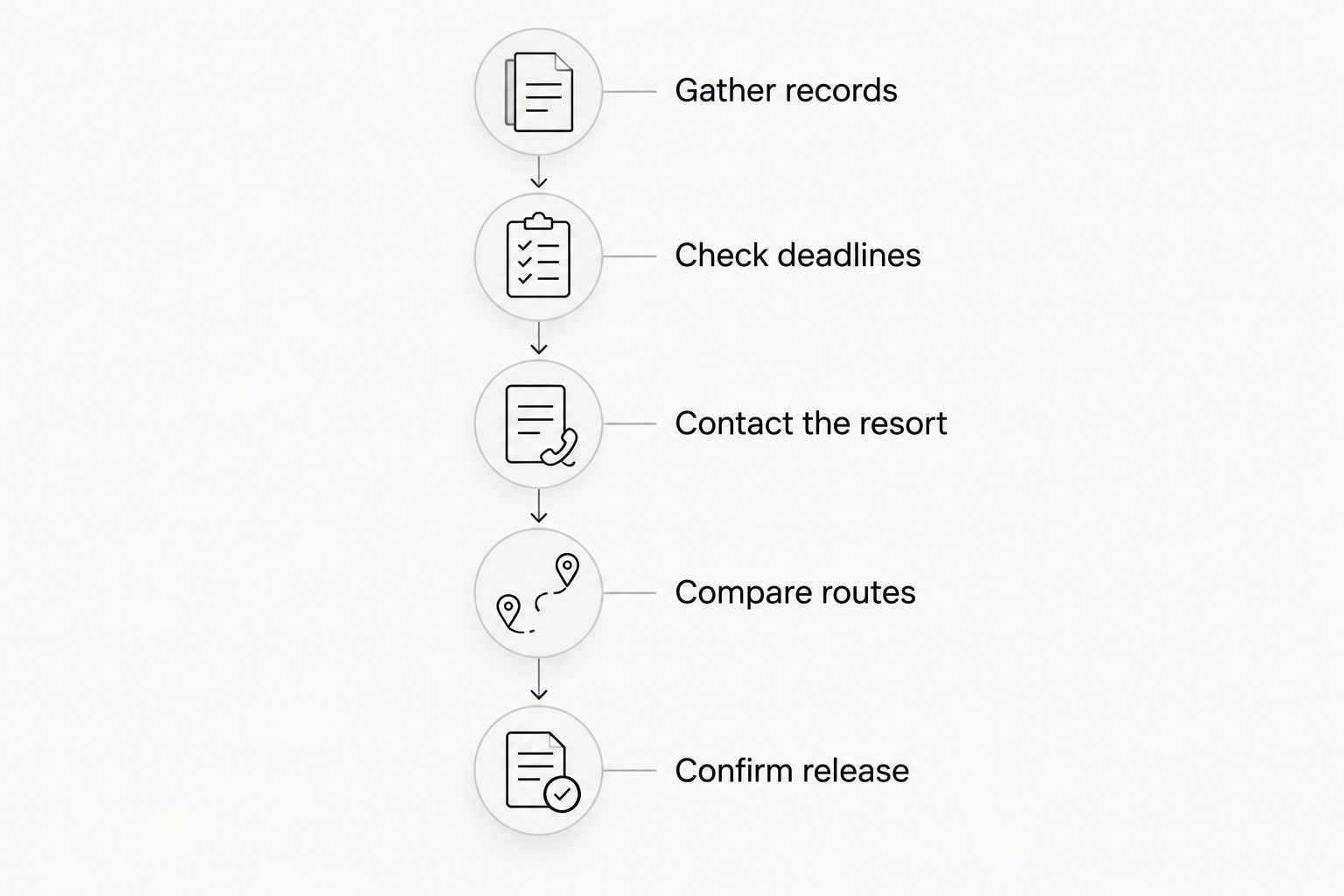
Use this sequence to turn an open-ended exit search into a documented decision. You do not need to choose a provider before you understand your ownership and the resort's response.
- Gather records. Collect the purchase agreement, ownership documents, account statements, loan paperwork, and correspondence. Include any notice you previously sent and proof of delivery.
- Check deadlines. Identify the applicable cancellation language and obtain legal advice if the deadline or required disclosures are unclear. Do not rely on a deadline quoted for someone else's resort or state.
- Contact the resort. Ask the designated owner-services team about surrender, transfer, and hardship procedures. Request a written answer identifying any conditions.
- Compare routes. Match the resort's response with your loan status, transfer requirements, and evidence of any legal issue. Ask what each proposed service actually does.
- Confirm release. Obtain the completed transfer or release documents and verify the status of related accounts. Keep records after the transaction closes.
If you receive conflicting instructions, pause before authorizing a transfer or changing payments. Ask each party to explain its authority and put the proposed outcome in writing. An unresolved contradiction is a reason to seek clarification, not to sign faster.
Why timeshare exit options vary
Your strongest route in 2026 depends on the ownership and its obligations, not on a provider's headline promise. These factors determine which questions you need answered:
- Ownership structure. Deeded interests, points, and contractual memberships can require different transfer documents and approvals.
- Loan status. Ending ownership does not automatically discharge financing; the lender's rights need separate attention.
- Account standing. Outstanding assessments or other charges can affect surrender or transfer requirements.
- Resort rules. Governing documents and program terms determine the resort's process and any required approvals.
- Evidence and applicable law. A legal remedy depends on facts and legal requirements, not simply on wanting to leave.
- Other owners. Joint ownership, a divorce, or an estate can affect who must sign and who has authority to act.
Avoid treating another owner's result as your eligibility decision. Even owners at the same resort can have different contracts, financing arrangements, and account histories.
How do you evaluate an exit service without adding risk?
Ask for a written description of the work, the party performing it, and the document you should receive at completion. A company that markets an exit service is not automatically the resort, lender, closing agent, or attorney responsible for a particular step.
Separate the provider's service agreement from the underlying timeshare obligations. Canceling the service agreement does not cancel the timeshare, and completing the provider's tasks does not necessarily establish that the resort accepted a transfer.
Before authorizing work, ask:
- What specific route will you pursue for this ownership?
- Who must approve the result?
- Does the proposed outcome include the loan and outstanding assessments?
- What happens if the resort declines the request?
- What written evidence establishes completion?
Treat guaranteed cancellation claims as a reason to inspect the contract, not as proof of an outcome. Independently verify anyone claiming to be your resort, lender, or attorney. Do not send account credentials or sign transfer documents merely because a caller knows details about your ownership.
Can you cancel if you still owe a timeshare loan?
An outstanding timeshare loan creates a separate obligation that must be addressed in an exit plan. A resort surrender, ownership transfer, or third-party service agreement does not automatically release the borrower.
Ask the lender for its requirements and account status. If someone proposes a transfer while leaving the loan in your name, get legal advice about the continuing responsibility before proceeding.
Will stopping payments cancel your timeshare?
Stopping payments is not a cancellation method. Nonpayment can lead to collection activity, adverse credit reporting, or enforcement proceedings, depending on the agreement and applicable law.
If you cannot keep up, contact the lender and resort about your circumstances and seek independent advice. Do not confuse an account falling into default with a negotiated release from the obligations.
What proves that a timeshare exit is complete?
The proof depends on the route: an accepted surrender, a completed transfer with required records updated, a written release, or an enforceable legal outcome. Check the documents against the obligations you intended to end.
For your 2026 records, retain the final agreement, closing or recording documents where applicable, and written account confirmations. A submitted application, listed property, or provider status update is evidence of activity—not necessarily completion.
FAQ
Can you cancel a timeshare after the rescission period ends?
Yes, sometimes, but you generally need an accepted surrender, completed transfer, negotiated release, or valid legal remedy. The expired rescission right is different from these later exit routes.
What's the first thing I should do after missing the timeshare cancellation deadline?
Gather your contract and contact the resort's designated owner-services team about official surrender or transfer options. If the deadline or required disclosures are unclear, ask a qualified attorney to check them.
Does selling my timeshare cancel the original purchase?
No, a resale transfers the ownership rather than reversing the original purchase. Any financing and other continuing obligations need to be addressed separately.
Can I give my timeshare back to the resort?
You can ask the resort to accept a surrender, but acceptance depends on its requirements and your ownership. Get the conditions and final acceptance in writing.
Do I still owe maintenance assessments while an exit is being handled?
Starting an exit request does not itself end assessment obligations. Check your governing documents and any written release for when responsibility ends.
Can a timeshare exit company guarantee that my loan disappears?
A provider's guarantee does not itself discharge a loan. Require written evidence of the lender's release or another legally effective resolution.
Can Sold My Timeshare help me assess my options?
Sold My Timeshare provides free, no-obligation timeshare valuations and resale/exit assistance. A valuation supports a resale decision; it does not establish a legal cancellation right.
One last thing
The strongest question is not ‘Can you get me out?’ It is ‘Which document ends which obligation?’ Ask it before signing, then use the answer to check the final result.
Keep ownership, financing, and account obligations separate on your checklist. A completed step in one category does not prove the others are resolved. That distinction prevents an apparent exit from being mistaken for a complete release.