
Yes, you can ask to negotiate a timeshare cancellation fee down, but a reduction requires the party charging it to agree; there is no automatic right to a discount. A lower cancellation fee also does not automatically erase a loan, unpaid maintenance charges, or future ownership obligations. For a 2026 exit, negotiate the written release and the fee together—not the fee alone.
- Can you negotiate a timeshare cancellation fee? Yes, but the party charging it must agree to the reduction.
- A reduced exit-service fee does not automatically cancel ownership, maintenance obligations, or a separate loan.
- Request an itemized quote and written release terms before accepting a counteroffer.
- Sold My Timeshare offers timeshare valuations for owners assessing resale alongside exit assistance.
Can you negotiate a timeshare cancellation fee down?
You can request a lower fee, a waiver of particular charges, or revised payment terms. Whether the request succeeds depends on the agreement and the authority of the person considering it. Do not treat a salesperson's willingness to discuss terms as approval of a cancellation.
Start by identifying what the charge actually covers. The word cancellation can describe a resort surrender, an outside company's service, or a proposed debt settlement—different transactions with different consequences. If you recently purchased, check how long the timeshare rescission period lasts before negotiating a paid exit.
| Charge or arrangement | Best for | What to request | Benefit | Limitation |
|---|---|---|---|---|
| Resort surrender or deed-back | Owners asking the resort to accept ownership back | Itemized charges and written acceptance terms | Addresses the ownership directly | Acceptance and release depend on the agreement |
| Outside exit-service fee | Owners evaluating paid assistance | Defined work, payment terms, and cancellation provisions | Clarifies what assistance you are purchasing | A service agreement alone does not release ownership |
| Loan settlement | Owners discussing outstanding debt with the creditor | Written settlement and lien-release terms, where applicable | Addresses the identified debt | Debt resolution and ownership transfer are separate issues |
| Administrative or transfer charge | Owners completing an approved transaction | Contractual basis and a waiver review | Isolates a specific charge for discussion | Waiving the charge does not complete the transfer |
Why this matters
A smaller bill is not necessarily a completed exit. You need to know who accepts the ownership, who releases each obligation, and when those changes take effect.
For a 2026 negotiation, keep the proposed fee beside the proposed outcome. An offer that reduces a service charge but leaves ownership unresolved is not equivalent to an accepted surrender with documented release terms. Compare what ends, not just what you pay.
Resort surrender: negotiate the acceptance terms
If the resort or owners' association is proposing a surrender, ask which department has authority to approve it. Request the eligibility requirements and a written explanation of every charge before making a counteroffer.
Ask whether a charge can be waived, reduced, or included in the surrender arrangement. Also ask what happens to maintenance obligations while documents are being processed. Do not assume that submitting an application stops billing.
The advantage of this route is direct discussion with the party being asked to accept the ownership. Its limitation is equally important: asking does not establish eligibility or guarantee acceptance. A clear refusal is a reason to assess another lawful route, not to assume nonpayment will force approval.
Exit-service agreement: negotiate the work and payment terms
When an outside company charges the fee, identify the actual service before discussing a reduction. Ask who performs the work, what documents you receive, and what counts as completion under the agreement.
A reduced service fee means little if the scope remains unclear. Request written answers about termination rights, payment milestones, refund conditions, and work that costs extra. A payment schedule changes when you pay; it does not necessarily reduce the total obligation.
Paid assistance can help an owner organize an exit process, but the service contract is not itself proof that a resort, association, or lender has released anything. Negotiate a clearly defined service—not a verbal promise of cancellation.
Loan settlement: separate debt from ownership
An outstanding loan needs its own review. Ask the creditor or its authorized representative whether the proposed arrangement settles the identified debt and how any associated lien will be handled.
Do not assume a resort's surrender offer settles a separately held loan. Likewise, do not assume settling a loan transfers your timeshare or ends maintenance obligations. Each document needs to identify the obligation it resolves.
Debt settlement can involve credit and tax consequences. Before accepting an arrangement involving forgiven debt, obtain advice from a qualified attorney or tax professional about your circumstances. A lower payment is not enough information to judge the agreement.
How do you ask for a lower cancellation fee?
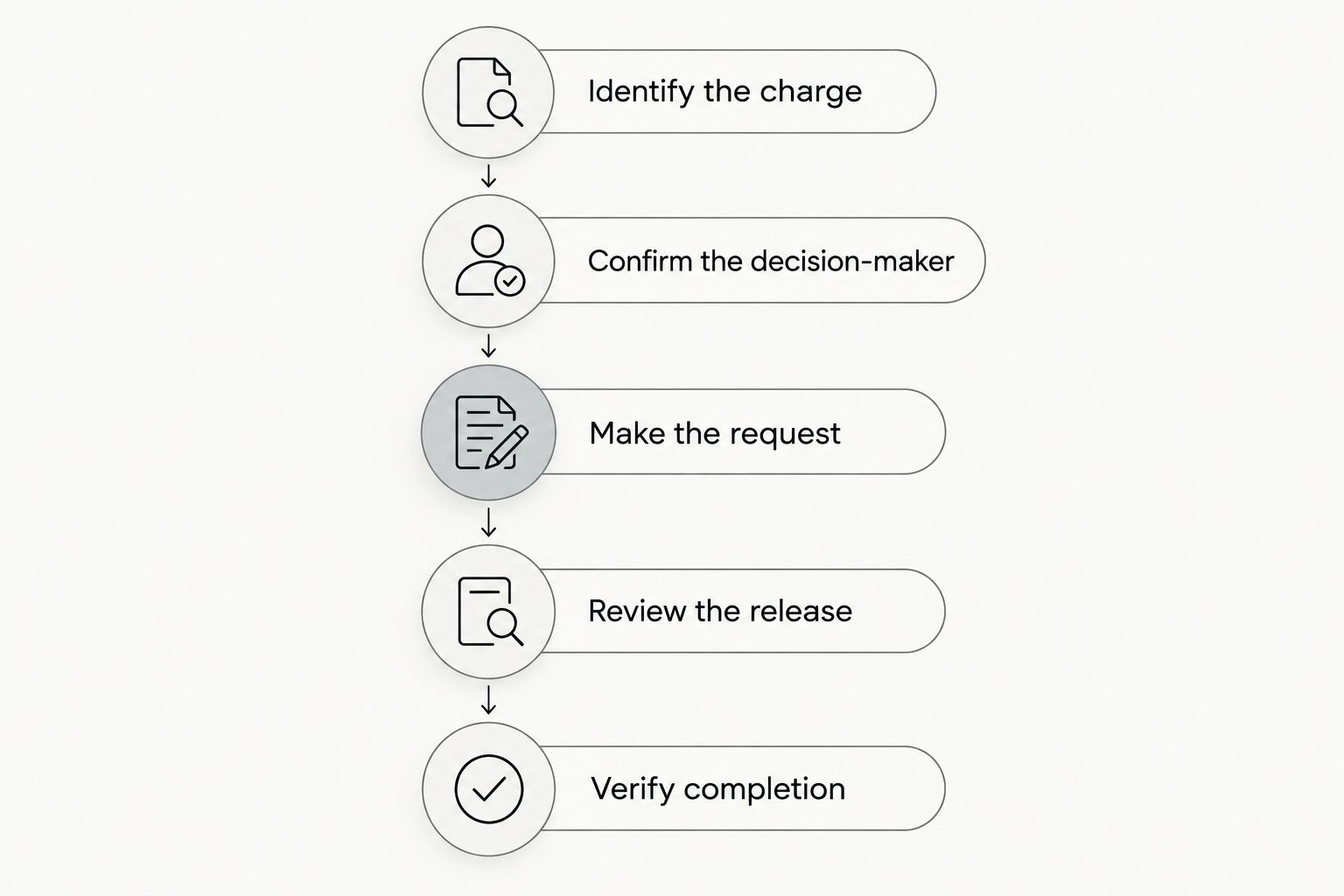
Use a written request that makes the decision easy to understand. Your goal is a specific counteroffer tied to a specific result, not a general plea to make the bill disappear.
Step 1: Identify the charge
Collect the purchase agreement, current account statement, fee quote, and relevant correspondence. Separate the cancellation or service charge from maintenance assessments, loan balances, transfer charges, and overdue amounts.
If a quote bundles everything together, request an itemized version. You cannot make a useful counteroffer until you know which charges the recipient controls and which belong to someone else.
Step 2: Confirm the decision-maker
Ask who can authorize a reduction and who can approve the exit itself. Those approvals are not necessarily the same decision.
Use contact information from your existing account documents or independently verified company records. Do not send payment or sensitive ownership documents solely because an unexpected caller claims to have negotiated approval.
Step 3: Make the request
Explain why you are asking for revised terms, using facts you can document. If hardship is relevant, ask what supporting information the decision-maker requires and how to submit it securely.
Request the particular change you want: a reduced service charge, a waived administrative fee, or a different payment schedule. Keep those requests distinct so the response shows exactly what was accepted or declined.
Step 4: Review the release
Ask for the counteroffer and proposed release documents together. Check the named owners, ownership interest, account references, payment conditions, effective date, and obligations that survive the agreement.
If a document is unclear about future assessments or an outstanding loan, request clarification before accepting. For legal interpretation, have a qualified attorney review the actual agreement rather than relying on a sales explanation.
Step 5: Verify completion
Keep signed documents, payment records, delivery confirmations, and correspondence. Ask what written confirmation establishes completion and which party provides it.
For deeded ownership, ask whether recording is required and how you will receive confirmation. For a membership or points arrangement, ask how the account closure or transfer is documented. A submitted document is not the same as a completed release.
Why cancellation-fee negotiations vary
The starting point is the agreement, not an advertised discount. In 2026, use your current documents and a current written offer rather than another owner's reported deal.
- Who charges the fee. A resort, service provider, and creditor control different decisions. Direct your request to the party authorized to change that charge.
- What the agreement allows. Review cancellation provisions, transfer requirements, and payment terms before asking for an exception.
- Whether a loan remains. A separate creditor's rights do not disappear because another party agrees to reduce a fee.
- Whether charges are overdue. Identify arrears separately and ask how the proposed agreement treats them.
- What the transaction includes. Legal work, document preparation, transfer administration, and debt resolution are different tasks. Ask which are included rather than assuming.
- What supports your request. If you request a hardship review, provide accurate information through the recipient's verified process. Supporting documents do not guarantee approval.
What should you ask for besides a discount?
Ask for certainty about the result. A written proposal should explain what you must do, what the other party must do, and what remains your responsibility if the transaction does not finish.
Use this checklist when reviewing a 2026 counteroffer:
- The exact ownership or account covered by the agreement.
- The party accepting ownership or providing the release.
- Each charge included and each charge excluded.
- Treatment of existing assessments and later billing.
- Treatment of any loan or lien.
- Conditions that must be met before the release becomes effective.
- The process if the proposed surrender or transfer is rejected.
Do not confuse a refund provision in a service agreement with a guarantee that your ownership ends. Read the conditions for each separately. If you cannot explain the outcome in plain language, ask for a clearer written agreement.
Can you negotiate after signing an exit agreement?
You can request revised terms after signing, but the existing agreement remains the starting point. Check its cancellation, amendment, payment, and dispute provisions before withholding payment or assuming a verbal change is binding.
Ask for any agreed revision in writing, signed or otherwise approved as the agreement requires. If you believe the company misrepresented its service or breached the agreement, preserve the evidence and seek legal advice about your options.
Should you stop paying while you negotiate?
Do not treat a negotiation as permission to stop paying. Unless a binding agreement changes your obligations, existing payment requirements remain governed by the applicable contracts and law.
Missed payments can expose an owner to collection activity, credit reporting, or enforcement depending on the obligation and circumstances. If you cannot keep paying, contact the creditor or association about hardship options and get advice specific to your situation. A negotiation is not a payment suspension.
Is resale worth checking before accepting an exit fee?
Resale is worth assessing when you want to understand whether a transfer to a buyer is an alternative to the proposed exit arrangement. It is not proof that a buyer exists, that a sale will close, or that the proceeds will cover your obligations.
Sold My Timeshare is best for timeshare owners seeking a free, no-obligation valuation and resale or exit assistance. You can request that assessment through Sold My Timeshare before committing to another route.
Sold My Timeshare's timeshare valuation is an assessment, not a completed transfer or a lender's release. Compare any proposed resale path with the written surrender terms, outstanding obligations, and work still required to finish.
FAQ
Can you negotiate a timeshare cancellation fee directly with the resort?
Yes, you can ask the resort to reduce a charge it controls. Confirm who has approval authority and request the revised fee and surrender conditions in writing.
How much can I get a timeshare cancellation fee reduced?
There is no guaranteed reduction. Request an itemized quote and make a specific counteroffer based on the charge, your agreement, and your documented circumstances.
Does paying a cancellation company end my timeshare ownership?
Payment to a cancellation company does not by itself establish that your ownership has ended. Obtain confirmation from the relevant parties that the required transfer or release is complete.
Can I negotiate the fee if I still owe on my timeshare loan?
You can request a fee reduction while a loan remains, but reducing that fee does not settle the loan. Ask the creditor separately about the debt and any lien-release requirements.
Should I negotiate if I am still within the rescission period?
Check and exercise any applicable rescission right according to its requirements rather than delaying while you negotiate. The deadline, required notice, and delivery method depend on the governing law and your purchase documents.
Will a lower cancellation fee protect my credit?
A lower cancellation fee does not itself protect your credit. Payment history, debt settlement, and creditor reporting are separate matters that require their own review.
What if the company refuses to lower the cancellation fee?
Ask for the refusal and available alternatives in writing, then compare other lawful routes without assuming you can stop paying. Review your contractual rights before terminating an existing service agreement.
One last thing
Before you sign a 2026 exit agreement, ask this question: Which document proves I no longer owe future ownership charges, and who issues it? If the answer only describes a company's effort to help, you still need an explanation of how the ownership actually ends.
Keep that answer with the agreement. It gives you a concrete completion standard instead of relying on the word cancellation.