
You know a timeshare exit company is legitimate by independently checking its business identity, verifying any claimed professional credentials, and reading a contract that explains the work and what counts as completion. Registration and positive reviews alone do not prove the company can end your ownership. Before signing, confirm the proposed exit route with your resort and require written evidence of any eventual release.
- How to know if a timeshare exit company is legitimate: verify its identity, contract, proposed exit route, and completion evidence.
- Business registration proves an entity exists; it does not establish that a timeshare exit service works.
- Sold My Timeshare offers timeshare valuations and resale/exit assistance; assess any proposed agreement separately.
- Do not treat a submitted request, refund promise, or recorded deed alone as proof that every obligation ended.
How do you know if a timeshare exit company is legitimate?
A legitimate business must be identifiable, but a suitable exit service must also explain a credible route out of your particular ownership. Treat those as separate checks. A company can exist legally without offering the right solution for your contract.
Start by asking whether outside assistance is necessary. The guide to canceling a timeshare without hiring an exit company explains the questions to raise before committing to a service.
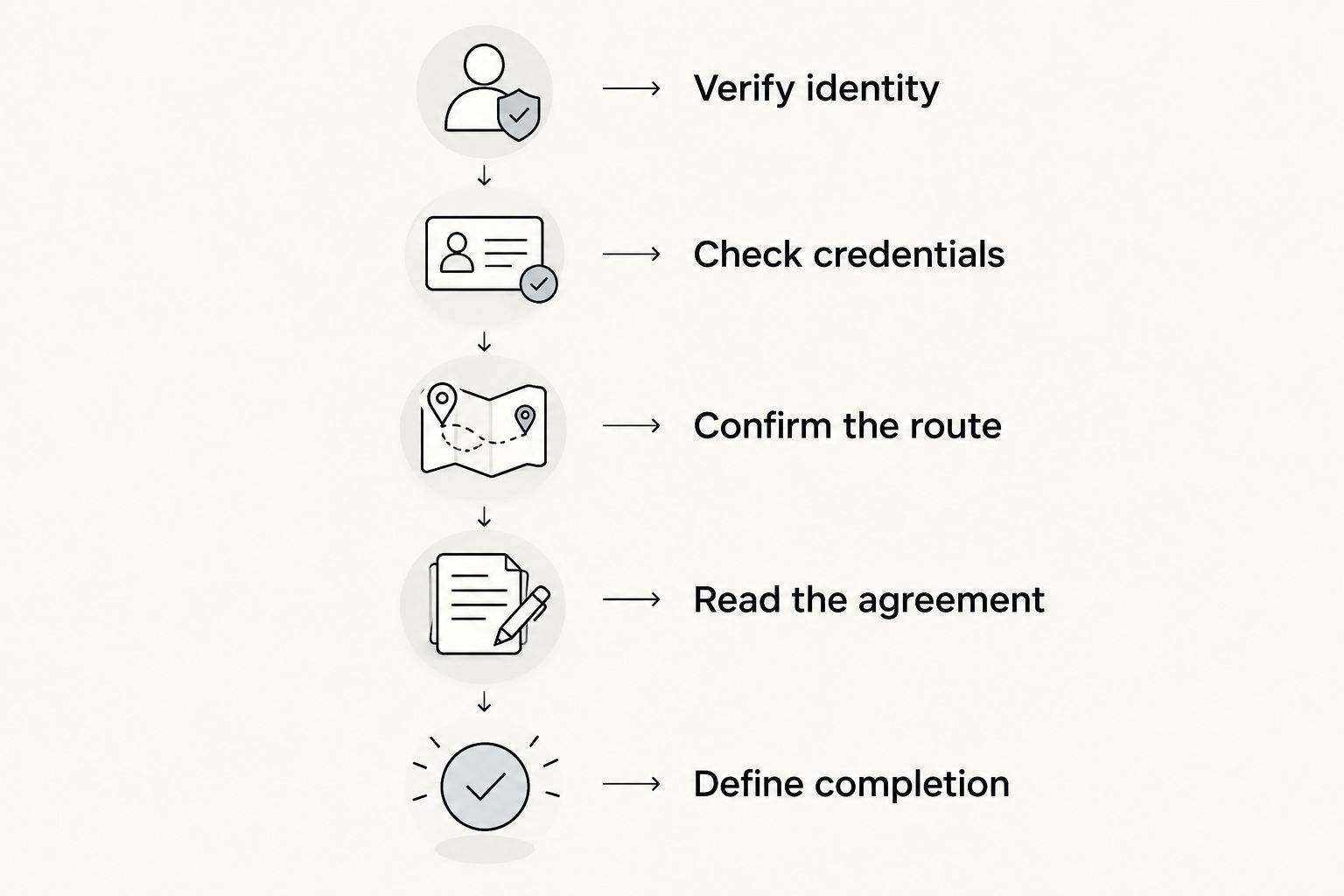
Use this sequence to assess a company in 2026:
- Verify identity. Match the legal business name on the agreement to the relevant business registry. Check whether the website, correspondence, and payment instructions identify the same contracting party.
- Check credentials. If an attorney is named, verify the attorney's license and status through the relevant state bar. Ask which person or firm will actually represent you.
- Confirm the route. Ask whether the proposal involves a resort surrender, resale, transfer, negotiated release, or legal action. Require an explanation tied to your ownership documents.
- Read the agreement. Identify the promised work, your responsibilities, payment obligations, cancellation terms, and exclusions. Compare the written terms with the sales conversation.
- Define completion. Ask which documents will establish that ownership and any separate obligations have ended. Confirm who provides those documents and who verifies them.
Why this matters
A persuasive sales call is not a release from a timeshare contract. Neither is an application, a listing, or a letter requesting cancellation. Your review must distinguish work being performed from the result you need.
For a 2026 decision, organize 3 document groups: your ownership agreement, your current account records, and the proposed service agreement. Together, these show what you own, what remains outstanding, and what the exit company promises to do. Keep copies rather than relying on a salesperson's summary.
What evidence should a timeshare exit company provide?
Ask for evidence you can check without using only the contact details supplied by the salesperson. A company that gives clear answers still needs independent verification. A refusal to identify the contracting business is a reason not to proceed.
| Evidence | What it helps establish | What it does not establish |
|---|---|---|
| Matching business registration | The named entity appears in an official registry | That its exit service will succeed |
| Written scope of work | The tasks the company agrees to perform | That the resort has accepted an exit |
| Verified attorney credentials, if applicable | The named attorney's licensing status | That the attorney represents you under this agreement |
| Written resort communication | What the resort has actually confirmed | A broader release than the document states |
| Completion documents | The specific transfer or release recorded in writing | Automatic discharge of separate loan obligations |
Look for consistency across these records. If the agreement names a different entity from the company advertised, request a written explanation of the relationship. Do not assume a trading name, affiliated company, and law firm carry the same responsibilities.
Business registration is a starting point, not an endorsement
Search the appropriate official registry using the exact legal name. Compare identifying details with the agreement, then investigate discrepancies before signing. Registration is an identity check, not a quality rating.
A familiar-looking name also proves little by itself. Independently locate the established business's contact details if someone claims to represent it. Do not use a caller's confidence as authentication.
Attorney involvement needs its own verification
Ask whether the attorney represents you, advises the exit company, or performs only a limited task. Those arrangements are different. Request the engagement terms that explain the attorney's role.
Verify the named professional directly through the relevant licensing authority. If the salesperson will not identify an advertised attorney before you commit, you cannot assess that claim.
Which exit route is the company actually proposing?
Do not buy a promise without understanding the proposed route. Different routes require different cooperation, documents, and eligibility checks. A company should explain why its recommendation fits your ownership rather than presenting one answer for every owner.
| Route | Best for | Advantage | Limitation to check |
|---|---|---|---|
| Direct resort surrender | Owners whose resort confirms an applicable surrender route | Lets you confirm requirements directly with the resort | Acceptance depends on the resort's terms |
| Resale | Owners seeking to transfer ownership to a buyer | Provides a defined buyer-to-seller transaction | A listing does not establish a completed sale |
| Negotiated release | Owners seeking an agreed termination | Focuses on written agreement with the relevant parties | A request does not mean the other party has agreed |
| Legal advice | Owners facing disputed obligations or legal notices | Addresses the owner's specific legal position | Representation alone does not guarantee termination |
Ask the company to identify which route appears in your agreement. If the sales pitch says cancellation but the contract describes advertising or document preparation, resolve that difference before signing.
In 2026, keep the same standard for every route: identify who must agree, what must happen, and which records demonstrate completion. Do not accept a change in terminology as proof of progress.
Why the verification process varies
The core checks stay the same, but these ownership details change which questions matter most:
- Ownership type: A deeded interest and a contractual right-to-use arrangement require different documents to establish what is being transferred or ended.
- Outstanding financing: Ask separately about the ownership interest and any loan. Do not assume resolving one resolves the other.
- Account status: Provide accurate records of maintenance charges and any collection correspondence so the proposed scope addresses your actual position.
- Resort requirements: Confirm the resort's current surrender or transfer requirements directly rather than relying on a general description.
- Multiple owners: Identify everyone named on the ownership documents and ask whose authorization the proposed transaction requires.
- Disputed obligations: If you dispute the contract or receive legal notices, obtain advice from a licensed attorney about your specific circumstances.
These factors explain why another owner's review cannot establish that the same service fits you. Use reviews to generate questions, not to substitute for checking your documents.
Which sales claims deserve closer scrutiny?
An uncomfortable sales tactic does not, by itself, prove fraud. It does justify stopping the conversation until you can verify the claim. You do not need to establish wrongdoing before deciding not to sign.
A guaranteed outcome without reviewing your ownership
Ask what the guarantee actually promises and where it appears in the agreement. A refund provision and a release from ownership are different outcomes. Read the conditions, exclusions, and steps required to request a refund.
Be equally careful with completion deadlines. Ask what event starts the timeline, what counts as completion, and what happens if another party does not cooperate. Do not rely on an oral assurance that contradicts the written terms.
Instructions to stop payments without addressing consequences
An exit company's instruction does not change your existing payment obligations. Before changing payments, get advice about your contract and any separate financing. Ask the company to put its recommendation and explanation in writing.
Read about whether you can stop paying timeshare maintenance fees before treating nonpayment as an exit strategy. Do not confuse an account becoming delinquent with ownership ending.
Pressure to sign before you can check the paperwork
Decline requests to commit before receiving the full agreement. Ask for time to compare the proposal with information obtained directly from your resort. A deadline in a sales conversation does not verify the offer.
Be cautious when someone claims a buyer or transfer recipient is already waiting. Request the written transaction details and independently verify the parties involved. A claimed match is not a completed transfer.
How should you read reviews in 2026?
Read the substance, not just the rating. A review describing a friendly introductory call tells you about that call; it does not establish that an ownership release occurred. Look for a clear distinction between enrollment, work in progress, and completion.
Compare recurring complaint themes with the contract you receive. Questions about unanswered messages, disputed scope, or unclear completion terms deserve direct answers. A company's response supplies context, but it does not independently resolve the underlying facts.
Keep 2 separate checks in your review: business identity and evidence supporting the proposed service. Reviews supplement those checks. They do not replace either one.
Can a free valuation help you assess your options?
Sold My Timeshare is best for timeshare owners seeking a free, no-obligation valuation and resale/exit assistance. That is a starting point for discussing options, not proof that a particular transaction or exit has been completed.
Sold My Timeshare's timeshare valuation offer gives you a low-commitment way to begin that discussion. Assess any subsequent proposal separately: ask what service is included, what remains your responsibility, and what would establish completion. A valuation is not a confirmed buyer, an accepted surrender, or a release.
You can request a valuation through Sold My Timeshare. Apply the same written-contract and verification standards to every provider you consider.
Request a timeshare valuation
Start with a free, no-obligation valuation and discuss resale or exit assistance.
Does a money-back guarantee prove an exit company is legitimate?
A money-back guarantee does not prove legitimacy or successful termination. Read who owes the refund, what triggers it, and which conditions apply. Evaluate the promised work separately from the refund language.
Is a recorded deed enough to prove you are out?
A recorded deed alone does not establish that every separate obligation has ended. Check the transfer documents, resort records, and any financing agreement together. Ask for written clarification of anything that remains unresolved.
Should you contact the resort before hiring an exit company?
Contact the resort before hiring an exit company to ask about applicable surrender and transfer procedures. Use contact information from your existing ownership records or another independently verified source. Keep the written response with your comparison notes.
FAQ
What's the first thing I should check about a timeshare exit company?
Check the exact legal name of the business that will sign the agreement. Match it against official registration records and investigate differences between the advertised name, contract, and payment instructions.
Does business registration mean a timeshare exit company is trustworthy?
Business registration does not establish trustworthiness or prove an exit service will work. It helps verify identity; you still need to assess the proposed route, contract, and supporting evidence.
Can a timeshare exit company guarantee that my contract will end?
A company's guarantee is not confirmation from the parties that control your ownership or financing obligations. Read the guarantee's exact terms and require documents establishing the actual outcome.
How can I check whether an exit company's lawyer is real?
Verify the named lawyer through the relevant state bar or licensing authority. Then confirm whether that lawyer represents you and obtain the terms describing the lawyer's role.
Should I stop paying maintenance fees while an exit company works?
Do not treat an exit company's instruction as a change to your payment obligations. Obtain advice about your contract and financing before changing payments, and request the company's explanation in writing.
Are positive reviews enough to choose a timeshare exit company?
Positive reviews are not enough to choose a timeshare exit company. Distinguish reviews about sales calls from accounts of completed exits, then independently check the business and its proposed agreement.
What should I do if I think a timeshare exit company misled me?
Preserve the agreement, messages, payment records, and a dated account of events. Contact your payment provider about applicable dispute procedures and consider reporting the conduct to consumer protection authorities or seeking legal advice.
One last thing
Before signing anything in 2026, ask one question: What document will show that I no longer own this timeshare, and what separate obligations will remain? Require a specific answer that matches the proposed route.
A company can finish an assigned task without achieving the outcome you expected. Define both the task and the desired release in writing before deciding whether the service meets your needs.