
Yes, you can cancel a timeshare without an exit company if you exercise a valid rescission right before its deadline; after that, you need an accepted surrender, completed resale or transfer, or another legally supported resolution. An outstanding loan and ongoing maintenance obligations require separate attention. In 2026, start with your purchase documents and the resort’s owner-services department—not a promise that someone can automatically erase your contract.
- Can you cancel a timeshare without an exit company? Yes, through timely rescission or another accepted resolution.
- Rescission, resort surrender, and timeshare resale are different routes; none makes an unpaid loan disappear automatically.
- Sold My Timeshare offers free, no-obligation timeshare valuations for owners considering resale or exit assistance.
- Keep written proof of cancellation, acceptance, and any release from future obligations.
Why this matters
Canceling a purchase is not the same as ending an older ownership. Rescission reverses a recent purchase under applicable rules. A surrender or resale addresses ownership after that cancellation opportunity has passed.
Your first task is identifying which situation applies. The guide to how long the timeshare rescission period lasts explains the deadline question; your contract and applicable law determine the answer for your purchase.
Do not spend a live cancellation period comparing service providers. Check the deadline and delivery instructions immediately, and preserve proof that you followed them.
Can you cancel a timeshare without an exit company?
Yes. You do not need an exit company to exercise a statutory cancellation right, ask your resort about surrender, or investigate a resale. Whether you can complete an exit depends on the contract, applicable law, financing, and the other parties’ acceptance.
Use this comparison to choose your first action in 2026:
| Route | Best for | Main advantage | Main limitation |
|---|---|---|---|
| Rescission | Recent buyers within the applicable cancellation period | Lets you invoke a cancellation right directly | Requires compliance with the deadline and notice rules |
| Resort surrender | Owners asking the resort to accept ownership back | Starts with the party administering the ownership | Acceptance and eligibility are not automatic |
| Resale | Owners seeking a buyer for transferable ownership | Transfers ownership through a completed transaction | Requires a buyer and satisfaction of transfer conditions |
| Independent legal advice | Owners facing disputed rights, debt, or legal notices | Addresses the specific legal problem | Does not itself cancel ownership or guarantee a result |
Rental is not a cancellation route. Letting someone use your reservation does not, by itself, transfer ownership or release your obligations.
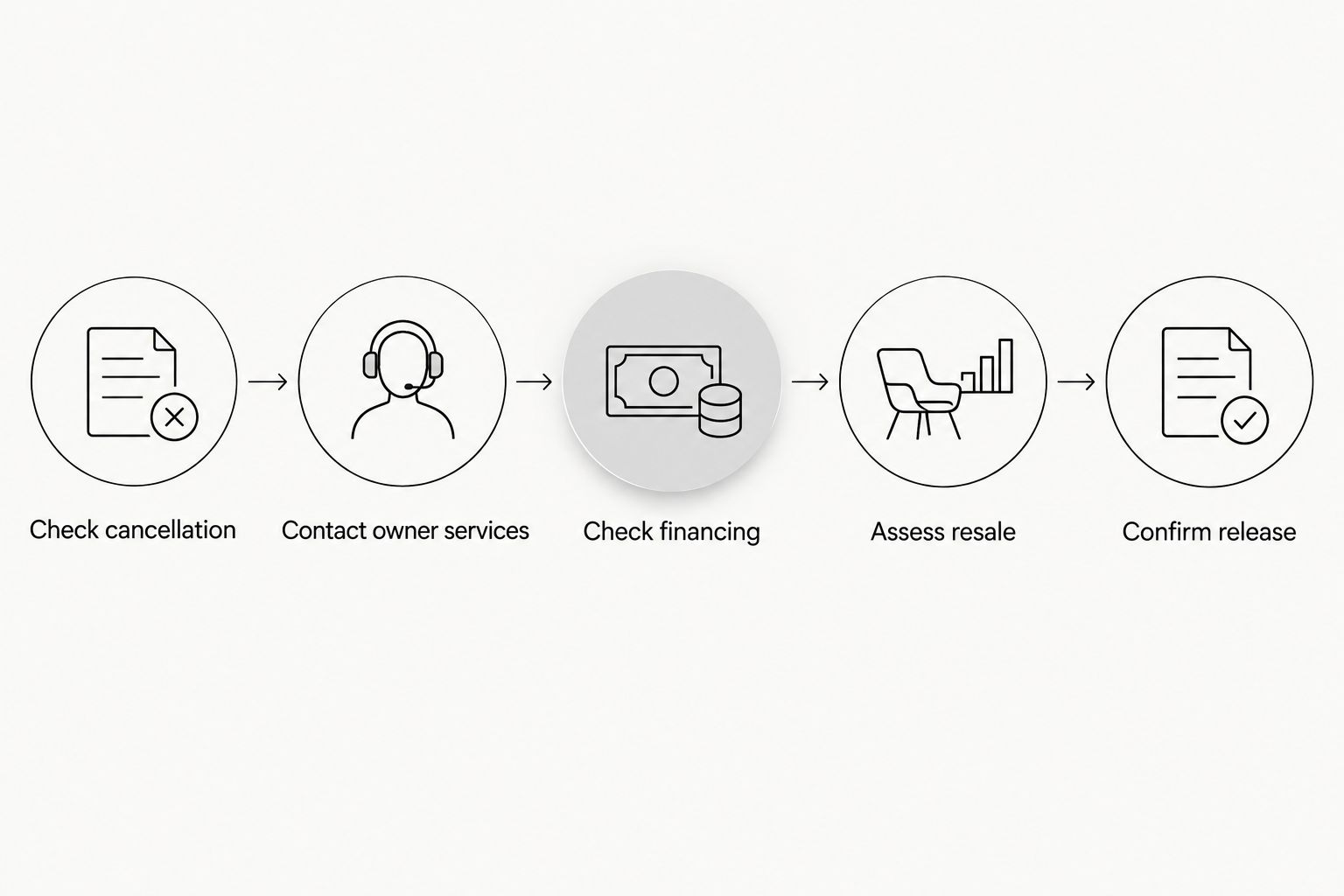
Follow this sequence before hiring anyone
- Check cancellation. Find the contract’s cancellation section, signature date, required disclosures, delivery address, and permitted notice method.
- Contact owner services. Ask the resort whether it accepts surrender requests and request the current requirements in writing.
- Check financing. Identify the lender, outstanding obligations, and any conditions affecting a transfer or release.
- Assess resale. Confirm what you own and what restrictions a buyer would inherit before treating resale as an exit plan.
- Confirm release. Obtain documentation showing what ended, when it ended, and which obligations remain.
Keep a separate record of communications with the resort, lender, and any service provider. An assurance from one party does not establish that another party has released you.
Rescission: act within the applicable cancellation period
If your cancellation period is open, follow the required notice process rather than waiting for an exit consultation. A phone conversation is not a substitute for a written notice when the governing rules require writing.
Read the cancellation provision together with the applicable state requirements. Check what starts the clock, how days are counted, where notice belongs, and whether timely mailing or actual receipt controls.
These state-law examples illustrate why a universal deadline is unsafe:
| State | Statutory cancellation period | Trigger to check |
|---|---|---|
| Florida | 10 calendar days | The later of contract execution or receipt of the required documents |
| Nevada | 5 calendar days | Execution of the purchase contract |
| Virginia | 7 calendar days | The later of contract execution or receipt of the public offering statement |
The statutory references are Florida Statutes §721.10, Nevada Revised Statutes §119A.410, and Virginia Code §55.1-2221. These examples concern purchaser cancellation rights, not a general right to abandon an older ownership; verify the provision governing your transaction before relying on a deadline in 2026.
A cancellation notice should clearly identify you, the purchase, and your decision to cancel. Use the required delivery method, keep a copy, and retain evidence of dispatch or delivery as applicable.
Do not assume the deadline restarts because you stopped using the timeshare. If the deadline or governing jurisdiction is disputed, seek legal advice promptly rather than guessing.
Resort surrender: ask for written acceptance terms
A resort surrender, sometimes called a deed-back, requires the receiving party’s agreement. You cannot make the resort accept ownership simply by sending a deed or announcing that you are finished.
Ask owner services:
- Does the resort currently accept surrender applications for this ownership?
- Who is authorized to approve the request?
- Must financing or account issues be resolved first?
- Which documents complete the surrender?
- What written confirmation establishes the end of future obligations?
The advantage is direct communication with the organization that administers your ownership. The limitation is equally important: requesting surrender does not mean the resort has accepted it.
Keep paying attention to account notices while the request is pending. Obtain written instructions about ongoing obligations rather than treating an application acknowledgment as a release.
Best for: an owner willing to ask the resort directly and follow its documented acceptance process. If the resort declines, ask for the decision in writing before choosing another route.
Resale: transfer ownership rather than cancel the purchase
Resale is different from rescission. A buyer takes ownership through a completed transaction; listing the timeshare or receiving an inquiry does not finish that transfer.
Before listing, identify the ownership type, usage rights, account status, transfer restrictions, and financing. Ask who must approve the transfer and what documents establish completion.
Sold My Timeshare is best for timeshare owners seeking a free, no-obligation valuation before choosing resale or exit assistance. You can request that starting assessment through Sold My Timeshare.
The benefit is help assessing your ownership before committing to a route. The limitation is that a valuation does not itself produce a buyer, cancel a contract, or release a loan.
Best for: an owner exploring a transfer to a willing buyer. Evaluate the actual transaction requirements, not just whether someone agrees to advertise the ownership.
Request your timeshare valuation
Get a free, no-obligation valuation before deciding whether to pursue resale or exit assistance.
Why your cancellation options vary
Your options depend on the documents and parties involved—not how strongly you want to leave. These factors determine the next question to ask:
- Timing and jurisdiction. A recent purchase with an open cancellation period needs a different response from an older contract.
- Ownership structure. Deeded ownership and contractual usage rights require different transfer documents and procedures.
- Financing. Transferring ownership does not automatically discharge a separate debt or remove a lender’s security interest.
- Account status. Ask how unpaid assessments, maintenance charges, or other account issues affect the proposed resolution.
- Resort requirements. Surrender acceptance, transfer approval, and required paperwork depend on the governing documents and program terms.
- Legal disputes. Allegations of misrepresentation, collection activity, or conflicting ownership claims call for advice specific to the dispute.
For a 2026 exit plan, write down which factor blocks completion and who has authority to resolve it. That is more useful than collecting general assurances that an exit is possible.
What should you ask before hiring an exit company?
Ask what the company will do that you cannot already request directly. A defined service is easier to evaluate than a broad promise to get you out.
Request written answers about:
- The exact service and the party responsible for performing it.
- Whether the plan is rescission, surrender, resale, negotiation, or legal representation.
- Whether a licensed attorney will represent you and under what agreement.
- What happens if the resort or lender refuses the proposed resolution.
- Which documents will prove that ownership and related obligations have ended.
Read the agreement’s exclusions and cancellation terms before signing. A promise about ownership is not necessarily a promise about debt, collection activity, or credit reporting.
An outside provider can assist with a defined task, but hiring one does not create a cancellation right or compel resort acceptance. Compare the proposed work with the response you have already received from owner services.
Can you cancel after the rescission period ends?
Yes, an accepted surrender or another legally supported resolution can end ownership after rescission, but the expired cancellation right is not a general permission to walk away. Resale is another possible route when a transfer can be completed.
Ask the resort for its current process and obtain legal advice if you believe a separate claim supports cancellation. Do not present a complaint about the sales presentation as proof that the contract has already ended.
Does stopping maintenance payments cancel a timeshare?
No, stopping maintenance payments does not itself cancel a timeshare. Unpaid obligations can lead to collection or enforcement action under the contract and applicable law.
Before changing payments, get advice about your specific account. A plan that depends on ignoring bills needs a clear explanation of consequences, not reassurance that silence equals cancellation.
When should you consult an attorney instead?
Consult an attorney when you need advice about disputed cancellation rights, threatened legal action, lender obligations, or documents you do not understand. An attorney’s role is different from advertising a resale or processing an administrative request.
If you receive a lawsuit or foreclosure notice in 2026, treat the response deadline as a separate priority. Do not assume a pending surrender request or service agreement pauses a legal proceeding.
FAQ
Can I cancel my timeshare myself without paying an exit company?
Yes, you can exercise an applicable rescission right yourself and contact your resort directly about surrender. After rescission expires, an exit requires an accepted transfer, surrender, or another legally supported resolution.
What should I do first if I just bought a timeshare?
Read the cancellation provision immediately and identify the applicable deadline and notice requirements. Keep copies of your cancellation notice and proof that you used the required delivery process.
Will sending a cancellation letter end an older timeshare contract?
A letter alone does not establish that an older timeshare contract has ended. You need an applicable legal right or an accepted resolution, with documentation showing its effect.
Can I give my timeshare back if I still owe on the loan?
An outstanding loan requires separate attention before you assume a surrender resolves everything. Ask the resort and lender what must happen and obtain written confirmation of any release.
Is a quitclaim deed enough to get out of a timeshare?
A quitclaim deed alone does not establish that every ownership, contractual, and loan obligation has ended. Confirm valid acceptance, required transfer procedures, and any separate releases.
Can Sold My Timeshare help me understand my resale options?
Sold My Timeshare provides free, no-obligation timeshare valuations and resale or exit assistance. A valuation is a starting assessment, not proof that ownership has ended.
How do I know my timeshare exit is actually complete?
Review the final documents for the ownership transfer or cancellation and any separate release of debt or contractual obligations. Confirm the effective date and resolve anything the documents leave outstanding.
One last thing
Before signing an exit agreement in 2026, ask to see what the final completion documents are supposed to establish. The finish line is documented release—not a submitted application, an advertised listing, or a promise to keep working.
Keep that distinction in front of you throughout the process. This article provides general information, not legal advice for your contract or jurisdiction.