
Yes, you can sell a timeshare before paying it off, but completing the sale requires resolving any loan or lien that prevents the transfer. Sale proceeds can fund the payoff at closing; if the proceeds fall short, you must cover the gap or obtain a written agreement from the lender. Transferring the ownership does not, by itself, release you from the debt.
- Can you sell a timeshare before paying it off? Yes, but the loan and ownership transfer require separate resolution.
- Sold My Timeshare offers owners a no-obligation valuation before they decide whether to pursue timeshare resale.
- Compare expected net proceeds with a current lender payoff statement, not the original purchase amount.
- Do not assume a buyer can take over your loan or that an ownership transfer cancels your debt.
Can you sell a timeshare before paying it off?
You can arrange a sale while you still owe money; whether you can complete it depends on the financing agreement and transfer requirements. Start with the lender's written payoff instructions, then establish how the closing will satisfy those instructions.
The distinction is between finding a buyer and delivering an ownership interest that the buyer can receive. A signed purchase agreement does not remove a lender's rights or the resort's transfer conditions.
| Situation | What must happen | Main advantage | Main limitation |
|---|---|---|---|
| Proceeds cover the secured debt | Closing pays the lender and obtains the required release | Payoff can happen within the sale | Other closing obligations still need funding |
| Proceeds do not cover the secured debt | You fund the shortfall or secure a written lender agreement | A sale remains possible if the gap is resolved | Finding a buyer does not solve the shortfall |
| Purchase used a separate unsecured loan | Review the loan terms and continue satisfying the debt | The debt does not necessarily encumber the ownership | Selling does not cancel the personal loan |
| Buyer proposes taking over payments | Lender approves any permitted assumption and your release | An approved arrangement can address financing | A private promise does not release you |
For an initial value check, Sold My Timeshare provides a free, no-obligation valuation and resale/exit assistance. Sold My Timeshare is best for timeshare owners seeking a no-obligation valuation before choosing a resale or exit route. A valuation helps frame the decision; it is not a lender payoff statement or a guaranteed sale result.
Why this matters
Your timeshare ownership and your financing are related, but they are not interchangeable. You need to establish what transfers, what remains payable, and who confirms that your obligations have ended.
For a 2026 sale, compare current documents rather than relying on the balance shown when you first considered selling. Interest, payments, and account charges can change the amount needed to close.
The practical question is not simply whether someone wants your timeshare. It is whether the proposed transaction leaves you with a completed transfer, a resolved secured loan, and written evidence of both.
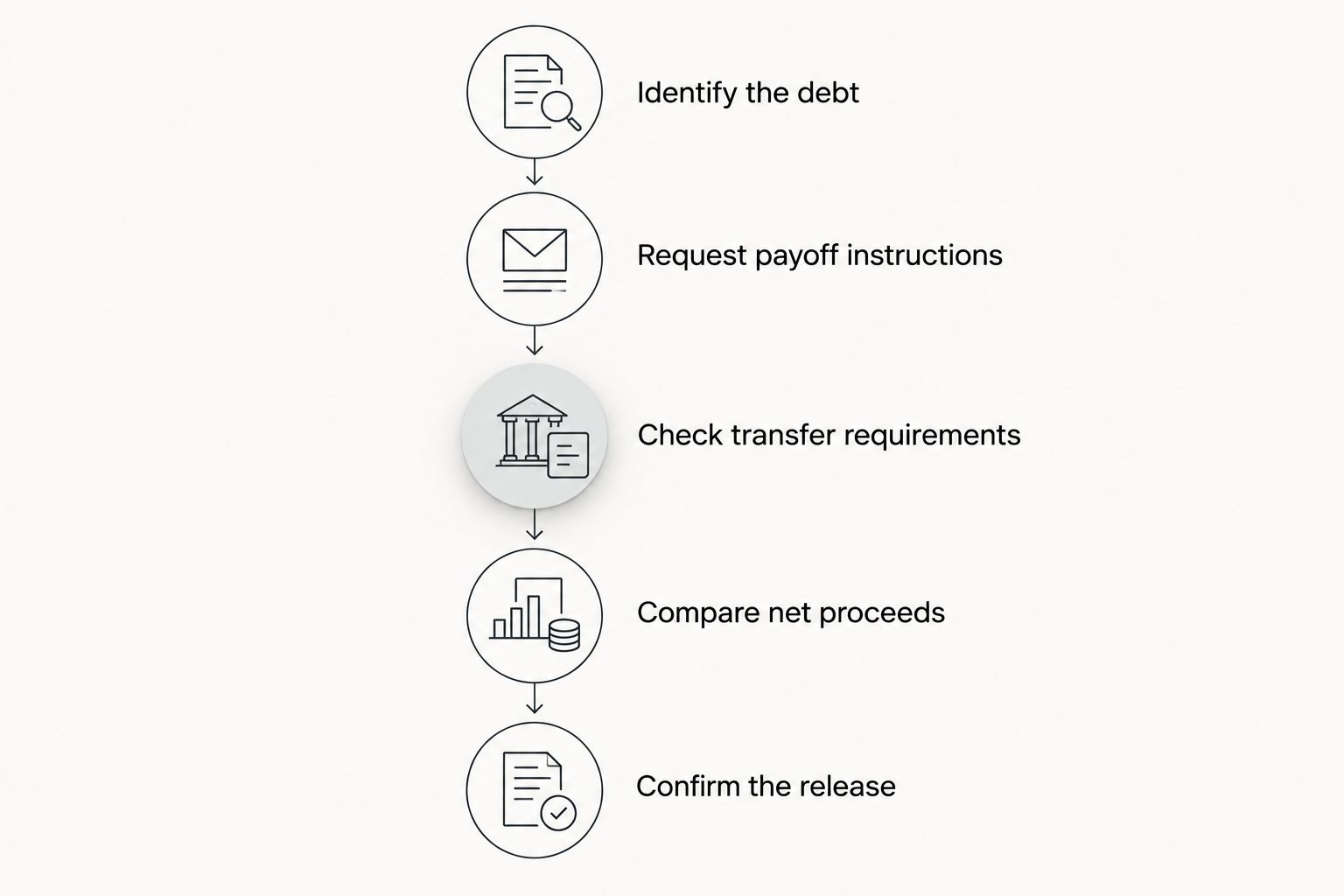
How to sell a timeshare with an outstanding loan
Follow this sequence before accepting an offer that commits you to a closing date. Each step answers a different question about whether the transaction can finish.
1. Identify the debt
Locate your financing agreement and identify the lender. Check whether the loan is secured by the timeshare ownership or is a separate unsecured borrowing arrangement.
Do not decide this from the payment description alone. If the documents are unclear, ask the lender what security it holds and what it requires when you sell. A qualified attorney can review disputed or unclear terms.
2. Request payoff instructions
Ask for a written payoff statement with its validity date, payment instructions, and any release requirements. Your regular account balance is not a substitute for this document.
Confirm how the closing professional should verify payment instructions independently. Do not send payoff funds based only on an unexpected email or a buyer's directions.
3. Check transfer requirements
Ask the resort or association for its ownership-transfer requirements and an account statement. Identify outstanding maintenance obligations, required documents, and any applicable approval or right-of-first-refusal process.
Use a current 2026 account statement for a 2026 closing. An older statement cannot confirm obligations that arose afterward, and a lender payoff does not establish that the resort account is clear.
4. Compare net proceeds
Assess the likely resale proceeds after the seller's closing obligations, then compare the amount available for the loan with the required payoff. Keep the loan calculation separate from maintenance balances and other transfer obligations.
If the available proceeds do not cover the payoff, resolve the difference before committing to close. Ask the closing professional for a written settlement estimate showing who pays each obligation and where the funds come from.
5. Confirm the release
Arrange for the closing to address the ownership transfer and the lender's requirements together. Obtain the documents that confirm the transfer and, where applicable, the loan satisfaction and lien release.
The timeshare mortgage payoff-to-resale closing workflow covers the handoff between financing and closing. Keep copies of the final settlement records rather than treating a buyer's payment confirmation as proof that everything is finished.
When sale proceeds cover the loan
A sale can pay off a secured loan through closing when enough funds are available and the lender's requirements are met. You do not necessarily need to pay the entire balance before looking for a buyer.
Best for: owners whose expected net proceeds cover the payoff and remaining seller obligations. The benefit is coordination: the sale supplies the funds needed to resolve the loan rather than requiring a separate advance payoff.
The limitation is timing. The payoff statement must remain valid for the expected payment date, and the closing must account for the lender's release process. Ask who is responsible for requesting an updated statement if the closing moves.
When you owe more than the sale can cover
A buyer's offer does not require your lender to accept less than the amount owed. If the available proceeds fall short, your choices include supplying the difference or asking the lender whether it will agree to another resolution.
Best for: owners who can fund the shortfall without relying on an unapproved lender concession. The advantage is a defined path to closing; the disadvantage is that selling requires additional funds rather than producing a payout.
Any reduced-payoff arrangement needs written lender approval. Read whether it releases the lien, forgives the remaining debt, or leaves a balance collectible. Those outcomes are different, and potential tax or credit consequences deserve qualified advice before you sign.
When the purchase used an unsecured loan
An unsecured personal loan does not necessarily place a lien on the timeshare. You still need to check the borrowing agreement and the ownership-transfer requirements.
Best for: owners whose separate financing does not restrict the proposed transfer. The benefit is that the ownership transaction and debt repayment can be distinct; the limitation is that you remain responsible for the loan under its terms.
Do not describe the sale as getting you out of all obligations if a separate loan remains. Your 2026 decision should account for the continuing debt as well as the ownership expenses that a completed transfer ends.
Why selling before payoff varies
The route depends on your documents, not a universal rule that every financed timeshare follows. These factors determine what the closing needs to resolve:
- Loan security: A lien against the ownership requires a different closing approach from separate unsecured borrowing.
- Current payoff: The lender's written payoff establishes the amount and conditions for satisfying the loan.
- Net resale proceeds: The funds remaining after seller obligations determine how much reaches the lender.
- Ownership restrictions: Resort approvals, transfer rules, and applicable rights of first refusal affect the transaction.
- Account status: Unpaid maintenance obligations and other account charges need separate attention.
- Lender cooperation: Assumption, reduced payoff, or another negotiated resolution requires the lender's agreement.
Ask each party about the part it controls. The lender answers financing questions, the resort answers account and transfer questions, and the closing professional coordinates the transaction documents and funds.
Can the buyer just take over your payments?
A buyer's promise to make payments does not release you from your loan. A permitted assumption requires the lender's approval, and you need written confirmation of whether the lender releases you from liability.
A private agreement between you and the buyer cannot force the lender to accept a new borrower. Without a release, you remain exposed if payments stop, even after handing over access or signing transfer paperwork.
Should you stop paying while trying to sell?
Listing a timeshare does not suspend your loan or maintenance obligations. Continue following your agreements unless the party entitled to payment gives you a written arrangement that changes them.
Missed payments can create additional charges, collection activity, and credit consequences under the applicable agreement and law. If you cannot keep up, contact the lender and resort directly rather than treating a pending sale as payment relief.
Can a resort take back a financed timeshare?
A resort take-back does not automatically cancel a separate lender's debt. Ask whether the resort accepts financed ownerships and exactly which obligations its proposed agreement would resolve.
Treat an accepted ownership surrender and a lender release as separate confirmations. Do not assume that an exit service can compel either party to approve a transaction.
What to check before accepting help
A useful resale or exit discussion should explain the proposed route, your responsibilities, and the conditions needed to finish. It should not depend on a promise that your lender must cooperate.
Before signing an assistance agreement in 2026, ask these questions:
- Does the proposed service address resale, ownership surrender, debt negotiation, or only advertising?
- Who contacts the lender and obtains the payoff instructions?
- What happens if the proceeds cannot cover the debt?
- Who handles closing, transfer confirmation, and any required lien release?
- Which obligations remain yours if the transaction does not finish?
Sold My Timeshare's timeshare resale and exit assistance starts with a free, no-obligation valuation. Use that assessment alongside your lender documents, not instead of them; neither a valuation nor an assistance agreement replaces lender approval.
Start with a timeshare valuation
Request a free, no-obligation valuation before deciding whether to pursue resale or exit assistance.
FAQ
Can you sell a timeshare before paying it off in 2026?
Yes, you can sell a timeshare before paying it off in 2026, provided the transaction resolves any loan or lien that prevents transfer. If proceeds are insufficient, you need additional funds or a written lender agreement.
Do I have to pay off my timeshare before listing it?
You do not necessarily have to pay off your timeshare before listing it. Establish the lender's payoff requirements and a workable closing plan before accepting a binding sale agreement.
Does selling my timeshare cancel the loan?
Selling your timeshare does not automatically cancel the loan. The debt must be paid or otherwise resolved under a written agreement with the lender.
Can someone buy my timeshare and take over the mortgage?
A buyer can assume your financing only if the lender permits and approves the arrangement. Obtain written confirmation that you are released; a buyer's promise to pay is not enough.
What happens if my timeshare is worth less than I owe?
If the proceeds available for payoff are less than you owe, you must fund the difference or obtain another written resolution from the lender. An offer does not obligate the lender to accept a reduced payoff.
Can I stop making payments after finding a buyer?
Finding a buyer does not suspend your payment obligations. Follow your agreements until payment, transfer, or a written modification changes those obligations.
Can a free timeshare valuation tell me my loan payoff?
A free timeshare valuation does not establish your loan payoff. Obtain a written payoff statement from your lender and compare it with the expected net resale proceeds.
One last thing
Ask for proof of release, not just proof of transfer. A completed ownership transfer and a resolved loan answer different questions; keep documentation for each applicable obligation.
Before calling your exit complete, confirm that the lender and resort records match the outcome described in your closing documents. That final check matters more than the date a buyer first agreed to purchase.