
Yes, creditors can pursue valid timeshare debts against your estate after you die, subject to state probate rules, claim deadlines, and any enforceable security interest. The obligations can include an unpaid loan and maintenance assessments; death does not automatically cancel either. Your heirs generally do not owe those debts personally just because they are family, but co-signing, joint ownership, and certain spousal obligations change the analysis.
- Can creditors come after your estate for timeshare debt? Yes; valid claims can reduce estate assets before inheritance.
- Heirs generally do not inherit personal liability merely because they are beneficiaries.
- A timeshare loan and maintenance assessments need separate review; resolving one does not automatically resolve the other.
- Sold My Timeshare offers timeshare valuations and resale/exit assistance, not a determination of probate liability.
Why this matters
An estate debt and an heir's personal debt are different obligations. Confusing them can lead you to pay a bill you do not personally owe—or distribute estate money before a valid claim is resolved.
If you are handling an estate in 2026, start with the ownership documents rather than a collector's description of the account. The timeshare exit guide for estate executors addresses the ownership side; probate counsel should address creditor claims and distribution rules.
Can creditors come after your estate for timeshare debt?
Yes. A creditor can seek payment of an enforceable timeshare obligation from estate assets through the procedures that apply to the estate. Whether the creditor receives payment depends on the debt, available assets, applicable exemptions, claim priority, and compliance with state law.
An invoice does not establish that a claim is valid or payable ahead of other obligations. The executor must distinguish the deceased owner's liability, obligations arising during administration, and any independent liability belonging to someone still living.
| Situation | What the creditor can pursue | What you should verify |
|---|---|---|
| The deceased owner owed a timeshare loan | A valid estate claim and, for secured debt, remedies against collateral | Loan agreement, payoff statement, borrower names, and security documents |
| Maintenance assessments remain unpaid | Payment through applicable collection and estate procedures | Assessment history, governing documents, and dates charges accrued |
| A survivor co-signed the loan | The survivor's own contractual obligation, as well as applicable estate remedies | Whether the survivor signed as a borrower or guarantor |
| A beneficiary is named only in the will | Estate assets, not automatic personal payment by the beneficiary | Whether the beneficiary separately accepted ownership or assumed an obligation |
| The estate lacks enough assets | Available assets according to applicable priorities and secured-creditor rights | Insolvency rules, exemptions, and the treatment of secured claims |
These distinctions matter more than whether a collector calls the account an inherited debt. Ask what document creates the obligation and whose signature makes that person responsible.
Unpaid loans: identify the borrower and the collateral
A timeshare loan does not disappear when its borrower dies. The lender's remedies depend on the agreement, whether the debt is secured, and applicable law.
For an estate file opened in 2026, obtain the signed loan agreement and a current account statement. Confirm whether the timeshare ownership actually secures the loan; financing described informally as a mortgage is not enough to establish that point.
A secured lender can have rights against its collateral that differ from an unsecured creditor's probate claim. Foreclosure or surrender also does not automatically establish that every remaining obligation has been released.
Ask for written confirmation identifying what any proposed settlement resolves. A document addressing the ownership transfer is not necessarily a release of the loan balance or a co-borrower's liability.
Maintenance assessments: check when charges accrued
Maintenance assessments require a separate review from the purchase loan. Paying off the financing does not, by itself, end ownership or the assessments attached to it.
Separate charges that accrued before death from charges assessed while the estate continues to hold the ownership. Their treatment can differ under governing documents and state law, including rules concerning administration expenses and creditor priorities.
Request an itemized ledger showing assessments, payments, collection charges, and the periods involved. Match it against ownership records rather than assuming every amount on the latest statement belongs in the same category.
Stopping use of the timeshare does not itself terminate ownership. Leaving reservations unused, mailing back membership materials, or notifying the resort of a death is not a substitute for a legally effective transfer or termination.
Why timeshare estate liability varies
The answer for your estate depends on several specific facts—not a universal timeshare inheritance rule.
- Ownership structure: A deed, membership contract, trust interest, and points arrangement require review of their actual terms. The marketing name does not establish the legal structure.
- Signatures: A co-borrower or guarantor has a different position from a beneficiary who never signed an agreement.
- State law: Probate procedures, exemptions, creditor deadlines, and certain spousal obligations vary by jurisdiction.
- Security interests: A creditor with enforceable collateral rights has remedies that an unsecured claimant does not.
- Timing: Pre-death arrears and charges arising during estate administration need separate classification.
- Estate assets: Available assets and statutory priorities determine whether an otherwise valid claim receives payment.
For a 2026 estate review, keep the owner's home state and the timeshare's location in view. Real property located outside the owner's home state can introduce additional estate-administration requirements.
What should an executor do when a timeshare bill arrives?
Best for executors: document the obligation before authorizing payment or distributing assets. This protects the estate's decision-making without assuming that every demand is valid or that every demand can be ignored.
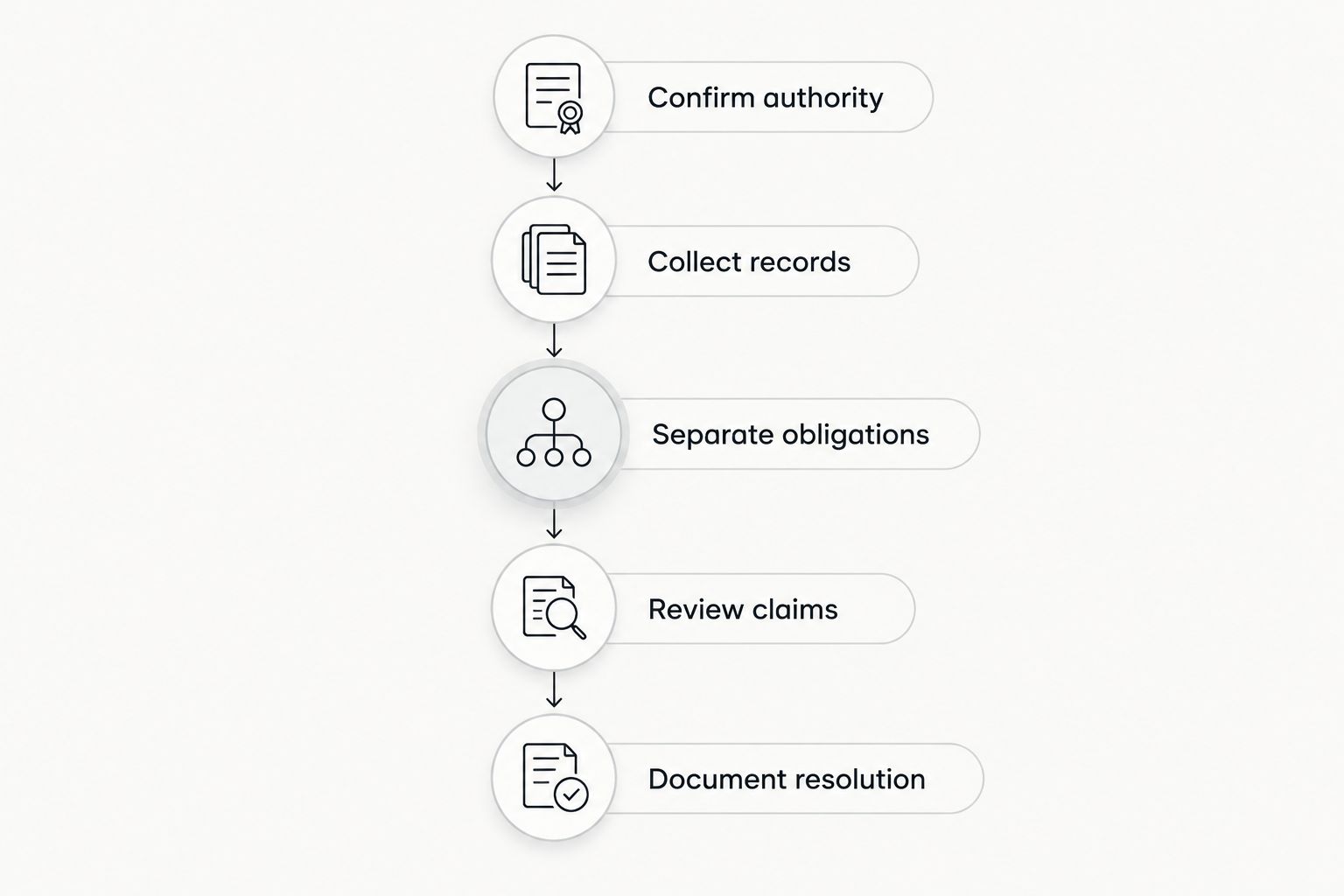
- Confirm authority. Identify the appointed personal representative and obtain the documents establishing that authority. A relative receiving mail is not automatically authorized to settle estate obligations.
- Collect records. Request the ownership instrument, governing agreement, loan documents, and account ledger. Identify each owner, borrower, guarantor, and creditor.
- Separate obligations. Distinguish the loan from maintenance assessments, and pre-death charges from later charges. Keep any dispute about one obligation from obscuring the others.
- Review claims. Have probate counsel check applicable deadlines, notice requirements, validity, and priority before paying disputed demands or making distributions.
- Document resolution. Obtain the required transfer, acceptance, settlement, and release documents. Confirm which obligations end and which remain.
A practical file starts with 3 record groups: ownership documents, financing documents, and billing records. Keeping them separate makes it easier to identify a missing release or a demand addressed to the wrong person.
Can heirs be forced to pay timeshare debt personally?
Heirs generally do not become personally liable just because they inherit from the deceased owner. A creditor's right to seek payment from estate assets does not automatically extend to a beneficiary's separate bank account.
Personal liability requires a separate legal basis. Examples include a signed borrowing obligation, an applicable spousal-liability rule, or obligations attached to ownership the survivor already holds or later accepts.
Do not sign a payment plan, ownership transfer, or assumption agreement simply to stop collection calls. First establish whether the document creates a new personal obligation rather than merely acknowledging the estate's existing account.
Can you refuse an inherited timeshare?
You can decline an inheritance through the procedures that apply to your circumstances. A legally effective disclaimer is different from telling the resort that you do not want the account.
For federal qualified-disclaimer treatment, an adult beneficiary generally faces a 9-month deadline measured from the transfer creating the interest, often the owner's death for an inheritance. Written-delivery requirements, acceptance restrictions, and state law also matter; this is not a universal deadline for every refusal of an inheritance.
Get advice before using the ownership, directing its transfer, or signing resort paperwork. A disclaimer does not erase a debt you already owe as a co-borrower, and it does not itself cancel valid claims against the deceased owner's estate.
What happens if the estate cannot pay the timeshare debt?
An insolvent estate does not automatically make its beneficiaries responsible for the shortfall. Claims are handled under applicable priority rules, while secured creditors retain whatever enforceable rights the law provides.
The executor should not pay whichever creditor demands payment most aggressively. Paying claims out of order or distributing assets improperly can expose a personal representative to liability.
For an estate being administered in 2026, use the applicable state's current probate procedures. Do not assume that an informal agreement with the resort also resolves a separate lender's claim.
Which ownership-resolution route should the estate consider?
Best for deciding the next move: compare legal obligations before comparing exit services. The right route must address both the ownership and any debt that survives its transfer.
| Route | Best for | Benefit | Limitation |
|---|---|---|---|
| Resale | An estate assessing whether ownership can be transferred to a buyer | Tests a market-based transfer route | Requires a willing buyer and does not automatically release separate debt |
| Resort surrender | An estate seeking an agreed return of ownership | Addresses termination directly with the receiving resort or association | Requires acceptance and clear written terms |
| Legal review | Disputed claims, unclear title, insolvency, or personal-liability questions | Establishes legal rights and procedural duties | Advice alone does not transfer ownership or cancel a contract |
Sold My Timeshare is suited to timeshare owners seeking a free, no-obligation valuation and resale/exit assistance. That service is relevant when assessing an ownership-resolution route; it does not establish creditor priority, a beneficiary's liability, or whether a disclaimer is effective.
Before proceeding with Sold My Timeshare timeshare resale/exit assistance, keep probate questions with the estate's legal adviser. A valuation informs the transfer decision, not the legal enforceability of a debt.
Request a timeshare valuation
Get a free, no-obligation valuation while you assess resale and exit options.
FAQ
Can creditors come after your estate for timeshare debt in 2026?
Yes, creditors can pursue valid timeshare debts against estate assets in 2026, subject to applicable claim procedures and creditor rights. Heirs generally do not become personally liable merely because they are beneficiaries.
Do children have to pay a deceased parent's timeshare bills?
Children generally do not owe a deceased parent's timeshare bills simply because they are the owner's children. Co-signing, existing ownership, or accepting obligations creates a different legal question.
Does a paid-off timeshare still create estate obligations?
Yes, a paid-off timeshare can still carry maintenance assessments and other enforceable ownership obligations. Paying the purchase loan does not itself terminate the ownership.
Does refusing the inheritance cancel the estate's timeshare debt?
No, refusing an inheritance does not cancel valid debts owed by the deceased owner's estate. A properly completed disclaimer addresses the beneficiary's inheritance, not the creditor's underlying claim.
Can a collector make me pay from my own account?
A collector cannot require you to pay solely because you are related to the deceased owner. Personal liability needs a separate legal basis, such as your own signed obligation or an applicable spousal-liability rule.
Will selling the timeshare clear every debt?
Selling a timeshare does not automatically clear every related debt. Loan payoffs, assessment balances, transfer requirements, and releases must be addressed in the transaction documents.
Can Sold My Timeshare determine whether an estate owes a creditor?
Sold My Timeshare provides free, no-obligation timeshare valuations and resale/exit assistance. An estate's lawyer should determine creditor-claim validity, payment priority, and personal-liability questions.
One last thing
Returning the timeshare and settling the debt are separate results. Before closing the file, ask for written answers to 2 questions: who owns the interest now, and which obligations have been released?
For your 2026 estate records, retain the documents answering both questions. A reassuring phone call establishes neither. This article provides general U.S. information, not legal advice for a particular estate.