
When a timeshare owner dies without a will, the ownership generally passes under state inheritance law unless a surviving joint owner, trust, or other valid arrangement controls the transfer. Death does not automatically cancel the timeshare, its maintenance fees, or an outstanding loan. Your next step in 2026 is to check the ownership documents before accepting a transfer, signing anything, or treating an estate bill as your personal debt.
- What happens to a timeshare when the owner dies without a will depends on state law and ownership documents.
- A surviving joint owner, trust, or estate can control the next steps; a family relationship alone does not decide responsibility.
- Rejecting an inheritance requires a valid disclaimer, not simply telling the resort you do not want it.
- Sold My Timeshare offers free, no-obligation timeshare valuations; legal inheritance questions belong with an estate attorney.
What happens to a timeshare when the owner dies without a will?
The timeshare does not disappear, and the resort does not automatically take it back. State intestacy laws determine who inherits property not otherwise covered by a valid transfer arrangement. Intestacy means dying without a valid will governing that property.
Start with the deed or membership agreement, not the family tree. A name on an emergency-contact form or reservation does not establish ownership. For the estate's broader administrative steps, see the guide to timeshare exit for estate executors.
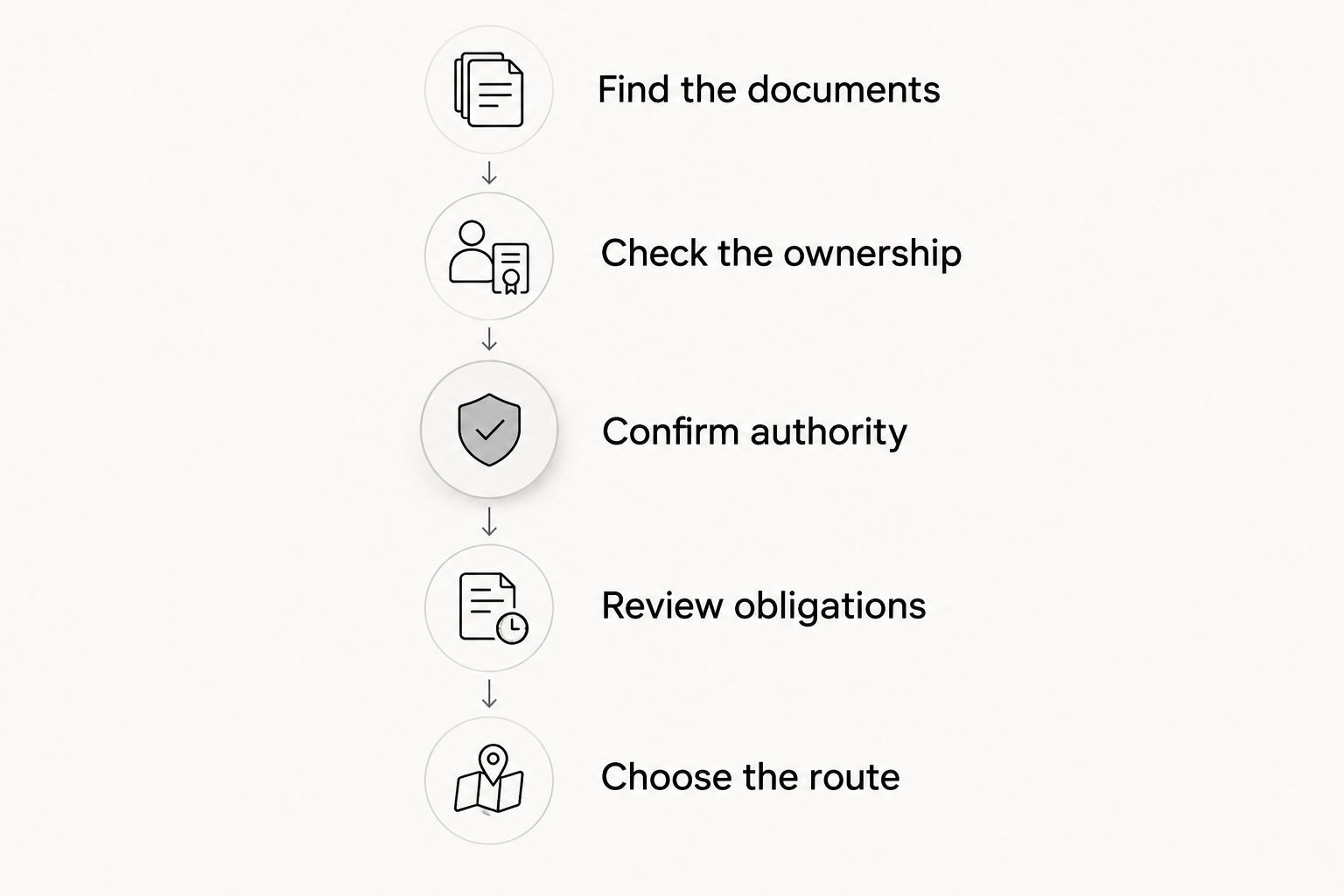
- Find the documents. Collect the deed, purchase contract, membership agreement, loan statements, and maintenance-fee notices.
- Check the ownership. Identify every named owner and any survivorship or trust provisions.
- Confirm authority. Determine who is legally authorized to act for the estate or trust.
- Review obligations. Separate ownership charges, loan obligations, and any proposed transfer requirements.
- Choose the route. Review inheritance, disclaimer, resale, or an agreed return with the appropriate legal and administrative help.
These steps establish who can act. They do not mean an heir must accept ownership or that a resort must approve a return.
Why this matters
A timeshare creates separate questions: who receives the ownership, who can handle the paperwork, and who owes particular charges. Those answers are not necessarily the same. A person authorized to administer an estate is not automatically the person who inherits its property.
In 2026, keep estate correspondence separate from your personal finances. Ask the resort to identify the contractual owner, the account balance, and its deceased-owner procedure in writing. A request for information should not become an agreement to assume ownership or personally guarantee payment.
Sole ownership: state inheritance law controls
If the deceased person owned the timeshare individually and no valid nonprobate transfer applies, the interest generally becomes part of the estate administration. State law determines the heirs and their shares. Do not assume the oldest child, the person paying funeral expenses, or the relative who used the resort inherits it.
The court-appointed personal representative handles estate matters within the authority granted by law and the court. Without a will, this representative is often called an administrator rather than an executor. Being a relative does not itself authorize you to sign a deed for the deceased owner.
Best for: families establishing who can act before discussing a transfer. The benefit of formal administration is clear authority; the limitation is that paperwork and creditor issues must be addressed before distribution.
Joint ownership: the deed determines survivorship
Joint ownership does not always mean the surviving owner receives the deceased person's entire interest. Ownership with a valid right of survivorship generally passes to the surviving owner outside probate. An interest held as a tenant in common generally follows the deceased owner's estate arrangements instead.
Ask an estate attorney to read the recorded ownership language. A resort account showing multiple names is not a substitute for reviewing the deed and applicable law.
Best for: a surviving co-owner checking existing rights and obligations. Survivorship can simplify the ownership transfer, but it does not erase obligations the surviving owner already has under a signed agreement.
Trust or membership ownership: review the governing agreement
A timeshare properly held in a trust generally follows the trust's terms rather than intestacy rules for individually owned property. The successor trustee's authority comes from the trust and applicable law, not simply from being next of kin.
Points-based and right-to-use arrangements require their own document review. The word points does not establish whether you are dealing with real estate, a contractual membership, or an interest connected to a trust.
Best for: families whose documents identify a trustee or contractual succession process. The advantage is an existing framework; the limitation is that the trust or membership terms still need to be applied correctly.
| Ownership arrangement | Who generally handles the interest | Main advantage | Main limitation |
|---|---|---|---|
| Sole ownership without another valid transfer arrangement | Estate representative, subject to state law | Formal authority to administer the interest | Estate administration and creditor matters remain |
| Joint ownership with valid survivorship rights | Surviving owner | Ownership generally passes outside probate | Existing contractual obligations do not disappear |
| Tenancy in common | Estate representative for the deceased owner's share | The deceased owner's share can be identified | Surviving co-ownership does not resolve inheritance |
| Ownership properly held in a trust | Authorized trustee | Trust terms provide succession instructions | Trustee authority and resort requirements still matter |
| Contractual membership | Party authorized under the agreement and applicable law | Agreement provides a starting point | Membership terms alone do not answer every estate question |
Why the outcome varies
The result in 2026 depends on documents and law, not a resort's verbal assurance that an heir must take over. These factors determine which process applies:
- Ownership wording: sole ownership, survivorship, tenancy in common, and trust ownership create different transfer paths.
- Applicable state law: inheritance, probate, creditor, and disclaimer rules depend on the relevant jurisdiction.
- Property location: deeded property outside the owner's home state can require additional estate proceedings.
- Contract terms: membership, loan, and transfer agreements determine rights and obligations alongside applicable law.
- Prior actions: accepting benefits or exercising ownership rights can affect whether a disclaimer remains available.
Give the attorney the actual documents. A summary such as “Dad owned vacation points” is not enough to decide who inherits or whether a disclaimer works.
Do children automatically inherit their parents' timeshare debt?
Children do not become personally responsible for a deceased parent's timeshare debt solely because they are children. A valid creditor claim generally belongs against the estate unless another legal basis creates personal responsibility. A surviving borrower or someone who independently assumes an obligation presents a different situation.
Ownership and debt also need separate review. A loan secured by the timeshare can affect what happens to the property even when an heir is not personally liable for repayment.
Do not read that distinction as permission to ignore notices. Send estate claims to the authorized representative and ask counsel about deadlines. If you already signed the original purchase or loan agreement, disclose that immediately rather than assuming the deceased owner's estate carries the entire obligation.
Can you refuse a timeshare inheritance?
You can refuse an inheritance through a valid disclaimer, but refusing informally is not enough. A disclaimer must meet the applicable legal requirements. It also generally does not let you choose who receives the rejected interest next.
A federal tax-qualified disclaimer generally has a 9-month deadline, measured from the transfer creating the interest or the recipient reaching 21 years of age, whichever is later. For a typical inheritance, death creates the relevant transfer. Internal Revenue Code Section 2518 also requires a written refusal, appropriate delivery, and no prior acceptance of the interest or its benefits.
That federal rule is not a universal state-law inheritance deadline. For a death in 2026, ask an estate attorney to identify both the state disclaimer requirements and any federal tax requirements that matter to your circumstances.
Before that review, avoid booking a stay with the inherited interest or directing its transfer. Whether a particular action counts as acceptance is a legal question; do not assume a later disclaimer can undo it.
Who pays maintenance fees while the estate is open?
Maintenance-fee obligations do not automatically stop at death. The estate representative needs to identify valid claims and ongoing obligations, then handle them under estate law and the governing agreements. Whether a charge is payable, secured, or entitled to a particular priority requires review.
Ask for an itemized statement showing the period covered and the basis for each charge. Keep loan notices separate from association or resort notices so the estate can identify different creditors and agreements.
Do not pay personally simply because a bill arrives at your address. Forward it to the estate representative. If payment is necessary to protect an estate asset, the representative should document the decision and obtain advice about the proper source of funds.
Can the estate sell or return the timeshare?
An authorized estate representative can investigate a sale or an agreed return, subject to applicable authority, title requirements, and the receiving party's acceptance. Neither option happens automatically. A resort's deceased-owner procedure is not itself a promise to accept the ownership back.
Compare the available routes before signing:
| Route | Best for | Benefit | Limitation |
|---|---|---|---|
| Retain and distribute | An eligible heir who wants ownership | Preserves the vacation interest | The recipient must understand ongoing obligations |
| Resell | An estate investigating a transfer to a buyer | Provides a potential ownership-transfer route | Requires a buyer, proper authority, and completed closing |
| Request a deed-back or surrender | An estate seeking the resort's agreement to a return | Addresses transfer directly with the receiving organization | Acceptance is not automatic |
| Disclaim an inheritance | An eligible beneficiary who does not want the interest | Avoids accepting that inherited interest when legally effective | Has legal requirements and does not resolve the estate's underlying ownership by itself |
Sold My Timeshare is best for owners seeking a free, no-obligation timeshare valuation before considering resale or exit assistance. An authorized estate representative can use that information when assessing options, but a valuation does not establish signing authority or replace inheritance advice. Review the services at Sold My Timeshare after confirming who can act.
Request a timeshare valuation
Get a free, no-obligation valuation before considering resale or exit assistance.
FAQ
Does a timeshare automatically go back to the resort when someone dies?
No, death does not automatically return a timeshare to the resort. Ownership follows the deed, governing agreement, and applicable inheritance law unless a valid transfer or surrender is completed.
Who handles a timeshare when there is no will?
The legally authorized estate representative generally handles an individually owned timeshare that requires estate administration. A surviving owner or trustee can have authority instead when the ownership arrangement provides for it.
Can a resort force me to inherit my parent's timeshare?
A resort's demand does not by itself establish that you must accept an inheritance. Ask an estate attorney about your rights, disclaimer requirements, and any obligations you already have as a co-owner or borrower.
Can I use inherited timeshare points before deciding whether to keep them?
Using inherited timeshare points can affect your ability to disclaim the interest. Get legal advice before making reservations, accepting benefits, or directing a transfer.
Does getting a valuation mean I have accepted the inheritance?
A valuation does not by itself settle whether you have legally accepted an inheritance. Ask your estate attorney before requesting services or taking other action if you intend to disclaim; Sold My Timeshare's valuation is not a legal determination.
What should I do first after receiving a deceased owner's timeshare bill?
Send the bill to the authorized estate representative and preserve a copy. Do not assume that receiving the notice makes you personally liable, and do not ignore any stated response deadline.
One last thing
Rejecting an inheritance is not the same as ending the timeshare. A valid disclaimer changes who receives the interest under the applicable rules; it does not necessarily cancel ownership or the estate's obligations. Ask who receives the interest next before treating a disclaimer as a complete solution.
For an estate being handled in 2026, make a written list of the documents reviewed, the authorized decision-maker, and the next required action. Keep it with the estate records. This article provides general U.S. information, not legal advice for a particular estate.