
Yes, you can be sued for not paying timeshare fees when the debt is enforceable under your ownership documents and applicable law. Stopping payments does not cancel your ownership, and unpaid assessments can lead to collection activity, litigation, or foreclosure against a deeded timeshare. If you receive court papers, respond by the court’s deadline rather than waiting for an exit arrangement to finish.
- Can you be sued for not paying timeshare fees? Yes; nonpayment does not cancel an enforceable obligation.
- A collection letter, a lawsuit, and a foreclosure notice require different responses.
- Sold My Timeshare offers timeshare resale and exit assistance, not a substitute for responding to court papers.
- Get written confirmation of any release; a listing or exit-service agreement does not end ownership.
Why this matters
Treat unpaid fees and ending ownership as separate problems. You need to address an existing debt while establishing whether a sale, accepted surrender, or other documented release can end future obligations.
For owners reviewing their options in 2026, the immediate question is not just whether they want out. It is whether a collector, association, or lender has already started a process with a response deadline. The guide to stopping timeshare maintenance fees explains why stopping payments and ending ownership are different decisions.
This page provides general U.S. information for 2026, not legal advice for your contract or state. A licensed attorney should review a filed lawsuit, foreclosure notice, disputed liability, or proposed legal settlement.
Can you be sued for not paying timeshare fees?
Yes. An association, developer, lender, or other party with an enforceable claim can seek payment through a civil lawsuit. Who has the right to collect depends on the obligation and the documents establishing it; a maintenance assessment is not automatically the same debt as a purchase loan.
The claimant still has to establish its case. A demand letter alone does not prove that the balance is correct, that the sender owns the debt, or that every claimed charge is recoverable.
| Document or event | What it means | Your next move |
|---|---|---|
| Past-due account notice | The sender says a payment remains unpaid | Request an itemized balance and check your records |
| Debt-collection notice | A collector is seeking payment | Review the creditor, amount, and dispute instructions |
| Summons and complaint | A civil lawsuit has been filed | Check the court deadline and obtain legal advice |
| Timeshare lien or foreclosure notice | Enforcement against the ownership interest is being pursued | Have an attorney review the notice and governing law |
| Proposed settlement or surrender | Someone is offering terms to resolve obligations | Confirm exactly which debts and future charges it releases |
These events are not interchangeable. Do not assume a collection dispute pauses a court case, or that foreclosure automatically resolves every separate debt. Read each document for its own requirements.
Can unpaid maintenance fees lead to a lawsuit?
Unpaid maintenance fees can support a collection claim when the governing documents and applicable law make you responsible for them. Not using the resort does not, by itself, remove a contractual assessment obligation.
Check who owns the account, which assessment periods are included, and how payments were applied. If you already transferred the ownership, locate the effective transfer date and any written release instead of relying on the date you signed a listing agreement.
Can unpaid timeshare loan payments lead to a lawsuit?
Unpaid timeshare loan payments can lead to enforcement by the lender under the loan documents and applicable law. A loan balance and association assessments can create separate obligations, with different parties seeking payment.
Do not assume that resolving the maintenance account resolves the loan. Likewise, an accepted transfer does not establish that a lender released a borrower unless the relevant documents say so.
Why the consequences of unpaid timeshare fees vary
There is no single nationwide outcome for every unpaid timeshare account in 2026. The legal documents and the law controlling the claim determine the available remedies.
- Ownership structure: A deeded real estate interest and a contractual right to use accommodations do not necessarily face the same enforcement process.
- Type of debt: Maintenance assessments, special assessments, and purchase financing can arise under different documents.
- Contract terms: The signed agreement and governing documents establish payment duties and claimed default remedies, subject to applicable law.
- State law: Filing deadlines, foreclosure procedures, exemptions, and judgment-enforcement rules differ by jurisdiction.
- Account history: Payments, accepted settlements, completed transfers, and written releases affect what remains disputed.
- Procedural stage: An unpaid invoice calls for a different response from a summons or a scheduled foreclosure event.
Your neighbor’s experience does not establish your legal position. Compare the actual documents, not just the resort name or the fact that another owner stopped paying without receiving a lawsuit.
What should you do if you receive a demand or court papers?
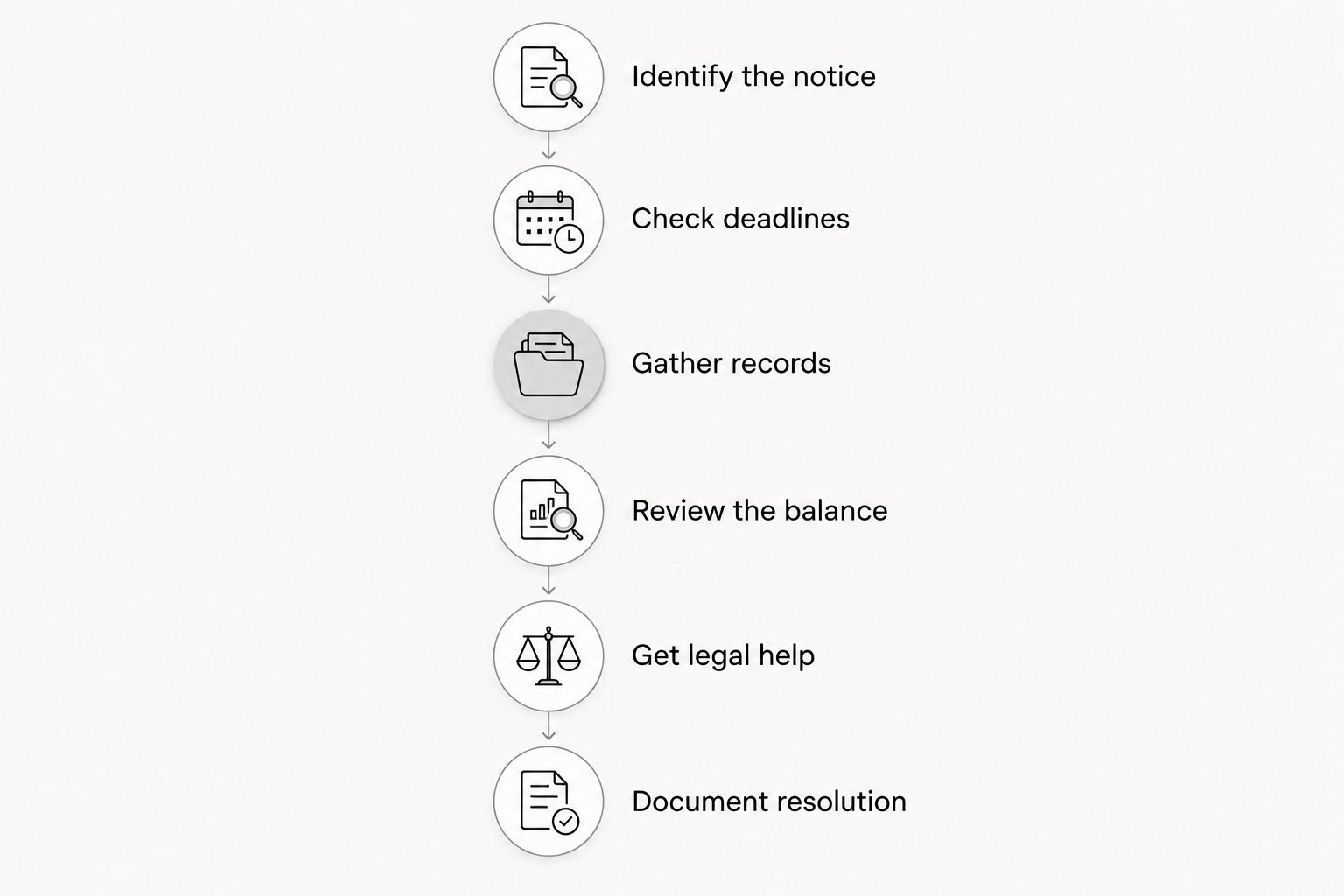
Use the following 6 steps to organize your response. If court papers have arrived, move the court deadline ahead of routine account discussions; negotiating with a creditor does not replace the required legal response.
- Identify the notice. Determine whether you have an account reminder, collection notice, summons, or foreclosure document. Keep the envelope and record when and how it arrived.
- Check deadlines. Read every response date and instruction. Verify a claimed court filing through the court using independently obtained contact information, not only details supplied by an unsolicited caller.
- Gather records. Collect the ownership agreement, loan documents, assessment statements, payment records, and correspondence about cancellation or transfer. Keep copies of documents you send.
- Review the balance. Separate principal assessments from interest, collection charges, and other additions. Ask for an itemized explanation when the total does not match your records.
- Get legal help. Ask a licensed attorney about the claim, defenses, response requirements, and settlement consequences. This is especially important when a lawsuit or foreclosure is already underway.
- Document resolution. Keep any signed agreement, payment confirmation, recorded transfer where relevant, and written release. Verify whether the resolution addresses existing debt, future assessments, or both.
The sequence helps you separate urgent legal work from the longer task of ending ownership. Keep those workstreams connected, but do not let an ongoing resale discussion distract you from a court deadline.
What rights do you have when a debt collector contacts you?
The federal Fair Debt Collection Practices Act gives consumers protections when a covered debt collector seeks a covered consumer debt. Its validation rules generally provide a 30-day period to dispute the debt after receiving validation information; follow the notice’s instructions and keep proof of delivery.
Under those federal rules, a timely written dispute generally requires the covered collector to stop collection of the disputed debt until it provides verification. The law does not cover every original creditor in the same way, and state protections can differ.
The 30-day collection-dispute period is not your deadline for answering a lawsuit. Court response deadlines come from the applicable court rules and papers. The Consumer Financial Protection Bureau’s debt-collection guidance explains the federal distinction between requesting verification and responding to a lawsuit.
Can a timeshare lawsuit affect your home or wages?
A timeshare lawsuit can create consequences beyond collection calls if the claimant obtains a judgment and applicable law permits enforcement against particular assets or income. A lien against the timeshare itself is not automatically a lien against your primary home.
Whether a judgment can support a home lien, wage garnishment, or bank-account enforcement depends on state law, required procedures, and exemptions. Federal protections also apply to certain benefits and limits on wage garnishment.
Do not accept either extreme claim: that your home is automatically at risk, or that a timeshare creditor can never reach anything beyond the timeshare. Ask an attorney to explain the exposure for your jurisdiction, ownership documents, and financial circumstances.
Can unpaid timeshare fees damage your credit?
Unpaid timeshare debt can affect your credit if reportable account information is furnished to consumer reporting agencies. The effect depends on what is reported and the rest of your credit history; no fixed score loss applies to every owner.
Under the federal Fair Credit Reporting Act, most negative account information generally remains on credit reports for 7 years, subject to the law’s reporting rules and exceptions. The reporting period is not the same thing as the deadline for filing a lawsuit.
For a 2026 credit review, obtain your reports and check the creditor name, balance, payment status, and delinquency information. Dispute inaccurate information through the appropriate reporting agency and furnisher, and retain supporting records. Paying or settling an account does not guarantee immediate deletion of accurate negative information.
Which route addresses the debt and ends ownership?
Choose a route that addresses your actual obligation, not just your wish to stop paying. A sale, surrender, payment arrangement, and legal defense solve different problems.
| Route | Best for | Benefit | Limitation |
|---|---|---|---|
| Written payment arrangement | Owners addressing arrears while retaining ownership | Establishes agreed payment terms if accepted | Does not end future ownership obligations by itself |
| Accepted surrender or deed-back | Owners whose resort agrees to take the interest back | Creates a documented route out of ownership | Acceptance and debt releases must be confirmed |
| Resale | Owners seeking a transfer to a buyer | Can end future ownership duties through a completed transfer | A listing alone changes neither ownership nor existing debt |
| Attorney-led review | Owners facing litigation or disputed legal liability | Addresses defenses, deadlines, and settlement terms | Hiring counsel does not guarantee cancellation or a particular result |
For any proposed agreement, ask three direct questions: Who releases you? Which obligations are released? When does the release become effective? An agreement addressing only overdue assessments is not necessarily a release from future assessments or a separate loan.
Sold My Timeshare is best for timeshare owners seeking a valuation and resale or exit assistance. Sold My Timeshare provides free, no-obligation valuations; that service is a starting point for evaluating ownership options, not a legal defense or a promise that a transfer will resolve disputed debt.
Request a timeshare valuation
Get a free, no-obligation valuation and discuss resale or exit assistance.
What should you check before agreeing to an exit service?
For any exit arrangement considered in 2026, read the promised deliverable rather than treating the word “exit” as proof of release. Identify who performs the work, what you must do, and what document will establish completion.
Ask for the proposed handling of existing arrears, a separate purchase loan, and upcoming assessments. If someone instructs you to stop payments, ask for the contractual and legal basis in writing and have an independent attorney assess the consequences.
An exit-service agreement is an agreement with that provider. It does not, by itself, bind your association or lender to cancel an obligation, stop litigation, or accept a transfer.
FAQ
Can I be sued even if I never use my timeshare?
Yes, nonuse does not by itself eliminate an enforceable payment obligation. Your ownership documents and applicable law determine whether assessments remain due.
Does a collection letter mean I have already been sued?
No, a collection letter is not the same as a filed lawsuit. A summons and complaint require a court-specific response, so identify the document before deciding what to do.
Can I ignore a timeshare lawsuit while an exit company works on my case?
No, an exit arrangement does not excuse a required court response. Missing the deadline can expose you to a default judgment, even while negotiations continue.
Do I have 30 days to dispute a timeshare collection notice?
A covered debt collector’s validation notice generally provides a 30-day dispute period under federal law. That period is separate from any lawsuit deadline, and the protections do not apply identically to every creditor.
Will selling my timeshare erase unpaid fees?
Selling your timeshare does not automatically erase existing unpaid fees. Confirm how arrears, loan balances, transfer requirements, and releases will be handled before treating the matter as resolved.
Does timeshare foreclosure cancel every amount I owe?
Timeshare foreclosure does not automatically establish that every separate obligation has been released. An attorney should review the foreclosure outcome, loan documents, and applicable law.
Can Sold My Timeshare help me assess my options?
Sold My Timeshare offers free, no-obligation timeshare valuations and resale or exit assistance. If you have court papers or need advice about legal liability, consult a licensed attorney as well.
One last thing
The most useful document is not the one saying someone has started your exit. It is the one establishing what obligation has actually ended.
Before closing your file in 2026, match the final paperwork to every relevant obligation: ownership, maintenance assessments, and any separate loan. Do not treat silence from a collector, a new listing, or a signed service agreement as written confirmation of release.