
Yes, a timeshare can affect your credit score when financing, missed payments, collections, or foreclosure appear on your credit reports; ownership alone does not automatically lower your score. Selling or exiting the timeshare does not erase an unpaid loan or accurate negative payment history, so protect your payment record while you arrange an exit in 2026.
- Can a timeshare affect your credit score? Yes—reported loans, late payments, collections, and foreclosure create credit risk.
- Sold My Timeshare offers timeshare owners a free, no-obligation valuation and resale or exit assistance.
- Stopping maintenance fees is not the same as canceling ownership or obtaining a release.
- Check your credit reports and get written confirmation of any payment arrangement or ownership transfer.
Can a timeshare affect your credit score?
A timeshare affects credit through the accounts and payment events reported about it—not simply because you own vacation time. A financed purchase creates a different situation from a paid-off ownership with current maintenance fees.
For owners considering a sale, Sold My Timeshare provides free, no-obligation valuations and resale or exit assistance. A valuation helps you evaluate resale; it does not release a loan or suspend payment obligations.
| Situation | Potential credit effect | What to check |
|---|---|---|
| Ownership without a reported loan | Ownership alone does not create a negative credit entry | Whether any associated account appears on your reports |
| Financed purchase | A hard inquiry and new loan can affect your score | Application authorization and account reporting |
| On-time loan payments | Reported payment history contributes to your credit profile | Whether payments appear accurately |
| Missed loan payments | Reported delinquency can damage your credit | Due dates, account status, and assistance options |
| Unpaid maintenance fees | A reported collection account can damage your credit | Collection notices and the underlying balance |
| Completed sale or surrender | Credit outcome depends on the debt resolution and reporting | Written releases and final account status |
There is no reliable universal point drop. Credit scores depend on your full credit file, the scoring model, and what the creditor actually reports.
Why this matters
An exit agreement and a credit-report update solve different problems. One addresses your contractual obligations; the other records how an account was handled.
That distinction matters when you are planning another credit application in 2026. Even after ownership ends, accurate late payments can remain on your reports. Conversely, paying an account does not necessarily remove an earlier delinquency.
Your immediate goal is to identify the creditor, confirm the account status, and establish what ends each obligation. Do not treat a sales listing or an exit-service contract as proof that the lender has released you.
A timeshare loan: credit effects begin before default
Financing can affect your credit before a payment is missed. A lender's hard credit inquiry can influence your score, and a new reported loan changes your credit profile.
A reported loan also creates payment history. Paying as agreed avoids a delinquency on that account, but it does not guarantee a higher score: other accounts, balances, and scoring factors still matter.
Check how the lender identifies the account rather than assuming every timeshare loan is reported as a mortgage. The contract and your credit reports are the starting points for understanding your particular financing.
Best for financed owners: review the loan separately from resort membership paperwork. Ask the lender—not just the resort or a resale representative—what balance remains and what would constitute a full release.
Maintenance fees: a paid-off timeshare still carries risk
Paying off the purchase loan does not necessarily end maintenance fees or other ownership obligations. An unpaid balance can become a collection matter, and a collection account reported to a credit bureau can affect your score.
Do not assume maintenance fees appear as monthly credit accounts. Check your reports and correspondence rather than treating the absence of a current entry as permission to stop paying.
Before withholding payments, read the guide to whether you can stop paying timeshare maintenance fees. The central distinction is simple: stopping payment and ending the obligation are not the same event.
Best for paid-off owners: request an itemized account statement and ask about an approved surrender or transfer. The limitation is that an inquiry alone changes nothing; you need written acceptance and confirmation of the obligations released.
Why the credit impact varies
Your 2026 credit review should focus on these factors rather than a promised point-loss estimate:
- Reporting practices. An account affects a particular credit report only when information about it reaches that bureau.
- Payment status. A current account, a reported late payment, and a collection account are different credit events.
- Delinquency severity. More serious or repeated delinquency generally carries greater credit risk than an isolated, less severe late payment.
- Your existing credit file. The same event does not produce the same score change for every borrower.
- The resolution terms. Paying in full, settling a balance, and transferring ownership do not necessarily produce identical account reporting.
- Reporting accuracy. An incorrect balance or account status needs a dispute, not another payment made without checking the records.
These factors explain why a promise of an exact score outcome is not a sound basis for choosing an exit service. Ask what happens to the debt and reporting instead.
What should you do before missing a timeshare payment?
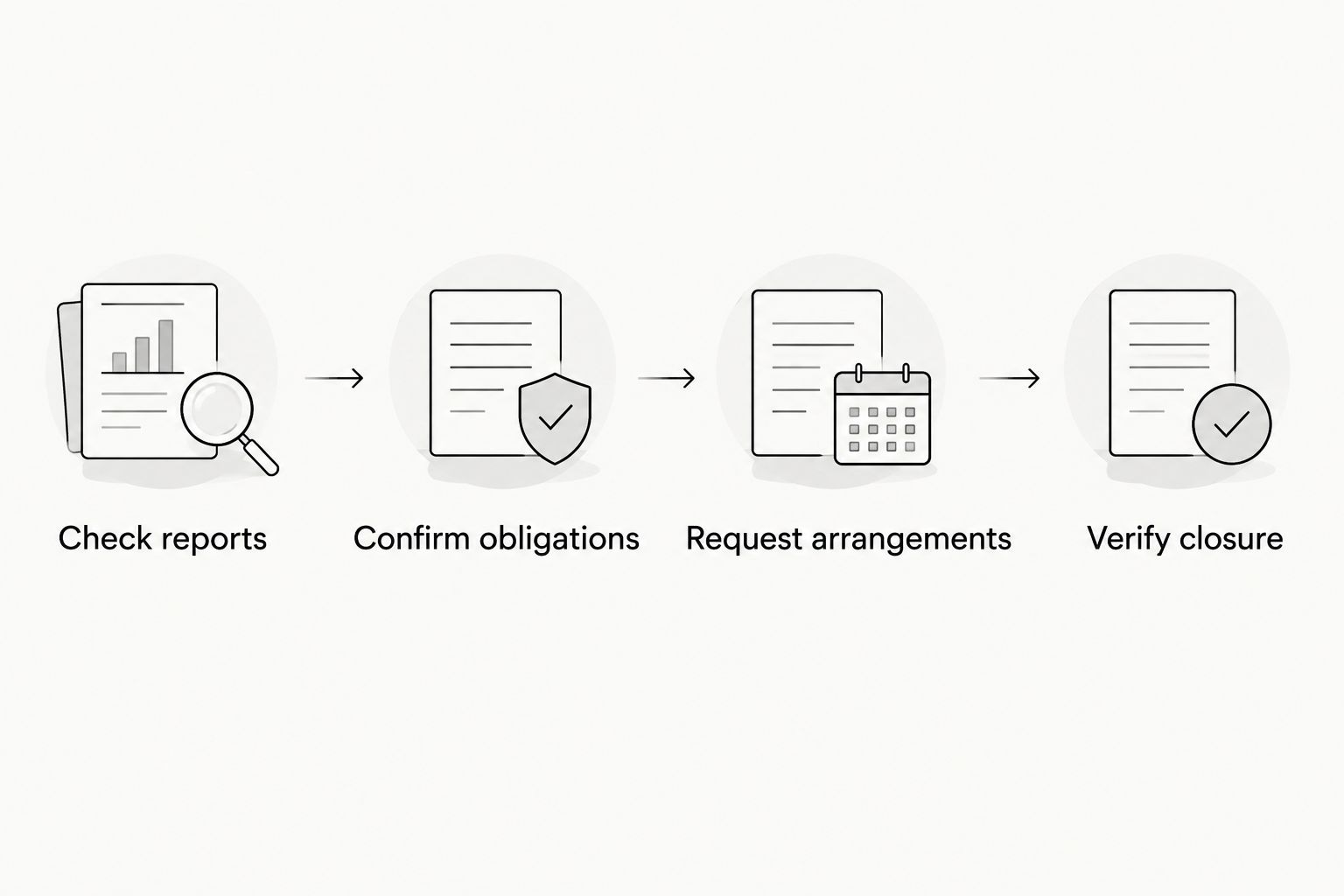
Build a written record before choosing an exit route. Use this sequence whether you want to keep the ownership temporarily, sell it, or request a surrender.
Check reports
Review your reports from the 3 nationwide credit bureaus: Equifax, Experian, and TransUnion. AnnualCreditReport.com is the federally authorized source identified in Federal Trade Commission consumer guidance.
Look for the lender's name, account status, payment history, balance, and any collection entry. A timeshare account might appear under a financing company's name rather than the resort name you recognize.
Confirm obligations
Gather the purchase agreement, loan documents, recent statements, and collection correspondence. Separate purchase financing from maintenance fees, assessments, and any other charges shown in your documents.
Ask who has authority to release each obligation. A resort's acceptance of a transfer does not, by itself, establish that a separate lender has forgiven or received payment for the loan.
Request arrangements
Contact the lender or account administrator before missing a payment. Ask about hardship assistance, repayment arrangements, and any resort-approved surrender process that applies to your ownership.
Ask how an arrangement affects due dates, interest, account status, and credit reporting. Do not stop an automatic payment merely because someone has started reviewing your request.
Verify closure
Keep signed transfer documents, payoff confirmations, releases, and final statements. Check that each document identifies the account or ownership interest it resolves.
After the resolution is processed, review your credit reports again. Dispute inaccurate reporting with the bureau and the business furnishing it, following Consumer Financial Protection Bureau guidance on credit-report errors.
Which exit route helps protect your credit?
The route matters less than whether you satisfy or obtain a written release from each obligation. A sale, surrender, or negotiated resolution is not automatically credit-neutral.
| Route | Best for | Main advantage | Main limitation |
|---|---|---|---|
| Lender payment arrangement | Owners facing payment difficulty who need a documented plan | Addresses the account before further missed payments | Does not itself end ownership; reporting depends on the terms |
| Resale | Owners evaluating a transfer to another buyer | Provides a potential ownership-transfer route | A listing does not satisfy the loan or complete a transfer |
| Resort-approved surrender | Owners whose resort offers and approves an applicable process | Uses the resort's own acceptance process | Acceptance and debt-release terms require confirmation |
| Negotiated debt resolution | Owners addressing a disputed or unaffordable balance | Establishes agreed treatment of a specific debt | Settlement can carry credit and tax consequences |
For a 2026 exit decision, compare the written documents—not a sales promise about protecting your score. Ask who receives payments, who releases the debt, and what happens if the proposed transfer fails.
Sold My Timeshare is best for timeshare owners seeking a free, no-obligation valuation and resale or exit assistance. Its stated service is relevant when you need to assess an exit; a valuation is not a creditor release or a guaranteed credit result.
Start with a timeshare valuation
Request a free, no-obligation valuation and discuss resale or exit assistance.
How long can a late timeshare payment stay on your credit report?
A reported late payment generally stays on your credit report for up to 7 years. CFPB consumer guidance explains this general reporting period for most negative credit information; selling the timeshare does not restart your credit history with a clean slate.
Lenders generally report payment delinquency once an account is at least 30 days past due. That reporting threshold is not a grace period: your contract can impose consequences before a delinquency reaches a credit bureau.
For collection accounts, the reporting period relates to the original delinquency that led to collection, not simply the date a collector acquired the debt. Check dates carefully if an old account appears with information you believe is inaccurate.
Can you sell a timeshare without hurting your credit?
A sale does not inherently damage your credit, but the associated loan and payment history still matter. Keep required payments current unless the creditor confirms a different arrangement in writing, and establish how any outstanding financing will be resolved.
An offer, signed listing agreement, or buyer's deposit does not prove that your obligations have ended. Confirm the completed transfer, lender release where applicable, and final account status before canceling payments.
Will a timeshare exit company protect your credit score?
Hiring an exit company does not guarantee credit protection. A service agreement with an intermediary does not prevent a lender or collector from reporting accurate information.
Be cautious about instructions to stop paying without a documented explanation of the consequences. If the proposed strategy involves default, foreclosure, or contested legal rights, have an appropriately licensed attorney review your situation before you act.
FAQ
Can a timeshare affect your credit score if you never financed it?
Yes, a paid-off timeshare can still create credit risk if unpaid ownership charges become a reported collection account. Ownership by itself does not automatically lower your score.
Does paying timeshare maintenance fees build credit?
Paying maintenance fees builds a credit payment history only if those payments are reported in a way the scoring model uses. Do not assume routine fee payments appear on your credit reports.
How many points will my score drop if I stop paying my timeshare?
There is no universal point drop for stopping timeshare payments. The result depends on what is reported, the severity of delinquency, your existing credit history, and the scoring model.
Will paying a timeshare collection delete it from my credit report?
Paying a collection does not automatically delete an accurate collection entry. Confirm the updated balance and status, and dispute reporting that remains inaccurate.
Does transferring a timeshare deed remove the loan?
Transferring a deed does not automatically release a separate loan obligation. Obtain written confirmation from the lender that the debt has been satisfied or that you have been released.
Can Sold My Timeshare help me assess an exit?
Sold My Timeshare provides free, no-obligation valuations and resale or exit assistance. Those services help you explore options; debt release and credit reporting still require confirmation with the responsible creditor.
One last thing
For your 2026 paperwork, keep separate evidence for ownership transfer and debt release. They can involve different parties, and a document proving one does not necessarily prove the other.
Before ending payments, ask a precise question: which document confirms that I no longer owe this specific obligation? Keep the answer with your final statements and check subsequent reporting against it. This is general consumer information, not individualized legal or credit advice.