
There is no single cost to get out of a timeshare in 2026: your total depends on the exit route, any outstanding loan, transfer requirements, and charges that remain due until ownership ends. A service fee alone does not tell you the full cost, so get a written breakdown that separates the work being offered from the obligations you still owe.
- How much does it cost to get out of a timeshare? Compare the total obligation, not just the service fee.
- Sold My Timeshare offers no-obligation timeshare valuations and resale or exit assistance; a valuation is not a release.
- Check cancellation rights and resort surrender options before signing a separate exit agreement.
- Require written confirmation of what ends your ownership and any remaining payment obligations.
Why this matters
The cheapest-looking proposal is not necessarily the least expensive exit. A quote that excludes loan payoff, closing work, or ongoing ownership charges leaves you comparing incomplete figures.
Sold My Timeshare is best for timeshare owners seeking a no-obligation valuation and resale or exit assistance. Its valuation service gives you a starting point for considering resale; it does not, by itself, cancel your contract or establish the final cost of leaving.
For your 2026 decision, separate two questions: what must you pay to complete the chosen route, and what must you keep paying until it is complete? Both belong in your budget.
How much does it cost to get out of a timeshare?
Your timeshare exit cost is the combined amount required to resolve the ownership, complete any transfer, and settle obligations that are not released. Compare written, ownership-specific proposals rather than a headline average.
Use this breakdown to check whether a proposal covers the whole transaction. Not every item applies to every ownership, and an estimate should distinguish confirmed charges from unresolved items.
| Cost component | What to confirm | Why it matters |
|---|---|---|
| Outstanding financing | Current payoff and the lender's requirements | Transferring ownership does not automatically release a separate loan |
| Ownership charges | Maintenance fees, assessments, and unpaid balances | Amounts due before completion affect the total |
| Service work | Tasks included, exclusions, and payment milestones | Paying for assistance is different from obtaining a release |
| Transfer and closing | Administrative, recording, title, or closing requirements | A quoted service fee can exclude transaction work |
| Continuing obligations | Who pays charges while the matter remains open | A longer process can leave additional bills to address |
| Completion evidence | Documents confirming acceptance, transfer, or release | You need proof of the outcome, not just proof of payment |
Ask each provider to identify who receives each payment. A payment to a service company is not the same as money paid to your lender, association, resort, or closing provider.
Also ask what happens if the proposed route fails. The agreement should explain the work already earned, any refund conditions, and which underlying obligations remain yours.
Contract cancellation: check the deadline before hiring help
Best for: recent purchasers whose applicable cancellation period remains open. Review your purchase documents immediately for the cancellation notice, deadline, delivery method, and recipient.
A valid cancellation right is different from a resale or a negotiated exit. Follow the applicable requirements exactly; a sales representative's verbal reassurance is not a substitute for delivering the required notice.
The advantage is that you are using a contractual or statutory cancellation process rather than finding a new owner. The limitation is timing: cancellation rights depend on the applicable law and documents, and missing the deadline changes your options.
For a purchase made in 2026, use the actual contract and applicable rules—not a deadline copied from an unrelated resort or state. Keep your notice, delivery evidence, and all responses together.
Resort surrender: ask what acceptance actually requires
Best for: owners whose resort or association accepts their ownership back under a documented program. Contact the organization responsible for your ownership and ask whether a surrender or deed-back option applies.
The advantage is a direct conversation with the party that administers the ownership. The limitation is eligibility: asking about a program does not mean your account qualifies or that the organization has accepted it.
Request written answers about financing, account balances, required documents, transaction charges, and the point when future ownership obligations end. If someone says you must become current first, ask for the full acceptance conditions before paying solely in anticipation of approval.
A completed surrender should leave you with evidence of what was accepted and what was released. Do not treat an application, a reference number, or an unsigned agreement as completion.
Resale: separate the sale proceeds from the exit expenses
Best for: owners pursuing a transfer to a buyer rather than cancellation. Resale involves finding an interested buyer and completing the ownership's transfer requirements.
The advantage is that a sale can move ownership to someone who wants it. The limitation is that listing does not guarantee a buyer, a completed transfer, or proceeds sufficient to clear outstanding obligations.
Ask for an estimated closing statement that separates expected proceeds from deductions and amounts you must contribute. Include financing, account balances, transfer work, and any agreed service compensation rather than focusing only on the advertised sale figure.
For a 2026 resale decision, distinguish completed-sale evidence from asking prices. A listing tells you what a seller wants; it does not establish what your ownership will sell for.
Exit assistance or legal advice: define the deliverable
Best for: owners who need help evaluating documents, negotiating an exit, or addressing a dispute. Choose the type of assistance that matches the problem rather than assuming every exit provider performs the same work.
The advantage is support with a process you do not want to handle alone. The limitation is scope: an agreement to contact a resort, review paperwork, or attempt negotiations is not automatically an agreement that guarantees release.
For a legal dispute, confirm whether you are retaining a licensed attorney and what representation includes. For nonlegal assistance, identify the specific tasks, responsible parties, and completion standard in the service agreement.
Ask who has authority to approve the actual exit. A provider can describe its services, but the contract should not blur the difference between work performed and an outcome controlled by another party.
Compare exit routes before comparing quotes
Use the same questions for every route under consideration. This prevents a limited administrative service from appearing directly comparable to a proposal that includes closing work or legal representation.
| Route | Best for | Main advantage | Main limitation |
|---|---|---|---|
| Timely cancellation | Eligible recent purchasers | Uses an existing cancellation right | Strict requirements and deadlines apply |
| Resort surrender | Owners accepted by the resort or association | Direct route to the receiving organization | Acceptance is not automatic |
| Resale | Owners seeking a buyer | Transfers ownership through a sale | Buyer interest and completion are uncertain |
| Exit assistance | Owners needing process support | Helps organize and pursue an exit | Service scope does not equal release |
| Legal representation | Owners with a dispute requiring legal advice | Addresses legal rights and remedies | Representation does not guarantee an outcome |
Choose the route first, then compare equivalent scopes of work. Otherwise, a smaller quote can simply mean that more work and more obligations sit outside it.
Why timeshare exit costs vary
The cost drivers are specific to your documents and account. These are the facts to establish before treating an estimate as a usable budget:
- Loan status: Identify the lender, current payoff, and conditions for releasing the debt. Keep financing separate from ownership-transfer paperwork.
- Account status: Obtain a statement showing maintenance fees, assessments, and other claimed balances. Ask how disputed amounts are handled.
- Ownership structure: Confirm whether you hold a deeded interest, points, or another contractual interest. The required transfer process depends on what you own.
- Exit eligibility: Establish whether cancellation, surrender, or another documented route is available to you. Do not pay on the assumption that acceptance is automatic.
- Service scope: Compare the actual tasks, exclusions, and completion conditions. Similar-sounding service names can describe different commitments.
- Completion requirements: Identify approvals, documents, and ongoing payment responsibilities. An incomplete transfer leaves an unresolved ownership question.
In 2026, the useful estimate is the one tied to these facts. A general promise about getting you out does not replace an account-specific explanation.
How to get a usable written estimate
Organize the information before you commit. You do not need to solve every issue yourself, but you need enough detail to understand what you are authorizing.
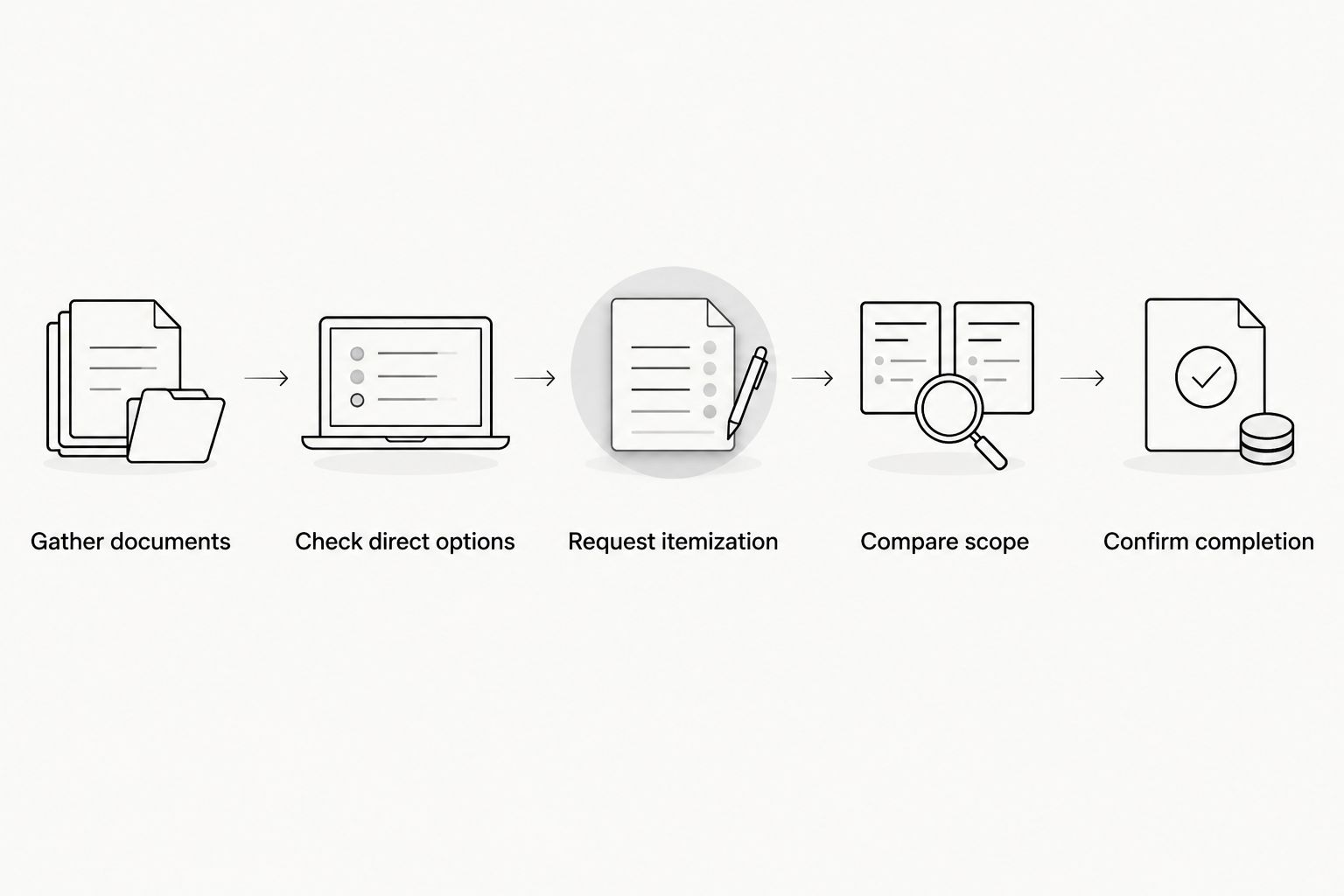
- Gather documents. Collect the purchase agreement, ownership documents, loan statement, latest account statement, and relevant correspondence. Redact sensitive information when initially asking general questions.
- Check direct options. Ask the resort or association about cancellation instructions, surrender eligibility, and transfer requirements. Keep the written response.
- Request itemization. Ask each provider to separate its own work from lender, resort, association, and closing obligations. Require clear exclusions.
- Compare scope. Read payment triggers, cancellation terms, refund conditions, and the promised deliverable. Do not compare totals until you understand what each includes.
- Confirm completion. Identify the documents that will establish the transfer or release, including treatment of any separate loan. Keep those records after the process ends.
Keep a separate list of unanswered questions. An estimate with unresolved financing or acceptance conditions is not yet a complete plan, even if the provider has given you a firm fee for its own work.
Request a timeshare valuation
Sold My Timeshare provides no-obligation valuations and resale or exit assistance.
Can I get out of a timeshare without paying an exit company?
You do not have to hire an exit company simply to ask about your contractual cancellation rights or the resort's surrender process. Start with the party identified in your ownership documents and request the applicable requirements in writing.
Handling inquiries yourself does not mean the underlying transaction has no expenses. Keep loan balances, ownership charges, and transfer requirements separate from whether you hire outside help.
Does selling my timeshare clear the mortgage?
Selling your timeshare does not automatically release a separate financing obligation. Ask the lender and closing provider how the loan will be satisfied and what written evidence confirms that result.
If expected proceeds do not cover the required payoff and transaction obligations, resolve that gap before committing to the sale. A buyer's willingness to take the ownership does not establish the lender's agreement to release you.
Should I stop paying while an exit is underway?
Do not treat an exit application or service agreement as permission to stop making required payments. Missed payments can lead to collection activity, credit reporting, or other consequences under your agreements.
If you cannot keep paying, contact the relevant creditor or association about your situation and seek qualified advice. Require any changed payment arrangement in writing rather than relying on an exit salesperson's instructions.
FAQ
How much does it cost to get out of a timeshare in 2026?
There is no single amount that applies to every timeshare exit in 2026. Your total depends on financing, account balances, the exit route, service scope, and transfer requirements; request an itemized written estimate.
What's the least expensive way to leave my timeshare?
Check applicable cancellation rights and direct resort surrender options before hiring outside assistance. The least expensive eligible route depends on your documents, account status, and acceptance requirements.
Do I still owe maintenance fees after hiring an exit company?
Hiring an exit company does not itself end your maintenance-fee obligations. Confirm when your responsibility ends under the ownership documents and completed exit agreement.
Can a timeshare valuation tell me my final exit cost?
A valuation does not establish your final exit cost. Sold My Timeshare offers no-obligation valuations and resale or exit assistance, but you still need an itemized account of financing, charges, and completion requirements.
Is a money-back guarantee the same as a guaranteed release?
A money-back guarantee is not the same as a guaranteed release from ownership. Read the refund conditions and identify the separate documents required to end your ownership and any financing obligations.
What paperwork should I keep after my timeshare exit?
Keep the executed transfer or release documents, acceptance confirmation, closing records, and any loan-satisfaction evidence. The required records depend on your ownership and the route used.
One last thing
A paid invoice proves you paid someone; it does not prove you are out. Before signing, ask the provider to name the exact document that will show your ownership has ended and explain how any separate debt will be resolved.
That question keeps the discussion focused on the result you need—not the activity someone promises to perform.