
Yes, you can refinance a timeshare loan if a lender approves replacement financing that pays off your existing balance. Refinancing does not remove maintenance fees or end your ownership, and a smaller monthly payment does not necessarily mean a lower total borrowing cost. This 2026 guide explains how to compare financing options without confusing debt relief with a timeshare exit.
- Can you refinance a timeshare loan? Yes, subject to lender approval; compare total repayment, not just monthly payments.
- Refinancing replaces debt. It does not cancel timeshare ownership or maintenance fees.
- Sold My Timeshare is best for owners seeking timeshare resale or exit assistance, not replacement financing.
- Using home equity to repay a timeshare loan puts your home behind the new debt.
Why this matters
A loan payment and the cost of ownership are separate obligations. Reducing the first does not eliminate the second, so your decision starts with whether you still want the timeshare.
If your goal is to leave ownership, Sold My Timeshare offers free, no-obligation timeshare valuations and resale/exit assistance. Check your ownership options before replacing debt you are trying to escape.
Can you refinance a timeshare loan?
Yes. You can use an approved replacement loan to pay off an existing timeshare loan, provided the new lender permits that use of the funds. Whether the transaction is called refinancing or debt consolidation matters less than its terms.
Do not assume the lender will accept your timeshare as collateral. An unsecured personal loan depends on the lender's underwriting rather than a lien on your timeshare; home-equity borrowing uses your home as security.
For a 2026 comparison, separate the following options by what they accomplish and what they put at risk.
| Option | Best for | Main advantage | Main limitation |
|---|---|---|---|
| Unsecured personal loan | Owners who want to keep the timeshare and qualify for better terms | Replaces the existing balance without pledging a home | Approval and savings depend on the actual offer |
| Home-equity borrowing | Homeowners evaluating secured debt with a clear repayment plan | Can provide funds to pay off the timeshare lender | Failure to repay puts the home at risk |
| Existing-lender modification | Owners seeking relief without a replacement lender | Changes the existing agreement if the lender agrees | Payment relief does not necessarily reduce total repayment |
| Resale or exit review | Owners who no longer want the timeshare | Addresses ownership rather than only financing | A transfer or exit does not automatically forgive debt |
Refinance only when the replacement loan improves your financial position on terms you understand. Approval alone is not evidence that the loan is a good deal.
Unsecured personal loan: compare the full repayment obligation
An unsecured personal loan can pay off a timeshare balance when the lender allows that purpose. Check permitted uses before submitting a full application, and distinguish a preliminary rate check from a final approval.
The benefit is straightforward: you replace the existing debt without using your home as collateral. The drawback is equally important: the approved rate, fees, and repayment term determine whether you actually save.
Ask whether an origination fee is deducted from the proceeds. If it is, the amount deposited must still cover the timeshare lender's payoff requirement; otherwise, you need additional funds to close the gap.
Best for: owners keeping their timeshare who receive a written offer that improves on the existing repayment obligation. Do not extend the debt merely because the payment looks easier to manage.
Home-equity borrowing: understand what secures the debt
A home-equity loan or line of credit uses your home as collateral. Paying off a timeshare loan this way moves the balance to a different obligation; it does not make the debt disappear.
The potential benefit is access to secured financing. The downside is that missed payments can put your home at risk, making this a different decision from replacing one unsecured balance with another.
For a home-equity line of credit, check whether the rate varies and how payments change between the draw and repayment periods. Compare the written terms rather than treating an initial payment as the long-term obligation.
Best for: homeowners who have assessed the collateral risk and can repay under the agreement's terms. A lower payment is not enough to justify securing timeshare debt against your home.
Existing-lender modification: ask before opening another loan
Your current lender is another place to ask about payment relief. Request a written explanation of any modification, hardship arrangement, or repayment change it offers; an inquiry does not guarantee approval.
A modification can avoid replacing the lender, but it is not automatically debt reduction. A longer term, deferred payment, or changed schedule can alter what you ultimately repay.
Ask how the arrangement affects interest, the remaining balance, and credit reporting. Keep making required payments unless the lender gives you a written agreement that changes those requirements.
Best for: owners whose immediate priority is payment relief and who need to understand their existing lender's options before applying elsewhere.
Why refinancing terms vary
The terms you receive depend on your application and the proposed loan. Compare these factors in each written offer rather than relying on a headline rate:
- Credit history: lenders assess your payment record and other information when deciding whether to approve financing and on what terms.
- Income and existing debt: your ability to support another repayment obligation affects underwriting.
- Payoff amount: the amount needed to close the old loan determines how much replacement funding you need.
- Repayment term: spreading repayment over longer periods reduces the payment for a given balance and rate but increases interest paid over time.
- Fees and rate structure: origination charges and variable rates can change the comparison between offers.
- Collateral: an unsecured loan and home-equity borrowing expose you to different risks even when their payments look similar.
Keep ownership expenses outside the loan comparison, then add them back into your household budget. Otherwise, a manageable replacement payment can hide an unaffordable total commitment.
How do you compare a refinance offer in 2026?
Use a document-led process. Compare the cost of keeping your current loan with the complete obligation created by the replacement loan.
- Get the payoff. Request a dated payoff statement from the current lender. A statement balance is not necessarily the amount required to close the account on the funding date.
- Check the offer. Obtain the proposed rate, APR, fees, repayment term, payment schedule, and permitted use of funds in writing.
- Compare repayment. Review 2 loan schedules: the remaining schedule on the current debt and the proposed replacement schedule. Include charges paid separately or deducted from the new loan proceeds.
- Check ownership costs. Add maintenance fees and other contractual ownership obligations to your budget. Refinancing does not remove them.
- Confirm payoff. Follow the lenders' payment instructions, then obtain confirmation that the old loan has been satisfied. Check whether any associated lien requires a release.
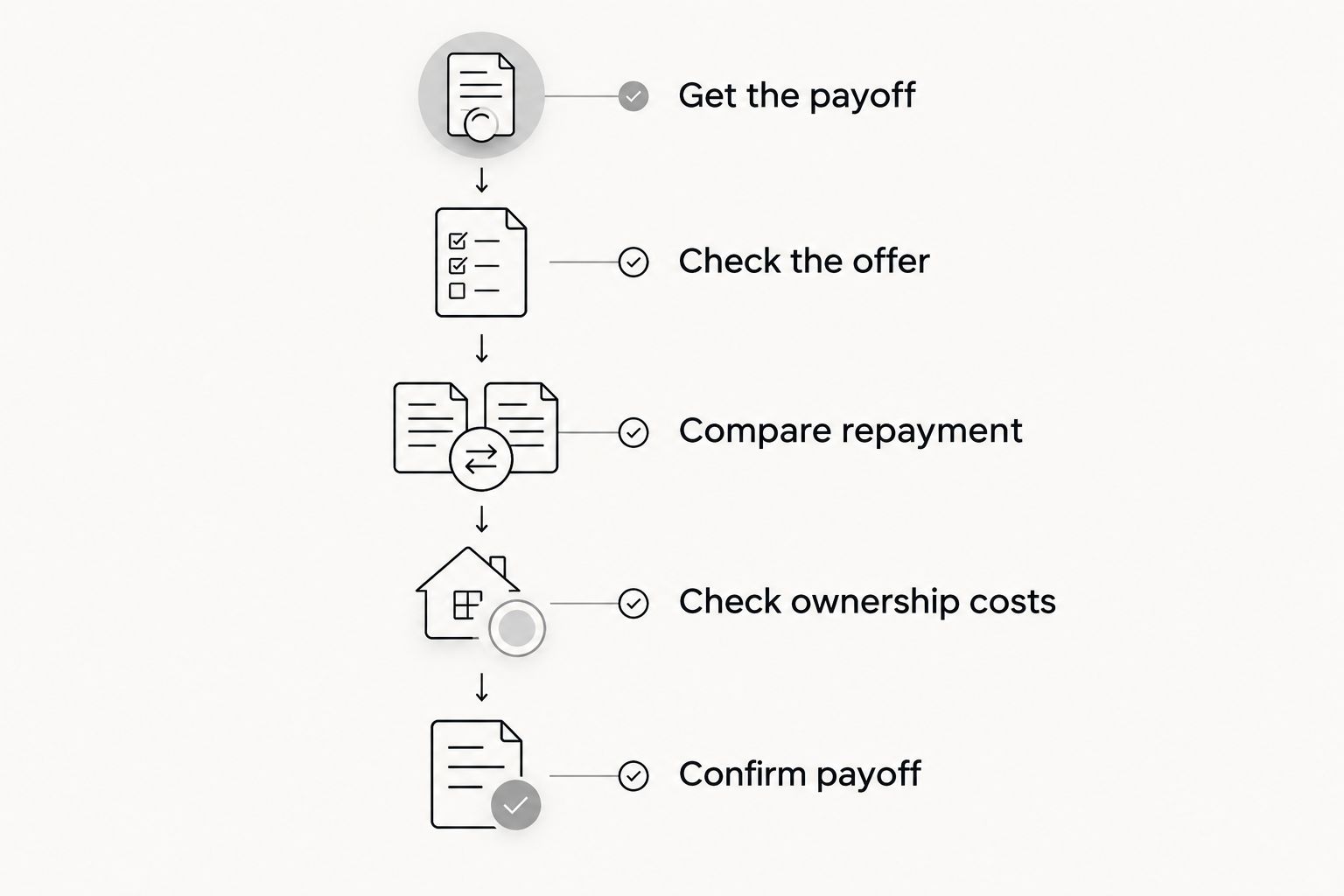
Keep 3 documents together: the current payoff statement, the replacement loan disclosure, and the final payoff confirmation. They answer different questions—what you owed, what you agreed to borrow, and whether the original debt was closed.
Do not stop the old loan's scheduled payments simply because the new loan is approved. Coordinate the payoff date and confirm completion before treating the original account as finished.
When does a lower payment fail to save money?
A lower payment fails to save money when the replacement loan's total remaining repayment exceeds what you would otherwise pay, after accounting for relevant fees. Extending repayment is a common way to reduce the payment without reducing the overall obligation.
Compare equivalent starting points. Use the current loan's remaining payments, not its original total, because payments already made cannot be recovered by refinancing.
A longer term can still serve a cash-flow need, but name that trade-off accurately. You are buying payment relief, not necessarily reducing borrowing costs.
For a 2026 decision, separate these questions: Can you afford the payment? Does the loan reduce total repayment? Do you still want the ownership? A favorable answer to one does not settle the others.
Can you refinance if you want to sell the timeshare?
Refinancing and selling are separate transactions, and a sale does not automatically clear the debt. Before borrowing again, establish how the existing balance would be handled if ownership transfers.
An unsecured replacement loan remains your obligation even after you sell the timeshare. With debt secured by the timeshare, the transfer process must address the lender's requirements and any applicable lien.
Read about selling a timeshare with a mortgage balance before assuming sale proceeds will cover the payoff. Compare the actual payoff with a realistic resale assessment, not the amount you originally paid.
Sold My Timeshare provides timeshare resale and exit assistance alongside a free, no-obligation valuation. That assessment helps frame the ownership decision; it is not a lender approval or a promise that a sale will satisfy your loan.
Check your timeshare ownership options
Request a free, no-obligation valuation before deciding whether to replace your loan.
Can refinancing stop maintenance fees?
Refinancing does not stop maintenance fees because replacing a loan does not end ownership. Keep those charges in your budget until the relevant contractual obligation has ended.
A paid-off timeshare can still carry ownership expenses. Ask the resort or association to explain what remains payable and what documentation confirms an approved transfer or surrender.
Do not treat a lender's payoff letter as proof that you no longer own the timeshare. Debt satisfaction and ownership transfer require separate confirmation.
FAQ
Can you refinance a timeshare loan in 2026?
Yes, you can refinance a timeshare loan in 2026 if a lender approves replacement financing and permits the funds to pay off that debt. Compare the APR, fees, repayment term, and total remaining repayment before accepting.
Is a personal loan better than keeping my timeshare loan?
A personal loan is better only when its terms improve your position after fees and repayment length are considered. A smaller payment alone does not establish savings.
Can I use home equity to pay off my timeshare loan?
You can use home-equity borrowing for a timeshare payoff if the lender permits it and approves your application. The new debt is secured by your home, so failure to repay puts the home at risk.
Will refinancing my timeshare hurt my credit?
Refinancing can affect your credit through a credit inquiry, a new account, and changes to existing balances. Ask whether a preliminary eligibility check uses a soft inquiry before authorizing a full application.
Can I refinance a timeshare loan with bad credit?
Approval with poor credit depends on the lender's underwriting and your overall financial profile. Compare any written offer with the existing obligation rather than accepting expensive replacement debt simply because it is approved.
Does selling my timeshare cancel the replacement loan?
Selling your timeshare does not automatically cancel a replacement loan. An unsecured personal loan remains payable under its agreement even after ownership transfers.
Does Sold My Timeshare provide timeshare refinancing?
Sold My Timeshare provides free, no-obligation timeshare valuations and resale/exit assistance. Those services address your ownership options rather than replacing lender underwriting or approving a new loan.
One last thing
You can pay off the timeshare lender and still owe every dollar of the replacement loan. Moving the balance changes who you repay, not whether the debt exists.
Before accepting a 2026 refinance offer, write down your actual objective: keep the timeshare with better financing, reduce immediate payment pressure, or leave ownership. Choose the process that addresses that objective instead of solving the wrong problem with a new loan.