
Yes, you can sell a timeshare for what you paid if a buyer agrees to that amount, but your original purchase amount does not establish its resale value. Recovering that amount also does not mean breaking even: loan payoff and seller-paid transaction expenses reduce what you keep. In 2026, base your decision on comparable completed sales and a written estimate of your net proceeds—not a promise to recover your investment.
- Can you sell a timeshare for what you paid? Yes, but original purchase amounts do not establish resale value.
- Compare completed timeshare resales, not just advertised listings, before setting your expectations.
- Sold My Timeshare offers free, no-obligation valuations for owners considering timeshare resale or exit assistance.
- A sale matching your purchase amount can still leave you short after loan payoff and transaction expenses.
Why this matters
Your purchase amount is a record of a past transaction, not proof of what another owner will pay today. If you treat it as a guaranteed recovery target, you risk rejecting a workable offer or trusting someone who promises an unsupported result.
Start with evidence rather than a commitment. Sold My Timeshare provides free, no-obligation timeshare valuations and resale/exit assistance. A valuation gives you an estimate to consider; it is not a completed sale or a guarantee that a buyer will appear.
Can you sell a timeshare for what you paid?
You can recover your original purchase amount only when an actual buyer supports it with an acceptable offer and the transaction closes. To recover that amount after expenses, your net proceeds must also cover those expenses. These are different tests.
Use the following sequence to decide whether your target has support:
- Confirm ownership. Identify the resort, ownership type, accommodation or points entitlement, usage schedule, and any restrictions. Compare what you legally own, not just the resort name.
- Find completed sales. Look for documented transactions involving comparable ownership interests. An advertised amount tells you what a seller wants; a completed transaction tells you what a buyer accepted.
- Check differences. Account for differences in season, usage rights, transferable benefits, maintenance obligations, and ownership status. A similar resort name does not make two interests equivalent.
- Calculate proceeds. Subtract the loan payoff and seller-paid transaction expenses from the proposed sale amount. Ask who pays each expense and when.
- Choose a goal. Decide whether you need sale proceeds, release from future ownership obligations, or both. That choice determines whether resale is the right route to investigate.
For a 2026 decision, ask when each comparable sale closed. Historical examples need context, especially when ownership rights or recurring obligations differ from yours.
Separate these three financial questions
| Question | What you are measuring | What it does not establish |
|---|---|---|
| Will the buyer pay what I originally paid? | Gross recovery of the original purchase amount | What remains after payoff and expenses |
| Will I receive money at closing? | Net proceeds after agreed deductions | Recovery of every ownership expense |
| Will I stop having ownership obligations? | Completion of the required transfer or release | A profit or repayment of past spending |
A sale can satisfy one goal without satisfying the others. Define success before you accept an offer, then check the closing documents against that definition.
Why timeshare resale outcomes vary
Timeshare ownership interests are not interchangeable. Evaluate these factors before treating another owner's result as a realistic target for your own sale:
- Ownership rights: A deeded week, points interest, and right-to-use arrangement can carry different rights and transfer requirements. Identify your actual contract structure.
- Resort and usage: Location, accommodation, season, and booking rights affect what a buyer receives. Match those details when reviewing comparable transactions.
- Recurring obligations: Buyers need to understand maintenance fees, assessments, and other continuing charges attached to ownership.
- Transferable benefits: Confirm which privileges follow the ownership and which do not. Do not advertise developer-purchase benefits as transferable without verification.
- Outstanding balances: A loan or unpaid ownership charges affect the work needed to complete a transfer and the proceeds you retain.
- Transfer rules: Approval requirements, transfer documentation, and any applicable right of first refusal affect the transaction process.
None of these factors proves that your timeshare will sell for a particular amount. Together, they explain why a valuation should describe its assumptions rather than deliver an unexplained headline figure.
What evidence should support your resale target?
A useful valuation connects its estimate to the ownership you actually hold. Ask what evidence supports it and whether that evidence describes completed sales, active advertisements, or an opinion without transaction records.
Give completed, comparable transactions more weight than unsupported promises. A listing that remains unsold does not prove that another buyer will accept the same terms. Equally, an isolated transaction with materially different rights does not establish your result.
For your 2026 review, collect three records:
- Ownership documents: The deed or contract, points allocation or usage details, and applicable transfer provisions.
- Account records: Current statements showing recurring obligations, outstanding charges, and any loan balance.
- Transaction evidence: Comparable completed sales and a written explanation of differences between those interests and yours.
Keep personal information out of public listings. Share documents through an appropriate private process, and verify who is requesting them before sending account details or identification.
Questions to ask about a valuation
Ask whether the estimate assumes a paid-off ownership, current maintenance accounts, or specific usage rights. Then ask what changes if one of those assumptions is wrong.
A clear answer is more useful than an attractive number. If the provider cannot explain the basis of the estimate, do not treat the estimate as evidence that you will recover your original spending.
Which route matches your actual goal?
Resale is the route to investigate when you want a buyer to pay for your ownership interest. A resort surrender or deed-back is a different discussion: its purpose is an accepted return of ownership, not necessarily recovery of your purchase amount. Rental addresses temporary use rather than a permanent transfer.
| Route | Best for | Main advantage | Main limitation |
|---|---|---|---|
| Resale | Owners seeking payment from a buyer | Provides a route to sale proceeds | Requires a buyer and completion of transfer requirements |
| Resort surrender or deed-back | Owners prioritizing release from ownership | Can address ownership directly with the resort if accepted | Acceptance and terms depend on the applicable program |
| Rental | Owners considering temporary use by someone else | Can make use of an eligible reservation or interval | Does not itself end ownership or continuing obligations |
These routes are not substitutes for checking your contract. Confirm rental permission before offering usage to someone else, and obtain written surrender terms before assuming a resort has accepted your ownership back.
For owners who need help choosing a starting point, Sold My Timeshare is best for owners who want a free, no-obligation timeshare valuation before deciding whether to sell. Its resale and exit assistance are relevant to that decision, but a valuation cannot establish a guaranteed sale outcome.
Request a timeshare valuation
Get a free, no-obligation valuation before deciding whether to pursue resale or exit assistance.
What if you still owe money on the timeshare?
Your loan balance does not determine what a buyer will pay. It determines an obligation that must be addressed as part of the transaction. If the proposed proceeds do not cover the required payoff and seller obligations, identify how the shortfall will be resolved before signing.
Request a current payoff statement from the lender and confirm the requirements for releasing any associated security interest. Do not assume that a buyer takes over your debt simply by agreeing to acquire the timeshare.
The guide to selling a timeshare with a mortgage balance explains the distinction between finding a buyer and resolving the outstanding financing. Keep those tasks separate in your planning.
Continue to follow your contractual obligations while you investigate a sale. An advertisement, valuation, or signed service agreement does not by itself change what you owe your lender or resort.
How do you protect yourself from a recovery promise?
A promise to recover your original purchase amount is not transaction evidence. Ask for written terms, independently verify the provider, and understand what service you are buying before agreeing to anything.
Be cautious when someone claims to have a committed buyer but will not explain the buyer's offer or the closing process. Pressure to act immediately is a reason to pause, not a substitute for verification.
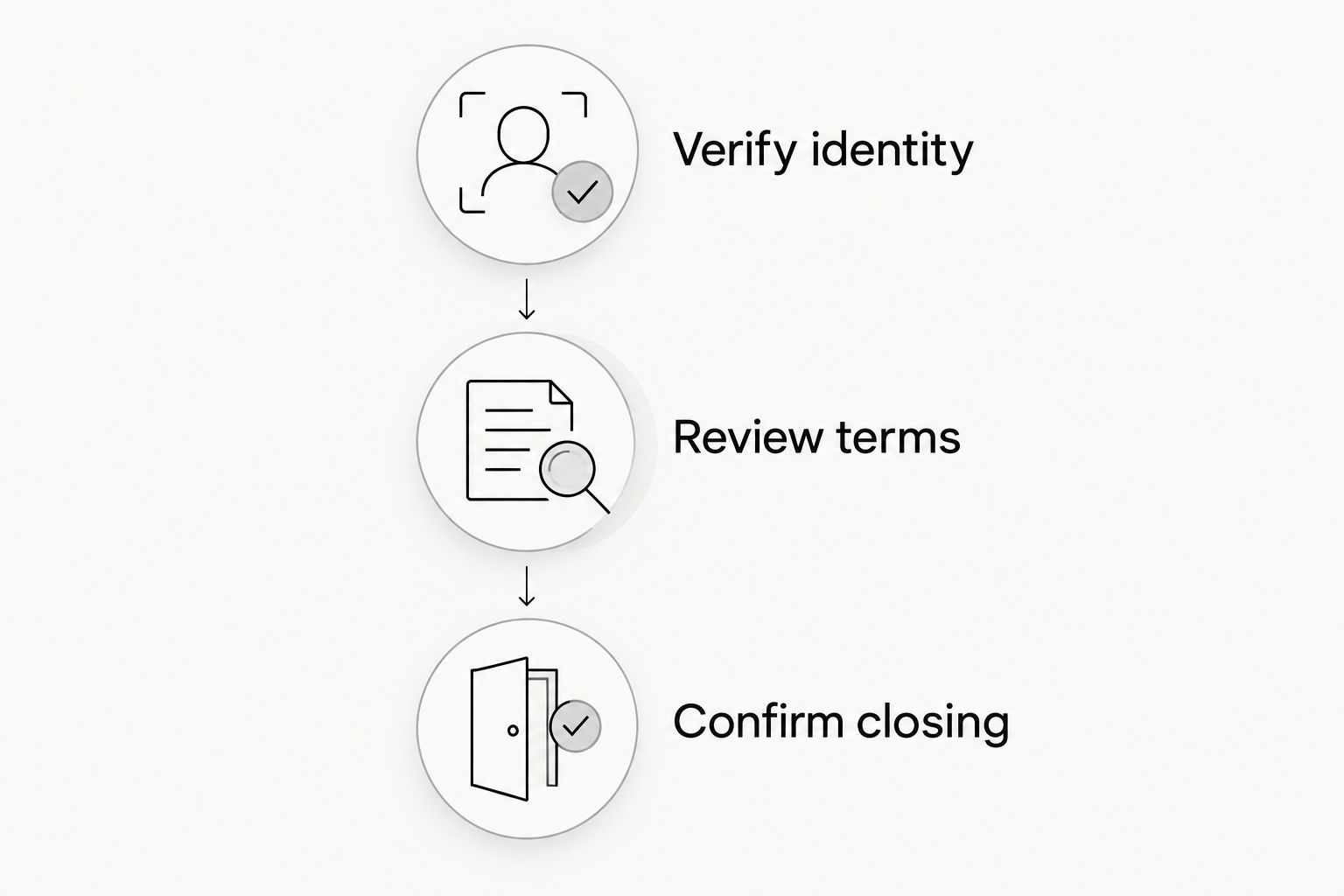
Use this review sequence:
- Verify identity. Confirm the business and the person contacting you through independently obtained information.
- Review terms. Read the service agreement, cancellation provisions, and description of work. Separate advertising services from a completed-sale obligation.
- Confirm closing. Identify who handles funds, documents, payoff, and the ownership transfer. Ask what written evidence you receive when the transaction is complete.
The Federal Trade Commission's consumer guidance on timeshares warns owners about resale scams. For your 2026 review, use that guidance alongside your contract and independent professional advice—not as a substitute for checking the specific transaction.
The same caution applies to any service provider. A reassuring conversation cannot replace a written explanation of responsibilities.
Should you wait until you can recover your original purchase amount?
Wait only if the decision fits your continuing obligations and the evidence supporting your target. Your original spending alone is not evidence that holding longer will produce a matching offer.
Compare the practical choices available now. Consider the obligations you retain while waiting, the terms of any real offer, and whether an accepted surrender route exists. Do not treat an unverified future sale as equivalent to an offer you can examine today.
Does selling for the original amount mean you broke even?
No—matching the original purchase amount does not establish that you broke even. Transaction expenses and financing costs affect your financial result, while maintenance and other ownership spending are separate parts of your total history.
Keep the analysis useful rather than emotional. Calculate what the proposed transaction leaves you with now, then separately record how much you spent during ownership.
FAQ
Can you sell a timeshare for what you paid in 2026?
Yes, if a buyer agrees to that amount and the transaction closes, but your purchase amount does not establish resale value. Compare completed sales and calculate net proceeds before treating that outcome as realistic.
Why isn't my original timeshare purchase amount a reliable resale estimate?
Your original purchase amount describes a past transaction, not what a buyer will pay for your ownership today. Resale evidence must account for the rights, obligations, and transfer terms attached to your specific interest.
Does an advertised timeshare listing prove what mine is worth?
No, an advertised listing shows what a seller is asking, not what a buyer has paid. Completed transactions involving comparable ownership interests provide stronger evidence.
Can I sell my timeshare if I still have a loan?
An outstanding loan must be addressed as part of the proposed transaction. Obtain a current payoff statement and confirm how the debt and any associated security interest will be resolved before closing.
Is a resort deed-back the same as selling my timeshare?
No, a deed-back is an accepted return of ownership to the resort rather than a sale to another buyer. Confirm eligibility, acceptance, and release terms directly with the resort in writing.
Can someone guarantee that I will recover my original investment?
A guarantee is not evidence of a completed sale or a qualified buyer. Review the written terms and supporting transaction evidence before relying on any recovery promise.
Does Sold My Timeshare offer a valuation before I commit?
Sold My Timeshare provides free, no-obligation timeshare valuations. Use the estimate to inform your decision, while distinguishing a valuation from a guaranteed offer or completed transfer.
One last thing
Ask for the net-proceeds explanation before focusing on the headline offer. A matching sale amount can still leave you with less than you expected, and an accepted offer is not the same as a completed transfer.
For your 2026 decision, write down two goals: what you need to receive and which obligations you need to end. Evaluate every proposed route against both. That keeps the decision tied to your situation rather than the amount you paid years ago.