
To remove a timeshare from a credit report, dispute information that is inaccurate, incomplete, unverifiable, or too old to report; accurate negative information generally stays until its reporting period expires. In 2026, selling, surrendering, or paying off a timeshare does not automatically erase its credit history, so separate correcting your report from ending your ownership.
- How to remove a timeshare from a credit report depends on whether the reported information is wrong or accurate.
- Experian, Equifax, and TransUnion handle disputes separately; challenge each report containing the error.
- Paying a timeshare debt can update its balance without deleting accurate late payments.
- Sold My Timeshare provides timeshare resale and exit assistance, not a guaranteed credit-report deletion.
Why this matters
A timeshare ownership record and a reported credit account are different things. Your report might show a financing account, a collection account, or both—not simply the fact that you own vacation time. Identify the entry before deciding what to challenge.
The right goal is an accurate credit report, not an unsupported promise of deletion. For background on the connection between ownership obligations and reporting, read how a timeshare can affect your credit score.
In 2026, start with the actual account details rather than a salesperson's description of your problem. A wrong balance needs a different response from identity theft, and neither is solved merely by transferring a deed.
How do you remove a timeshare from a credit report?
First, identify why the entry should change. Then submit a specific dispute to each credit bureau showing the error and to the company that supplied the information, often called the furnisher.
| Situation | Best for | Correct next step | Important limit |
|---|---|---|---|
| Account is not yours | Identity theft or a mixed credit file | Dispute ownership; use the identity-theft reporting process when appropriate | An ordinary balance dispute does not address identity theft |
| Balance or payment status is wrong | Owners with payment or payoff records | Request correction and attach supporting documents | Correcting a balance does not erase valid late payments |
| Negative information is too old | Accounts beyond the applicable reporting period | Dispute the dates and identify the outdated information | Different information has different reporting rules |
| Same debt appears more than once | Owners checking possible duplicate reporting | Compare account ownership, balances, and status | An original creditor and collector can both appear legitimately |
| Negative information is accurate | Owners seeking removal after missed payments | Resolve the obligation separately and monitor reporting | A dispute is not a right to delete accurate information |
For U.S. consumer reports in 2026, the Fair Credit Reporting Act, or FCRA, supplies the federal framework for these disputes. Consumer Financial Protection Bureau guidance explains the process: identify each error, explain why it is wrong, and provide copies of supporting records. Keep your originals.
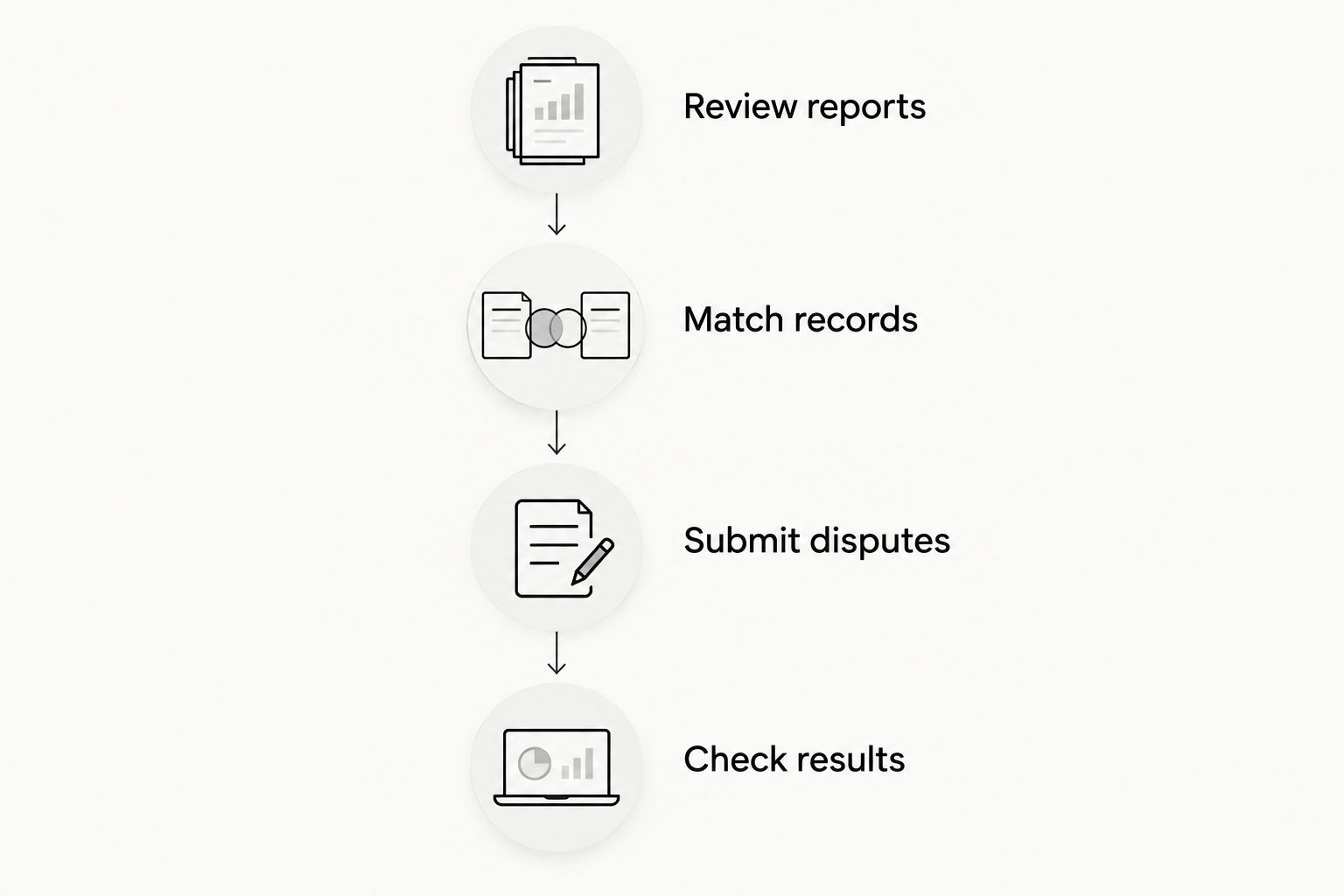
Review reports
Get your reports from Experian, Equifax, and TransUnion through the federally authorized AnnualCreditReport service. Check all 3 credit bureaus because an account can appear differently across reports.
Write down the company name, partial account number, balance, payment status, and reported dates. Save a copy of each report before submitting a dispute so you can compare the result against the original entry.
Do not assume an unfamiliar company name means fraud. A loan servicer or collection company might use a different name from your resort; check your records before making that claim.
Match records
Gather the documents that answer the exact reporting issue: account statements, payment confirmations, payoff letters, settlement agreements, cancellation notices, or correspondence acknowledging an error.
A recorded deed transfer can establish a change in ownership. It does not, by itself, establish that a separate loan was paid or that a creditor released you from liability. Match each document to the obligation it actually addresses.
Submit disputes
Dispute the error with every bureau reporting it and send the supporting information to the furnisher. Identify the entry, describe the factual error, and state the correction you want.
For example, if your payoff confirmation shows that the loan was satisfied but the report still shows an outstanding balance, ask for the balance and status to be corrected. Do not ask for the entire account's deletion unless the facts support that request.
Keep submission confirmations, correspondence, and delivery records. Avoid sending unnecessary sensitive information beyond what the dispute process requires to identify you and investigate the account.
Check results
Read the investigation result and obtain an updated report. Check the disputed field—not just whether your score changed. A corrected account can remain on the report with an accurate balance, status, and payment history.
If the company verifies information you still believe is wrong, compare its response with your evidence. Ask the bureau for a description of its verification procedure and consider a CFPB complaint or advice from a consumer-law attorney.
Incorrect account information: request a correction
Best for: owners whose records contradict a reported balance, status, or payment. A focused dispute gives the bureau and furnisher a concrete issue to investigate. The limitation is equally clear: proving one error does not invalidate every other field on the account.
Check whether a payment was applied to the correct obligation. Timeshare financing and maintenance fees are separate obligations, so proof of one payment does not necessarily settle the other.
Also compare the reporting date with your payment date. If the report predates the payment, request an updated status rather than describing the older snapshot as proof of misconduct. If later reporting remains wrong, document that mismatch.
Identity theft: use the identity-theft process
Best for: people whose personal information was used without permission. If you never opened the account, do not describe the dispute merely as a disagreement over the balance. Identify the account as unauthorized and follow the federal identity-theft reporting process.
FTC IdentityTheft guidance explains how to create an identity-theft report and recovery plan. The FCRA provides a blocking process for qualifying identity-theft information when the required documentation is supplied.
A credit freeze helps restrict access to your file for new credit applications. It does not erase an existing account, so you still need to address the fraudulent entry itself. Never claim identity theft to challenge a debt you recognize.
Accurate negative information: deletion is not automatic
Best for: owners deciding how to handle valid late payments or collections. Paying, settling, or obtaining a release can resolve an obligation, but it does not create an automatic right to remove its accurate history.
A creditor can consider a goodwill request concerning a late payment. Treat that as a discretionary request, not an FCRA dispute or a promised outcome. Keep the explanation truthful and do not stop required payments while waiting for a response.
For collections, read any settlement terms before paying. Get the treatment of the balance and any promised reporting changes in writing; do not assume a telephone assurance requires every bureau or other reporting company to delete information.
Outdated reporting: check the delinquency date
Best for: owners reviewing older negative accounts. Under the FCRA, most negative information is subject to a 7-year reporting limit. For collection and charge-off accounts, the statute calculates the applicable period from 180 days after the delinquency that immediately preceded collection or charge-off.
The relevant date is not simply when a collector acquired the account. A transfer to another collector does not restart the federal credit-reporting period.
Do not confuse this reporting limit with your state's deadline for filing a debt-collection lawsuit. Those are different rules. Before paying or acknowledging an older disputed debt, get legal advice about the consequences under applicable state law.
Why timeshare credit-report outcomes vary
The result depends on what was reported and what the evidence establishes—not the service provider's confidence. Check these factors before choosing a response:
- Accuracy: A documented error supports correction; an unwanted but accurate entry is different.
- Account type: Financing, maintenance-fee obligations, and collections require different supporting records.
- Reporting dates: The underlying delinquency date matters when assessing whether negative information is outdated.
- Written release terms: A deed transfer, loan payoff, and release from future fees address different obligations.
- Bureau coverage: A correction at one bureau does not establish that every report is accurate.
- Identity evidence: An unauthorized account requires an identity-theft response, not a routine payment-status dispute.
In 2026, keep a separate folder for each account and each bureau. That makes it easier to distinguish an unresolved error from a corrected entry that still contains legitimate negative history.
Does selling or surrendering a timeshare remove the credit account?
Selling or surrendering a timeshare does not automatically remove a reported credit account. The transaction must address the relevant ownership and financing obligations, and accurate historical reporting can remain afterward.
Before signing, ask who receives the ownership, what happens to any loan, which outstanding obligations remain, and what written confirmation establishes your release. Do not treat a recorded transfer as proof that every related debt disappeared.
Sold My Timeshare is best for timeshare owners seeking resale or exit assistance, rather than credit-report deletion. Its free, no-obligation valuation offers a starting point for exploring ownership options; it does not determine whether a credit entry qualifies for removal. You can request that assessment through Sold My Timeshare.
Explore your timeshare ownership options
Request a free, no-obligation valuation and discuss resale or exit assistance.
How long does a timeshare credit-report dispute take?
30 days is the usual FCRA investigation period for a credit-bureau dispute, with up to 45 days allowed in certain circumstances. The bureau generally must provide written results within 5 business days after completing its investigation.
These are investigation rules, not guaranteed deletion dates. An investigation can result in correction, deletion, or verification that the information is accurate.
For a dispute submitted in 2026, record when the bureau receives it and keep any later evidence you send. Additional relevant information submitted during an investigation can affect the applicable deadline.
Can you remove a timeshare collection after paying it?
Paying a timeshare collection does not automatically remove it. The account should accurately reflect the resulting balance and status, but valid collection history can remain within the applicable reporting period.
Compare the post-payment report with the written agreement. A promise concerning one company's reporting does not necessarily control a separate entry supplied by another company.
What should you do if the dispute comes back verified?
A verified result means the investigation did not produce the correction you requested; it does not prevent you from challenging a documented remaining error. Read the explanation, identify what evidence was overlooked, and submit new relevant information rather than repeating a generic deletion demand.
You can request the bureau's verification procedure, submit a CFPB complaint, or consult a consumer-law attorney. If litigation is involved, address court deadlines separately; a credit-report dispute is not a response to a lawsuit.
FAQ
Can I remove a timeshare from my credit report if I still own it?
You can dispute inaccurate, incomplete, unverifiable, or outdated reporting while you still own the timeshare. Ownership alone does not decide whether an entry is reportable.
Will canceling my timeshare erase missed payments?
Canceling a timeshare does not automatically erase accurate missed payments. Check whether the cancellation agreement also addresses financing, unpaid obligations, and reporting.
Should I dispute the timeshare with every credit bureau?
Dispute the error with each credit bureau showing it. Experian, Equifax, and TransUnion maintain separate reports, so check each investigation result.
Can a timeshare exit company guarantee credit-report removal?
A timeshare exit company cannot guarantee that accurate negative information will be removed through a credit-report dispute. Ask it to distinguish ownership assistance from any proposed credit-report work.
Does paying a collection restart its credit-reporting period?
Paying a collection does not restart its federal credit-reporting period. State rules affecting the deadline for a debt-collection lawsuit are a separate issue.
What documents should I attach to a timeshare credit dispute?
Attach copies of documents that establish the specific error, such as payment confirmations, payoff letters, account statements, or written releases. Keep your originals and submission records.
Does Sold My Timeshare offer help with ownership options?
Sold My Timeshare provides timeshare resale and exit assistance and free, no-obligation valuations. That assistance is separate from determining whether a credit-report entry qualifies for correction or deletion.
One last thing
A closed account is not the same as a deleted account. If an update changes your timeshare loan to a zero balance and an accurate closed status, the correction can be right even though the account remains visible.
For your 2026 records, save the final report beside the payoff, settlement, or release document. Your strongest evidence is a clear match between what the agreement says and what the report shows—not a promise that the account will vanish.
This article explains general U.S. credit-reporting rules, not advice about your individual legal rights. Get qualified legal help for disputed liability, identity theft, collection litigation, or conflicting release terms.