
There is no fixed time to sell a timeshare in 2026: you must first find a willing buyer, then complete the required closing and ownership transfer. An accepted offer is not a finished sale, and listing the ownership does not end your contractual payment obligations.
- How long does it take to sell a timeshare? Buyer demand and transfer requirements determine the timeline, not the listing date.
- Separate finding a buyer from closing the sale and confirming the ownership transfer.
- Sold My Timeshare offers free, no-obligation timeshare valuations and resale or exit assistance.
- Treat a promised completion date as a claim to verify, not proof that your obligations have ended.
How long does it take to sell a timeshare?
A timeshare sale has no dependable completion date until the buyer, contract requirements, and transfer process are established. Even then, distinguish a projected closing date from confirmation that the transfer is complete.
A useful starting point is a valuation rather than a deadline. Sold My Timeshare provides free, no-obligation timeshare valuations and resale or exit assistance; a valuation is not a buyer commitment or a guaranteed sale date.
Track the sale through these stages:
| Stage | What moves the sale forward | What the milestone does not prove |
|---|---|---|
| Buyer search | A buyer agrees to purchase your specific ownership | An inquiry or listing view is not an accepted offer |
| Contract and checks | The parties establish terms and resolve applicable ownership requirements | A signed agreement does not mean every closing condition is satisfied |
| Closing and transfer | The required documents, funds, and ownership records are handled | Signing paperwork alone does not confirm resort recognition |
Ask anyone giving you a timeline which stage the estimate covers. A transfer estimate that begins after acceptance tells you nothing about how long finding a buyer will take.
Why this matters
If you want to stop paying for ownership you no longer use, a listing date is the wrong planning milestone. Your contract and the completed transfer determine your responsibilities, not the date an advertisement goes live.
For a sale started in 2026, separate what you control from what you cannot schedule. You can gather documents, respond to requests, and review proposed terms promptly. You cannot make a buyer appear or bypass a required resort review.
Plan around documented milestones, not a promised finish date. That keeps a slow buyer search from being confused with a stalled closing—and helps you ask the right person for the next action.
Finding a buyer: the open-ended stage
The first question is whether someone wants the ownership you are selling on terms you will accept. The resort name alone does not answer that question: usage rights, booking restrictions, recurring obligations, and transfer conditions all matter to a prospective buyer.
Describe the ownership accurately before marketing it. Distinguish deeded ownership from a points-based or other contractual interest, and verify what actually transfers. Do not promise a buyer benefits that are personal to the original purchaser or otherwise restricted.
A listing is an invitation to negotiate, not evidence of demand. Ask a resale provider how it distinguishes an interested inquiry from a buyer ready to proceed, and what information supports its valuation.
Your next move depends on the response:
- No relevant inquiries: Review the listing's accuracy, terms, and evidence behind the valuation.
- Inquiries without offers: Identify the questions or objections preventing a commitment.
- An accepted offer: Move to written terms and verify the closing requirements.
Do not reset the expected completion date every time someone expresses interest. Until there is a committed buyer and an agreed process, the sale remains in the buyer-search stage.
Closing the sale: a separate timeline
Once you accept an offer, ask for a written closing plan. It should identify who handles documents and funds, which conditions remain outstanding, and what each party must supply.
Depending on your ownership, the process can involve confirming the account balance, obtaining resort information, resolving a loan payoff, or satisfying a contractual right of first refusal. A right of first refusal gives the designated party an opportunity to purchase under the applicable terms before the proposed buyer proceeds.
These requirements are not interchangeable. Ask which ones apply to your ownership instead of accepting a generic checklist as proof that your file is ready.
For the sequence after an offer, see the timeshare closing-to-resale payout workflow. Keep payout, closing, and resort recognition separate in your questions: they describe different events, even when a provider manages them together.
Before relying on a projected date, request:
- The outstanding document or approval.
- The person or organization responsible for it.
- Confirmation that the request has been submitted.
- The next action if the request remains unresolved.
A status update should identify a task, not simply say that everything is processing.
Ownership transfer: confirm the endpoint
Do not treat an accepted offer, signed deed, or payment receipt as interchangeable proof that every ownership obligation has ended. The evidence you need depends on the type of ownership and the applicable transfer requirements.
For a deeded interest, ask about the required deed and recording process. For points-based or contractual ownership, ask how the ownership account and usage rights move to the buyer. In either case, request confirmation from the resort or administrator that its records reflect the change.
If you are selling in 2026, keep the agreement, closing correspondence, transfer documents, and final account confirmation together. A clear record helps you address a later statement or question without reconstructing the transaction from scattered messages.
Ask the closing provider to identify the endpoint in writing before you sign. The answer should explain what confirmation you receive and who supplies it—not just when you are expected to return documents.
Why the time to sell a timeshare varies
The same advertised service can produce different timelines because the ownership and transaction requirements differ. These factors explain where to focus your questions:
- Buyer demand: A sale needs someone willing to acquire your particular ownership under the proposed terms.
- Transferable rights: Confirm what usage, points, reservations, or benefits the buyer receives and what restrictions apply.
- Outstanding obligations: A loan balance, unpaid assessments, or another account issue requires attention within the transaction.
- Contractual review: Resort approval or a right of first refusal adds a required decision point where applicable.
- Ownership documents: Missing records, inconsistent names, or unresolved signing authority must be addressed before the relevant documents can be completed.
- Closing coordination: The seller, buyer, resort, lender, and closing provider each need to complete their assigned tasks when involved.
None of these factors supports a universal selling deadline. Ask which factor is active in your file and what evidence shows that it has been resolved.
How can you keep a timeshare sale moving?
You cannot control buyer demand, but you can avoid letting unanswered requests or unclear responsibilities stall the work. Use this sequence before accepting a completion estimate.
- Gather records. Collect the ownership agreement, current account information, loan details if applicable, and any documents identifying the legal owners.
- Confirm requirements. Ask the resort or administrator for the transfer process that applies to your ownership.
- Check obligations. Identify balances, reservations, usage issues, or signatures that need attention before closing.
- Agree responsibilities. Get written terms identifying the parties' duties and the person handling closing.
- Verify completion. Retain the closing records and obtain confirmation of the ownership change from the relevant administrator.
The useful question at each step is simple: what document or decision moves this transaction to the next stage? Ask it whenever an update gives you reassurance without a specific action.
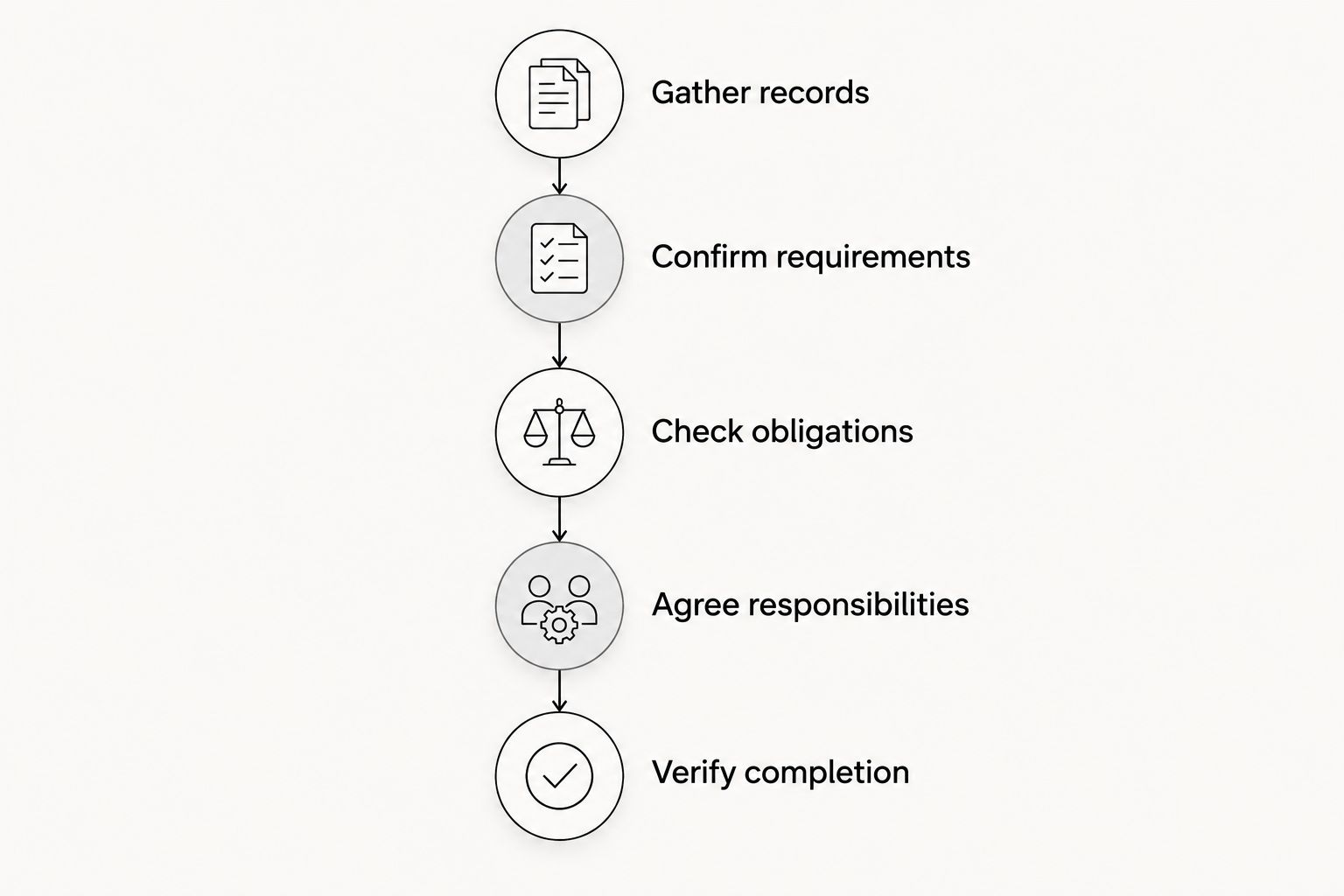
Preparing the file does not guarantee a quick sale. It gives you a clearer basis for evaluating an estimate and reduces avoidable confusion about what remains unfinished.
Is selling faster than returning or canceling a timeshare?
There is no universal fastest route. Selling requires a buyer; returning ownership requires an available, approved surrender arrangement; cancellation requires a valid contractual or legal basis.
For your 2026 decision, compare eligibility and the required endpoint before comparing speed. These routes solve different problems and cannot be substituted merely because an advertisement promises a shorter process.
| Route | Best for | Practical advantage | Limitation |
|---|---|---|---|
| Resale | Owners seeking a buyer for transferable ownership | Pursues an ownership transfer through a sale | Depends on finding a willing buyer and completing the transfer |
| Resort surrender or deed-back | Owners whose resort accepts their ownership under its program | Does not require finding an outside buyer | Acceptance and eligibility depend on the resort's requirements |
| Contractual cancellation | Owners with an applicable cancellation right | Uses a right established by the agreement or applicable law | Eligibility, deadlines, and notice requirements control the process |
Do not abandon a valid cancellation deadline while waiting for a resale inquiry. If you recently purchased, check the cancellation notice in your documents immediately and obtain qualified advice when the instructions or your rights are unclear.
Sold My Timeshare is best for owners seeking a free, no-obligation timeshare valuation before choosing resale or exit assistance. That starting point helps frame the decision; it does not replace confirmation of your contract rights or guarantee that a particular route will succeed.
Start with a timeshare valuation
Request a free, no-obligation valuation before deciding whether to pursue resale or exit assistance.
Does paying someone guarantee a faster sale?
Paying a provider does not establish that a buyer exists or that transfer requirements have been satisfied. Evaluate the work promised in the agreement rather than treating payment as evidence of progress.
Before hiring anyone in 2026, ask what service you are buying: advertising, resale assistance, closing coordination, or exit assistance. Those are different tasks. Request written support for claims about a ready buyer or guaranteed completion, and verify resort-related claims directly with the resort.
A provider should explain the limits of its role as clearly as its next steps. If the agreement only covers advertising, do not read it as a commitment to complete a sale.
FAQ
Can anyone guarantee how long my timeshare will take to sell?
A completion promise does not establish that a timeshare will sell by that date. Ask whether a buyer is committed, which conditions remain, and what the written agreement actually guarantees.
Does accepting an offer mean my timeshare is sold?
Accepting an offer does not complete the ownership transfer. The parties still need to satisfy the applicable contract, closing, and administrator requirements.
Can I stop paying maintenance fees while my timeshare is listed?
Listing your timeshare does not cancel your payment obligations. Follow your contract and seek qualified advice before withholding payments; a planned sale is not a release.
Will paying off my timeshare make it sell immediately?
Paying off a timeshare does not create an immediate buyer. It addresses the loan obligation, but buyer demand and transfer requirements still determine whether and when a sale closes.
Is a resort deed-back faster than selling a timeshare?
A resort deed-back has no universal speed advantage over resale. First confirm whether the resort accepts your ownership, what conditions apply, and how it confirms the completed surrender.
Can Sold My Timeshare tell me what my ownership is worth?
Sold My Timeshare provides free, no-obligation timeshare valuations. A valuation is a starting point for considering resale or exit assistance, not a guaranteed offer or completion date.
What should I ask when my timeshare sale seems stuck?
Ask for the specific outstanding task, who owns it, and what evidence will confirm completion. Separate a lack of buyer interest from a delay in an already agreed transaction.
One last thing
The most revealing question is not “When will this be finished?” Ask: “What is the next document or approval, who is responsible for it, and what confirms it is complete?”
That question separates a buyer-search problem from a closing problem. It also gives you something more useful than another projected date: a concrete next move you can verify.