
Your timeshare’s worth in 2026 depends on what a buyer will pay for the ownership rights you can transfer—not what you originally paid or what another owner hopes to receive. Your take-home proceeds are a separate calculation: subtract outstanding debt and seller-paid closing obligations from the accepted offer.
- Answering how much is my timeshare worth requires matching completed resales, not just advertised listings.
- Sold My Timeshare offers free, no-obligation timeshare valuations for owners considering resale or exit assistance.
- Compare transferable booking rights, annual maintenance obligations, ownership type, and outstanding debt before accepting a valuation.
- A resale valuation estimates buyer demand; it does not guarantee an offer or a completed transfer.
Why this matters
A timeshare valuation should help you choose a next step, not simply give you a reassuring figure. An estimate without matching ownership details or an explanation of seller obligations does not tell you what selling would accomplish.
Sold My Timeshare is best for timeshare owners seeking a free, no-obligation valuation before considering resale or exit assistance. A valuation is a starting point, not proof that a buyer will purchase your ownership. You can request that initial assessment through Sold My Timeshare.
Keep your goal clear: receiving sale proceeds and ending ownership are different outcomes. A proposal that addresses one does not automatically accomplish the other.
How much is my timeshare worth today?
Your timeshare’s current resale value is the amount a buyer agrees to pay for the specific rights being transferred. To assess that value in 2026, compare completed transactions involving genuinely similar ownership interests and check the obligations attached to yours.
Use the following distinctions when reviewing an estimate. They answer different questions and should not be treated as interchangeable.
| Measure | What it tells you | Best for | Main limitation |
|---|---|---|---|
| Original purchase amount | What you paid when you acquired ownership | Reviewing your purchase history | Does not establish current resale demand |
| Advertised asking amount | What a seller wants to receive | Finding competing listings | Does not show whether a transaction closed |
| Completed resale amount | What a buyer paid for a transferred interest | Evaluating comparable transactions | Requires a close match to your ownership |
| Estimated net proceeds | What remains after seller obligations | Deciding whether a sale meets your goal | Depends on an actual offer and closing terms |
Start with comparable completed sales, then work toward your net proceeds. If someone presents a valuation without explaining its basis, ask which ownership details were matched and whether the evidence reflects completed transfers or advertised listings.
An ownership at the same resort is not automatically a comparable sale. A different season, unit category, booking arrangement, or transfer restriction can change what the buyer receives.
Check the evidence behind the estimate
Ask when each comparable transaction closed and what transferred. For a 2026 valuation, older transactions need context: the ownership terms and recurring obligations should still be relevant to the comparison.
Request enough detail to distinguish an actual comparable from a resort name alone. A useful explanation connects the evidence to your ownership rather than treating every interest within a resort as identical.
How do I work out my timeshare’s resale value?
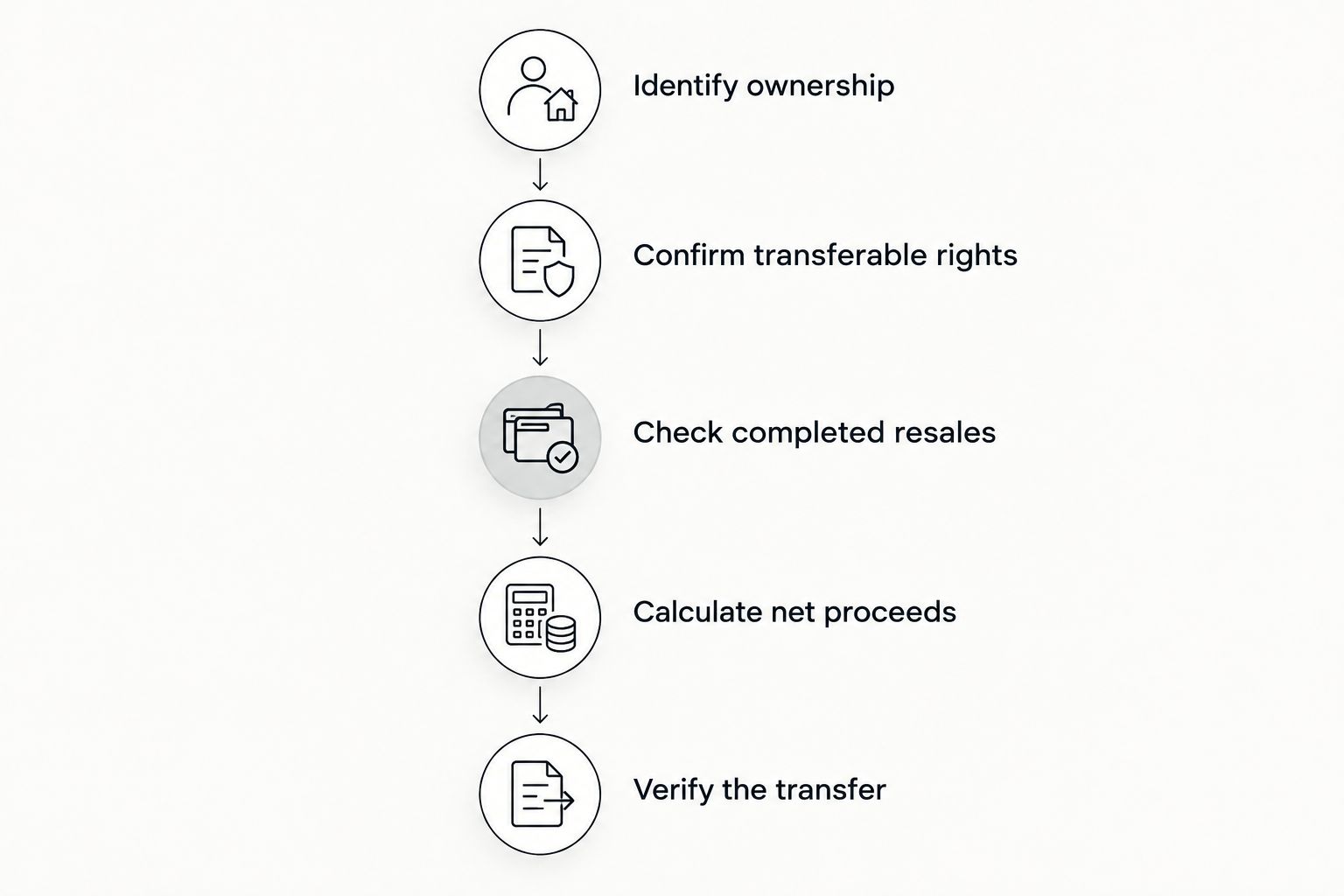
Follow this sequence before treating any estimate as a decision-ready answer. You do not need to resolve every legal detail yourself, but you do need to know what is being valued.
- Identify ownership. Gather your deed or membership agreement, resort name, ownership category, and account information. Establish whether you own a fixed week, floating use, points, or another contractual interest.
- Confirm transferable rights. Ask the resort or program administrator which booking rights and benefits pass to a resale buyer. Do not assume the buyer receives everything you currently use.
- Check completed resales. Look for transactions matching the resort, ownership category, season, unit entitlement, and usage frequency. Separate those records from active advertisements.
- Calculate net proceeds. Obtain a current loan payoff statement and identify seller-paid transfer and closing obligations. Use the written terms of an actual offer when one arrives.
- Verify the transfer. Confirm the required approvals, documents, and account changes. An agreement to sell is not the same as the resort recognizing a new owner.
Keep the supporting documents together. Your latest maintenance statement, account status, and ownership agreement help prevent a valuation from being based on incomplete or outdated information.
If you are assisting a parent or handling an inherited interest, also establish who has authority to request information and approve a transfer. Knowing the ownership details does not itself establish authority to sell.
Why timeshare values vary
A credible valuation explains the differences between your ownership and the evidence used to assess it. These factors deserve particular attention:
- Resort and location. Compare demand for the specific resort rather than assuming all vacation ownership in the destination attracts the same buyers.
- Season and booking access. A fixed holiday week and flexible access subject to reservation rules give buyers different booking rights. Match the actual entitlement.
- Unit and usage entitlement. Accommodation category, occupancy entitlement, and annual or alternating-year use affect what transfers. Resort name alone leaves these differences unresolved.
- Recurring obligations. Maintenance fees and any outstanding assessments belong in the buyer’s review. Use the current statement rather than an older figure from your purchase paperwork.
- Transfer restrictions and benefits. Resort approvals, resale limitations, and benefits excluded from transfer affect what a buyer receives. Verify them with the relevant administrator.
- Outstanding debt and account status. Debt affects the proceeds you retain and what must be resolved at closing. It does not establish the ownership’s market value.
Avoid treating these factors as automatic premiums or deductions. Their effect needs evidence from comparable ownership interests and the actual transfer terms.
For a 2026 review, ask for current account documents even if you obtained a valuation previously. An earlier estimate does not settle today’s payoff balance, maintenance obligations, or available buyer interest.
What will I actually receive after a sale?
Your net proceeds are the accepted sale amount minus the obligations you agree or are required to pay at closing. This is the figure to use when deciding whether an offer accomplishes your financial goal.
Request a written closing breakdown that identifies:
- The buyer’s agreed payment and any conditions attached to it.
- Your current loan payoff, if applicable.
- Seller-paid closing and transfer obligations.
- Any unpaid maintenance charges or assessments requiring resolution.
- How prepaid usage, reservations, or other adjustments will be handled.
Do not subtract the original purchase amount when calculating closing proceeds. That amount describes your purchase history; it is not the same as an unpaid loan balance.
If an offer will not cover the outstanding debt and closing obligations, ask how the shortfall must be handled before agreeing to proceed. The guide to selling a timeshare with a mortgage balance explains the issue to examine before a transfer.
An appealing headline valuation is not a substitute for a written net-proceeds breakdown. Ask who prepared that breakdown and which figures still need confirmation.
Should I sell, rent, or ask about returning my timeshare?
Resale, rental, and a resort-approved return solve different problems. Choose according to your goal and the options your ownership actually permits—not simply the largest-looking estimate.
| Route | Best for | Main advantage | Main limitation |
|---|---|---|---|
| Resale | Owners seeking a buyer and ownership transfer | Connects the ownership with a buyer willing to acquire it | Requires buyer agreement and completion of the transfer requirements |
| Rental | Owners seeking to make permitted use available temporarily | Addresses unused vacation time without selling the ownership | Does not end ownership or its ongoing obligations |
| Resort-approved return | Owners whose priority is ending ownership | Provides a direct route to discuss with the resort | Depends on the resort’s current requirements and acceptance |
Ask the resort about permitted routes before committing to a service agreement. A rental inquiry does not establish that renting is allowed, and a request to return ownership does not mean the resort has accepted it.
For resale, ask what happens if no buyer is found. For rental, check the guest-use and reservation rules. For a proposed return, request written confirmation of the conditions and the point at which your obligations end.
Sold My Timeshare provides timeshare resale, rental, and exit services. Its free, no-obligation valuation is relevant when you want an initial assessment; it does not replace written confirmation of your resort’s transfer rules or an actual buyer’s offer.
Request your timeshare valuation
Get a free, no-obligation valuation before deciding whether to pursue resale or exit assistance.
Can my timeshare be worth less than I paid?
Yes. Your original purchase amount does not establish what a resale buyer will pay in 2026. Compare the transferable ownership rights and evidence of buyer demand rather than using your purchase paperwork as a resale benchmark.
Keep two questions separate: what a buyer will pay, and whether that payment will cover your outstanding obligations. A sale can answer the first question without producing the proceeds you hoped to retain.
Is an online timeshare valuation accurate?
An online timeshare valuation is useful when it accounts for your exact ownership and explains the evidence behind the estimate. A resort-only estimate leaves out details needed to judge whether the comparison fits.
Ask Sold My Timeshare or any valuation provider to explain the assumptions behind its assessment. Treat an unexplained estimate as an opening discussion, not a guaranteed sale outcome.
Does a low valuation mean I should stop paying maintenance fees?
No. A low valuation does not cancel your ownership obligations. Review your agreement and seek qualified advice before changing payments; missed obligations can create problems separate from the resale value.
Keep valuation discussions separate from payment instructions. If someone tells you to stop paying as part of a proposed exit, request the legal basis and understand the consequences before acting.
FAQ
How much is my timeshare worth in 2026?
Your timeshare’s worth in 2026 depends on buyer demand for the specific ownership rights you can transfer. Use comparable completed resales, then calculate net proceeds after debt and seller-paid obligations.
Can I use advertised listings to value my timeshare?
Advertised listings show asking amounts, not confirmed sale outcomes. Use them to understand competing offers, but distinguish them from completed transactions when assessing value.
Does a paid-off timeshare automatically have resale value?
A paid-off timeshare does not automatically attract a buyer. Removing a loan balance changes your financial position, but buyer demand still depends on the transferable ownership and its obligations.
Can I sell my timeshare if I still owe on the loan?
An outstanding loan must be addressed as part of a proposed sale. Obtain a payoff statement and confirm with the lender and closing professional how the debt will be resolved.
Is renting my timeshare the same as getting out of it?
Renting your timeshare does not end ownership. Check your ownership’s rental rules and remember that making a reservation available to a guest does not transfer your ongoing obligations.
What documents should I gather for a timeshare valuation?
Gather your ownership agreement or deed, current maintenance statement, usage details, and loan payoff information if applicable. These documents help distinguish your ownership from superficially similar listings.
Does a free timeshare valuation commit me to selling?
Sold My Timeshare offers a free, no-obligation timeshare valuation. Review any later service agreement separately before authorizing listing, resale, or exit assistance.
One last thing
Ask which benefits a resale buyer will not receive. That question can expose a weak comparison even when the resort, accommodation category, and usage schedule appear to match.
Before accepting a 2026 valuation, request a written summary of the ownership being assessed, the evidence supporting the estimate, and the obligations excluded from it. A clear explanation helps you judge the next move without confusing an estimate with a completed sale.