
Timeshare cancellation has no single standard cost in 2026: the amount depends on whether you can rescind the purchase, arrange a resort surrender, transfer ownership, or need legal help. A service quote does not necessarily include your loan balance, overdue assessments, or obligations that continue until the exit becomes effective. Compare the written release and all remaining obligations—not just the cancellation fee.
- How much does timeshare cancellation cost? Compare the exit route, service scope, and obligations left after completion.
- Rescission, resort surrender, resale, and legal assistance solve different ownership problems; they are not interchangeable services.
- Sold My Timeshare offers no-obligation timeshare valuations and resale or exit assistance for owners considering their options.
- A paid invoice is not proof that your ownership or loan obligations have ended.
Why this matters
A cancellation proposal can sound reassuring while leaving the most important question unanswered: what exactly ends when the work is complete? Ending a service agreement, transferring ownership, and releasing a loan are different outcomes.
For your 2026 decision, separate the ownership problem from the sales pitch. Sold My Timeshare is best for owners seeking a no-obligation valuation before choosing resale or exit assistance. A valuation helps you examine the resale route; it is not a lender release or proof that a resort will accept a surrender.
How much does timeshare cancellation cost on average?
A single average is not a dependable budget for timeshare cancellation. The term covers different processes, and a quote for one process does not establish what another process requires.
Start by identifying the route that fits your contract. Then ask for an itemized proposal covering the work, exclusions, payment conditions, and evidence of completion.
| Route | Best for | Main advantage | Main limitation | What to establish before proceeding |
|---|---|---|---|---|
| Purchase rescission | Recent buyers whose cancellation right remains open | Uses an existing cancellation right | Deadlines and delivery requirements control eligibility | Required notice, recipient, deadline, and delivery method |
| Resort surrender or deed-back | Owners whose resort accepts their ownership | Lets you ask the resort directly about an exit | Acceptance is not automatic | Eligibility, account requirements, and written release terms |
| Resale or transfer | Owners with a transferable interest and a willing recipient | Provides an ownership-transfer route | Finding a buyer does not complete the transfer | Transfer approval, loan treatment, and closing responsibilities |
| Attorney assistance | Owners facing a dispute or needing legal advice | Provides advice about legal rights and claims | Hiring counsel does not guarantee cancellation | Scope of representation and the proposed legal outcome |
| Exit-service assistance | Owners considering outside administrative or negotiation help | Can provide help managing an exit process | A service contract does not itself end ownership | Exact tasks, exclusions, completion evidence, and refund terms |
Do not compare these routes as though they deliver the same result. A resale proposal addresses a transfer; an attorney engagement addresses legal work. Neither label, by itself, proves that all obligations will end.
Build a complete cancellation worksheet
For every proposal you review in 2026, record these categories separately:
- Professional services: The work the provider agrees to perform, including negotiations, document preparation, or legal representation.
- Existing obligations: Your outstanding loan, unpaid maintenance assessments, and other account balances.
- Completion expenses: Any required transfer, recording, closing, or administrative charges identified in writing.
- Continuing obligations: Payments that remain due while the process is underway.
- Excluded work: Disputes, appeals, additional documents, or other tasks outside the agreement.
Ask who receives each payment and what event makes it due. If a proposal combines everything into a single description, request the breakdown before signing. You need to distinguish money paid for assistance from money that resolves an existing obligation.
Purchase rescission: check the deadline first
Best for: recent purchasers who still have a contractual or statutory cancellation right. Rescission deserves immediate attention because the applicable notice period and delivery requirements determine whether you can use it.
Read the cancellation instructions in your purchase documents. Identify the recipient, permitted delivery method, required information, and deadline. Keep a copy of your notice and evidence of delivery; do not assume a conversation with a salesperson satisfies the written requirements.
The advantage is that you are exercising an existing right rather than asking someone to negotiate a later exit. The limitation is strict eligibility: an expired deadline requires a different analysis. If the instructions are unclear or the deadline is disputed, get advice from a licensed attorney promptly.
Resort surrender: ask what acceptance actually releases
Best for: owners whose resort or developer accepts their ownership for surrender. Contact the organization identified in your ownership documents and ask whether it has a surrender or deed-back process for your specific interest.
Request the eligibility rules and release terms in writing. Ask whether the account must be current, whether an outstanding loan prevents acceptance, and what documents establish completion. A resort's willingness to review an application is not the same as acceptance.
The advantage is direct communication with the organization administering your ownership. The limitation is that you cannot assume a program exists or that your account qualifies. Do not stop at an application acknowledgment: establish the effective release date and which obligations the acceptance covers.
Resale or transfer: separate ownership from debt
Best for: owners with a transferable interest and a willing buyer or recipient. A resale or transfer changes who owns the interest, subject to the requirements that apply to that ownership.
Check the transfer rules before advertising or signing a handover agreement. Ask who handles approval, account verification, closing documents, and any required recording. If a loan remains, obtain the lender's written explanation of how the proposed transaction affects it.
The advantage is a defined transfer process when a suitable recipient and required approvals are in place. The limitation is that an advertisement, purchase agreement, or signed deed alone does not establish that every required step is complete. Treat ownership transfer and debt release as separate questions until the relevant parties confirm both.
Professional help: define the work before hiring
Best for: owners who need legal advice or clearly defined assistance with a specific exit route. An attorney and an exit-service provider are not interchangeable. Ask who performs the work, whether legal representation is included, and who has authority to approve the outcome.
A useful agreement describes deliverables rather than relying on the word cancellation. It identifies whether the provider will request a surrender, seek a settlement, prepare transfer documents, or represent you in a dispute.
The advantage is help with work you cannot or do not want to manage yourself. The limitation is that paying for effort does not guarantee acceptance by a resort, lender, or other party. Before committing, review how to identify a legitimate timeshare exit company and verify the agreement against the promises made during the sales conversation.
Why timeshare cancellation costs vary
Your 2026 comparison should focus on the circumstances that change the required work. These factors determine whether proposals address the same problem:
- Cancellation rights: A valid rescission request follows a different process from an exit sought after that right expires.
- Loan status: An outstanding loan introduces a lender obligation that an ownership transfer does not automatically resolve.
- Account standing: Unpaid assessments and other balances need explicit treatment in the proposed agreement.
- Ownership structure: A deeded interest, points-based interest, or other contractual arrangement has its own transfer requirements.
- Exit route: Rescission, surrender, resale, and a legal dispute require different documents and approvals.
- Service scope: Advice, administrative assistance, negotiation, and legal representation are different deliverables.
A proposal is useful only when it explains how these factors apply to your account. Broad promises about helping every owner do not answer whether your particular contract can be ended through the proposed route.
How to compare cancellation proposals before you sign
Use this sequence to turn a sales conversation into a decision you can document. Keep the answers together with your purchase contract, account statements, and correspondence.
- Check rights. Find your cancellation instructions and establish whether a rescission deadline remains open. Address that question before evaluating a longer exit process.
- Confirm obligations. Request current account information and identify any separate lender. List what you owe and which party controls each obligation.
- Compare scope. Ask each provider to describe the same intended outcome. Separate work performed from releases or approvals that another party must grant.
- Review terms. Read the payment schedule, exclusions, termination provisions, and any refund conditions. Resolve differences between the written agreement and spoken promises.
- Verify release. Identify the document that will establish completion and the party that must issue or accept it. Decide how you will verify that outcome independently.
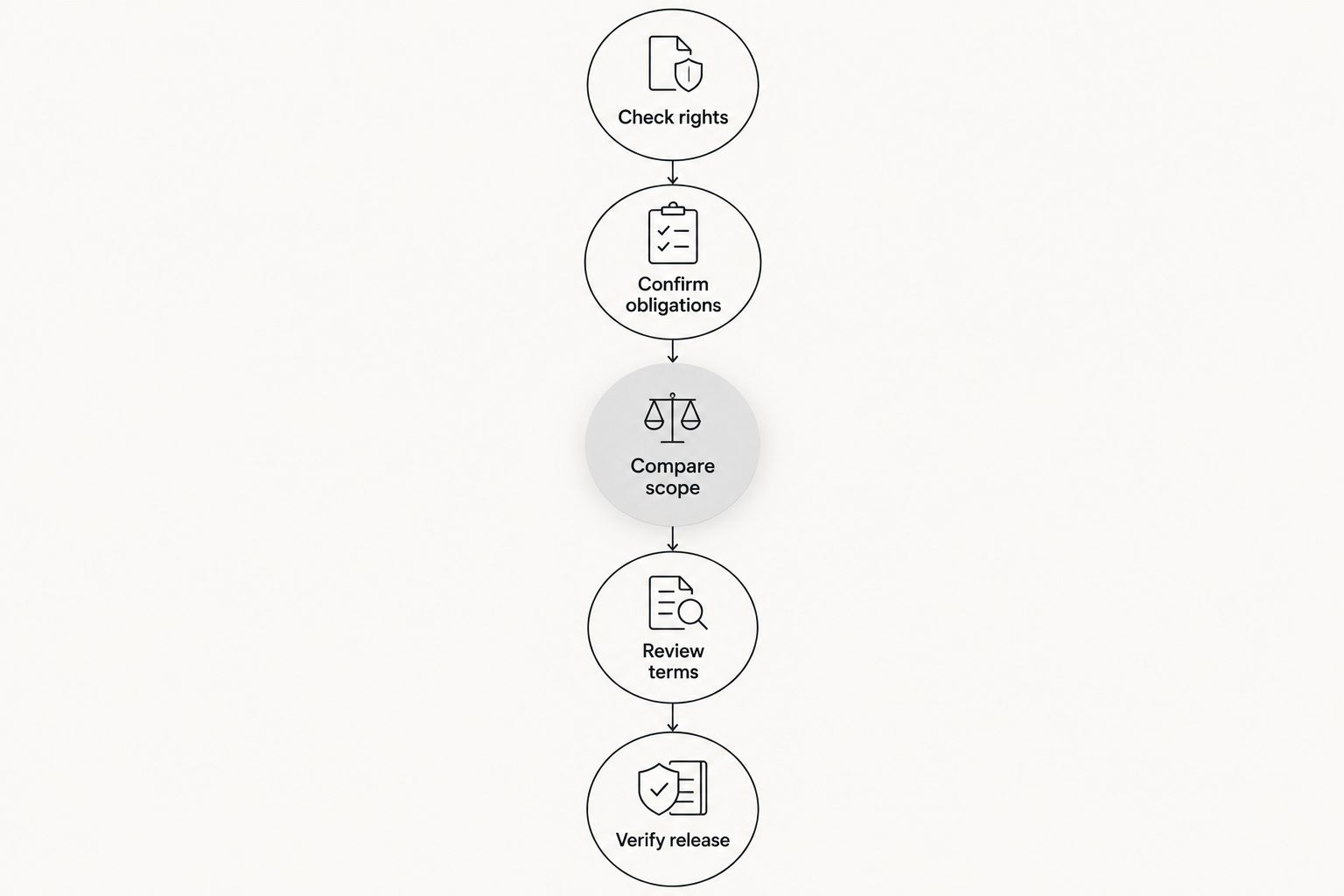
For a proposal dated 2026, make sure the account information supporting it is current. An older statement does not establish today's balance or show whether a later payment, assessment, or agreement changed your position.
If you want help assessing whether resale belongs in that comparison, Sold My Timeshare provides no-obligation valuations and resale or exit assistance. Keep the initial assessment separate from any later service agreement, and review that agreement on its own terms.
Request a timeshare valuation
Explore resale or exit assistance with a no-obligation valuation.
Does paying an exit company cancel my timeshare?
Paying an exit company does not itself cancel your timeshare. Payment satisfies whatever payment obligation the service agreement creates; ending ownership requires the applicable cancellation, surrender, transfer, or legal process.
Ask for the completion document before you hire the provider—not only after the work is underway. You should understand what that document establishes and which obligations it leaves untouched.
Will cancellation remove my timeshare loan?
Do not assume cancellation removes your timeshare loan. Ask the lender to confirm the treatment of the debt under the specific proposed transaction or settlement.
An ownership document and a loan agreement can create separate obligations. If the proposal promises relief from both, require written terms addressing both rather than relying on the general phrase “complete exit.”
FAQ
How do I know whether a timeshare cancellation quote covers everything?
A complete quote identifies the work, exclusions, payment conditions, and obligations that remain yours. Ask specifically about your loan, assessments, transfer requirements, and the document that proves completion.
Can I cancel my timeshare without hiring an exit company?
You can pursue an applicable rescission right or ask your resort directly about surrender without first hiring an exit company. Eligibility and completion depend on your contract, applicable law, and the resort's acceptance requirements.
Should I stop paying maintenance fees while cancellation is underway?
Do not assume an exit application suspends maintenance obligations. Follow your existing obligations unless an effective written agreement or advice from your own licensed attorney establishes a different course.
What should I ask an attorney before hiring them for timeshare cancellation?
Ask the attorney what legal work the engagement covers, who will handle it, and what outcomes remain outside the attorney's control. Confirm whether the work addresses ownership, debt, or both.
Is a money-back guarantee proof that an exit service is safe?
A money-back guarantee is not proof that an exit service will obtain a release. Read the eligibility conditions, exclusions, claim procedure, and definition of successful completion.
Can a timeshare valuation tell me whether resale is an option?
A timeshare valuation helps you assess the resale route, but it does not complete a sale or release a loan. Sold My Timeshare offers no-obligation valuations alongside resale and exit assistance.
What proves that my timeshare exit is complete?
Completion requires the documents applicable to your exit route, such as an accepted cancellation, written surrender release, or completed transfer. Confirm separately how any remaining loan or account balance is treated.
One last thing
Ask for a description of the final release before you discuss the sales agreement. A provider should explain what completion looks like, who confirms it, and what obligations remain afterward.
For any 2026 proposal, write your required outcome in plain language: whether ownership ends, what happens to the loan, and when future assessments stop being your responsibility. Match the agreement to that outcome. A reassuring conversation is useful; a documented release is what answers the ownership question.