
You can stop using a timeshare, but simply walking away does not legally cancel your ownership, loan, or maintenance-fee obligations. In 2026, stopping payments without a valid cancellation, completed transfer, or written release exposes you to contract enforcement, collections, and possible credit consequences; nonpayment alone is generally a civil matter, not a crime.
- Is it legal to walk away from a timeshare? Stopping use is not a legal exit from payment obligations.
- U.S. timeshare owners should check rescission rights before considering resale, a deed-back, or negotiated release.
- A paid-off timeshare can still carry maintenance-fee obligations until ownership or contractual responsibility ends.
- Get written confirmation covering ownership, loan obligations, and outstanding fees before treating a timeshare exit as complete.
Why this matters
Not using your timeshare and no longer owing money are different outcomes. Giving up reservations, returning membership materials, or telling a resort you are finished does not establish that the resort has released you.
Your next move is to identify the obligation you need to end. The guide to getting out of a timeshare contract legally explains the distinction between cancellation, transfer, and release. For a 2026 decision, use your signed documents and current account records—not a sales pitch—as the starting point.
This is general U.S. information, not individualized legal advice. State law, the property's location, your ownership structure, and your contract determine the remedies available to you and the creditor.
Is it legal to walk away from a timeshare?
Walking away is not a recognized cancellation procedure by itself. You can decide not to travel, but the contract and ownership documents determine whether payments remain due. A creditor does not have to treat silence, nonuse, or a stopped automatic payment as surrender.
The relevant question is not just whether you can leave. It is whether you have ended each obligation attached to the ownership.
| Action or route | Best for | What it accomplishes | Main limitation |
|---|---|---|---|
| Stop using it | Owners who no longer want to travel | Ends your personal use | Does not cancel ownership or required payments |
| Timely rescission | Buyers still within an applicable cancellation period | Cancels a qualifying purchase when properly exercised | Requires compliance with the applicable deadline and instructions |
| Resort deed-back | Owners whose resort accepts a surrender | Returns ownership through an accepted transfer | Eligibility and treatment of debt require confirmation |
| Resale | Owners with a transferable interest and a willing buyer | Transfers ownership through a completed transaction | Does not automatically discharge a separate loan |
| Negotiated release | Owners who need an agreed resolution | Ends the obligations specified in the agreement | Exclusions and unresolved balances still matter |
Choose a documented exit, not an unexplained payment stop. A route is complete only when its required steps are finished and the documents establish what responsibilities have ended.
If you recently bought: check rescission first
Rescission is the cancellation right available during an applicable statutory or contractual period. Its benefit is that an eligible buyer can cancel by following the required process rather than finding another owner. Its limitation is timing: missing the deadline changes your options.
Locate the cancellation notice in your purchase paperwork. Check the deadline, delivery method, recipient, and address. Do not assume a phone call, conversation with a salesperson, or ordinary email satisfies the instructions.
Keep a copy of your notice and proof of timely delivery or mailing, as required. If the deadline is close or the instructions conflict, contact a licensed attorney promptly rather than waiting for a resale consultation. Do not substitute a general online deadline for the rule that applies to your purchase.
If the cancellation period ended: ask about an accepted exit
After rescission expires, cancellation is not automatic merely because you regret the purchase or cannot travel. Ask the resort or developer directly whether it accepts voluntary surrenders, deed-backs, or another written release process.
An accepted surrender offers a route without finding a buyer. The drawback is that acceptance is not guaranteed, and the resort's conditions can exclude your account. Ask whether an outstanding loan, delinquent fees, or the ownership type affects eligibility.
A deed-back request is not a completed deed-back. Before signing, establish who accepts the ownership, what documents must be recorded or processed, and when your payment responsibilities end. Keep confirmation from the relevant parties after completion.
If you want to sell: separate the transfer from the debt
A resale transfers an ownership interest to a buyer through the applicable closing process. It does not prove that a lender has released the seller. Treat ownership, loan liability, and resort account responsibility as separate questions.
Resale is a suitable route to investigate when the interest is transferable and a buyer is willing to take it. Its limitation is that a listing is not a sale, and a signed sale agreement is not necessarily a completed transfer.
Sold My Timeshare is best for timeshare owners seeking a valuation before choosing a resale or exit route. Sold My Timeshare provides free, no-obligation valuations and resale/exit assistance. A valuation helps you explore the resale route; it is not a cancellation notice, completed transfer, or creditor release.
Ask what the proposed transaction resolves and what remains your responsibility. Do not stop payments solely because someone has listed the ownership or introduced a prospective buyer.
Why the consequences of walking away vary
There is no single outcome for every timeshare default. For a 2026 review, these documents and account details determine which questions need answers:
- Ownership structure: A deeded interest and a contractual right to use accommodations involve different documents and enforcement procedures.
- Outstanding financing: A loan creates obligations that need separate attention, even when the ownership itself transfers.
- Account standing: Unpaid assessments or other charges affect the balance at issue and can affect eligibility for a voluntary surrender.
- Applicable law: State law and the contract govern enforcement, foreclosure procedures, and available defenses.
- Exit documentation: An inquiry, pending transfer, signed agreement, and completed release represent different stages—not interchangeable proof of an exit.
You do not need to predict every possible consequence before asking for help. You do need to avoid assuming that another owner's experience establishes what your resort, lender, or association will do.
What happens if you stop paying?
Stopping payments can trigger collection activity and the remedies permitted by your documents and applicable law. Depending on the obligation, those remedies include credit reporting, a lawsuit, or foreclosure against a deeded timeshare interest. These outcomes are not automatic in every case.
A foreclosure or repossession also does not establish that every related debt disappears. Whether any remaining balance is collectible requires a review of the loan, the enforcement process, and applicable law.
Do not ignore a demand letter, court filing, or foreclosure notice while waiting for an exit provider to respond. Check the stated response deadline and get legal advice about the document. A pending complaint against a seller does not itself suspend your obligations or stop a court proceeding.
How do you leave a timeshare without relying on default?
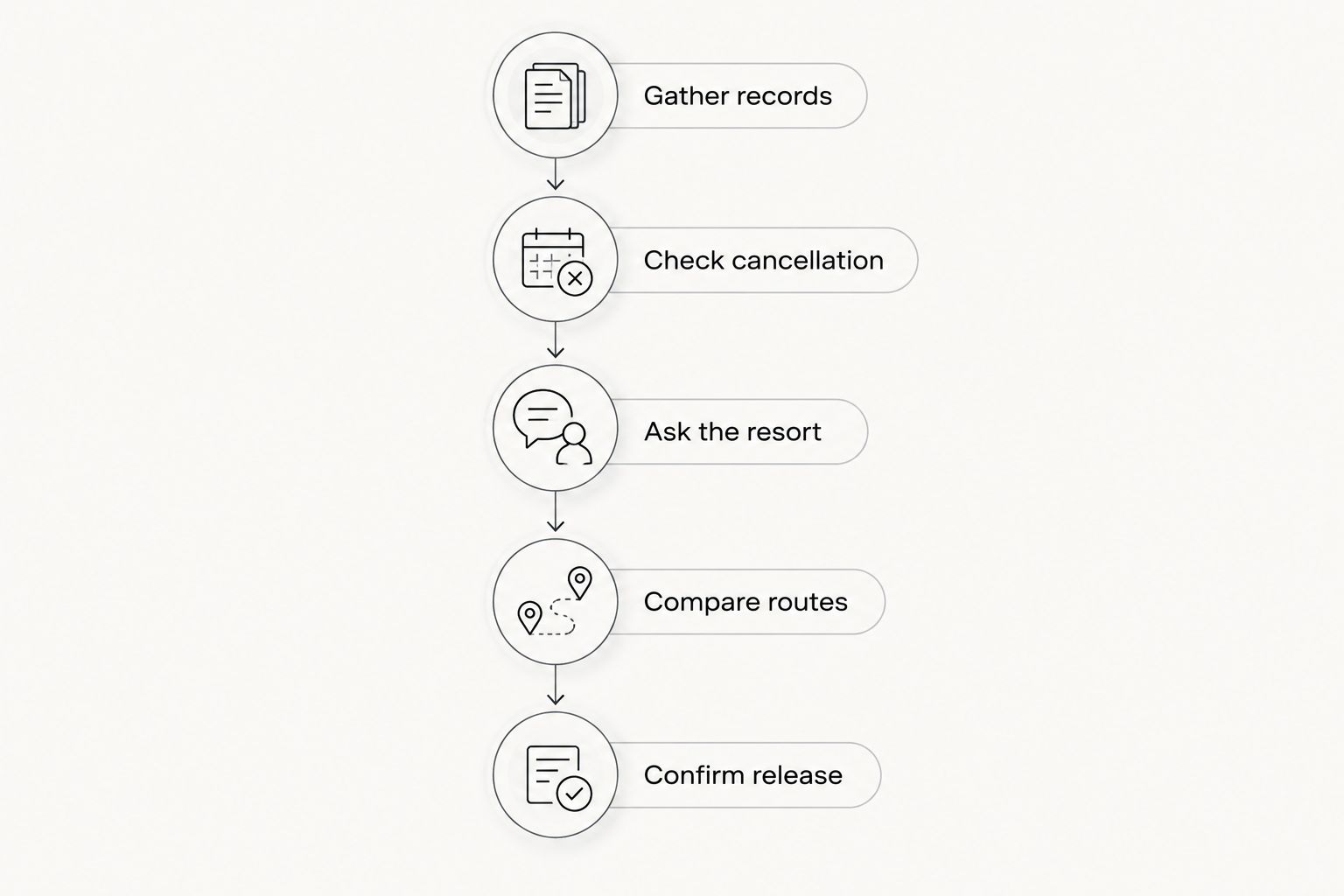
Use this sequence to turn an intention to leave into a documented decision. The purpose is not to make you keep an unwanted ownership; it is to prevent an incomplete exit from becoming an unexpected debt dispute.
- Gather records. Collect the purchase agreement, deed or membership documents, financing agreement, recent statements, and cancellation notice. Include correspondence about previous exit requests.
- Check cancellation. Establish whether a rescission right remains available. If it does, follow the applicable instructions before spending time on other routes.
- Ask the resort. Request its current surrender or transfer requirements in writing. Ask which account conditions apply and whether an associated lender must approve anything separately.
- Compare routes. Review an accepted surrender, resale, or negotiated release against your actual ownership and debt. Ask each provider to identify the documents that will establish completion.
- Confirm release. Keep the final transfer records, account confirmation, and any applicable loan satisfaction or release. Check that each document covers the correct owners and obligations.
For a 2026 exit file, save the final documents together with the correspondence explaining their effect. A recorded transfer addresses title; a lender's release addresses the debt it identifies. Neither should be treated as proof of something the document does not say.
Can you walk away if the timeshare is paid off?
Paying off the purchase loan does not, by itself, end maintenance-fee obligations. Those obligations can continue under the ownership documents until a valid transfer, termination, or release takes effect.
Ask the resort to confirm both your financing status and your ownership status. A statement showing no loan balance answers a different question from confirmation that you no longer own the interest or owe assessments.
Does hiring an exit company stop your obligations?
Hiring an exit company does not, by itself, cancel a timeshare or suspend payments. The service agreement with that company is separate from your agreement with the resort, association, or lender.
If a provider tells you to stop paying, request the contractual or legal basis in writing and have an independent attorney review the consequences. Also ask what the provider will actually deliver: advice, correspondence, a transfer, or a signed release are different services.
What should a written release actually cover?
The strongest reassurance is a document that answers your specific obligations—not a message saying the matter is being handled. Read the operative language and identify who is bound by it.
Check these points before treating an exit as complete:
- Ownership: Does the paperwork establish a completed transfer or termination of your interest?
- Financing: Has the lender confirmed how the loan is resolved, if a loan exists?
- Assessments: Does the agreement explain responsibility for outstanding and future charges?
- Named owners: Does the resolution address everyone whose signature or contractual responsibility matters?
- Effective date: Is it clear when the agreed release takes effect and whether conditions remain?
An agreement does not release a party's claim simply because that party is mentioned in passing. If the wording is unclear, ask for clarification before signing. Use a licensed attorney when the documents involve a dispute, a threatened lawsuit, or an unresolved loan.
When should you ask for a valuation?
Ask for a valuation when you are evaluating resale, not when an imminent cancellation or court deadline needs attention. Sold My Timeshare offers a low-commitment starting point for owners exploring resale or exit assistance.
Keep the purpose clear: you are gathering information before selecting a route. Sold My Timeshare's free, no-obligation valuation does not replace legal advice about a default notice or establish that a resort has accepted a surrender.
Request a timeshare valuation
Explore resale or exit assistance with a free, no-obligation valuation.
FAQ
Can I go to jail for not paying my timeshare?
Ordinary timeshare nonpayment is generally a civil debt matter, not a crime. Separate misconduct or disobeying a court order raises different legal issues, so do not ignore court documents.
Can I stop paying if I never use my timeshare?
Not using your timeshare does not cancel payment obligations. Check your contract and obtain a valid cancellation, completed transfer, or written release before treating those obligations as ended.
Will walking away from a timeshare hurt my credit?
Walking away can affect your credit if delinquency, collections, or other reportable events reach your credit file. There is no single credit-score outcome that applies to every owner.
Can I give my timeshare back to the resort?
You can return a timeshare through a deed-back or surrender only when the applicable process permits it and the recipient accepts it. Request written eligibility requirements and confirmation of what happens to any loan or unpaid charges.
Can I cancel after the rescission period ends?
Cancellation after rescission ends requires another valid contractual or legal basis, or an agreed resolution. An accepted surrender, completed resale, or negotiated release can provide a different route, depending on your circumstances.
Does a quitclaim deed get me out of a timeshare loan?
A quitclaim deed does not itself release you from a loan. Any transfer must comply with applicable requirements, and the lender must separately address your liability.
What should I do if I am already behind on timeshare payments?
Contact the resort and lender to establish your account status and ask about available resolutions. Get legal advice promptly if you receive a lawsuit, foreclosure notice, or other document with a response deadline.
One last thing
A transfer document and a debt release answer different questions. Before closing your 2026 timeshare exit file, match each obligation to the document that ends it. If nobody can identify that document, do not treat a reassuring phone call as proof that the obligation is gone.